Sunday, October 18, 2026
Advertisement
Home Blog Page 153

CROWN Act Passes Tennessee House

0

Measure prohibiting discrimination against natural hairstyles could soon move to the governor’s desk for a signature

NASHVILLE — The House of Representatives on April 18, 2022 passed The CROWN Act, making Tennessee’s statehouse the first in the deep South to approve legislation prohibiting discrimination against natural hairstyles.

Senate Bill 136, sponsored by Sen. Raumesh Akbari and Rep. Karen Camper, passed the House Monday on a vote of 50–25. The Senate approved the measure last May.

The CROWN Act, an acronym meaning “Creating a Respectful and Open World for Natural hair,” would prevent employers from adopting policies against natural and protective hairstyles, such as braids, locs and twists. 

Under the measure, an employee who is subjected to a violation of their right to wear their hair naturally may file a complaint to the Department of Labor and Workforce Development. 

For decades, black hair has been unjustly policed as too “unprofessional” or “unkempt” for public spaces, such as classrooms and workplaces, says Sen. Akbari.

“This is a big day for any Tennessean who has ever been told their hair looks unprofessional,” said Akbari, who parents own a haircare business in Memphis. “No one should ever have to experience discrimination because of the hair that grows out of their head. 

“Every Tennessean should feel free to wear their natural CROWN!” said Akbari.

In June 2019, California became the first state to outlaw racial discrimination against individuals based on their natural hairstyles. Since then, at least 12 more states have made the CROWN Act law. 

If signed into law, Tennessee would be the first state in the deep South to ban discrimination against natural hair. 

“Tennessee made history today in passing the CROWN Act and turning the page on decades of discrimination against natural hairstyles and textures,” said Rep. Camper. “This is an important step toward freedom and respect for workers, no matter how we wear our hair.”

The Tennessee Senate is expected to soon take a final technical action on the bill to match language between the House and Senate versions and then send the bill to the governor for a signature.

“ Abundant Mercy” – In the Huddle 

TODAY’S SCRIPTURE

(Nehemiah 9:17, NLT)

They refused to obey and…became stubborn and appointed a leader to take them back to their slavery in Egypt. But you are a GOD of forgiveness, gracious and merciful, slow to become angry, and rich in unfailing love. You did not abandon them…

TODAY’S WORD

When the Israelites were in the desert on the way to the Promised Land, they got tired, started complaining, and wouldn’t obey GOD’s commands. But GOD didn’t say, “You’re done.” HE kept providing them water and food and helping them defeat their enemies. At one point they made an idol and said, “This is the god that brought us out of slavery.” After all GOD had done for them, you would think GOD would say, “All right, you’re on your own,” but GOD would not abandon them. When we make mistakes, GOD doesn’t abandon us. When we don’t follow HIS commands, we get off course, but GOD doesn’t give up on us. Even when we ignore HIM or give somebody else the credit that HE deserves, HE doesn’t say, “I’ll show you who’s in charge.” He’s full of mercy. HE won’t turn HIS back on you. You may have made some poor decisions, but through HIS grace and unfailing love, HE already has a new way to get you to your destination.

PRAYER FOR TODAY

FATHER, thank YOU for YOUR mercies that are new every morning and for YOUR great unfailing love. Thank YOU that my mistakes and failures are not too much for YOUR mercy. I believe that I am covered by YOUR grace and that YOU will get me to my destination. In JESUS’ Name, Amen.

Getting Comfortable With The Uncomfortable – Visiting The Infirmed! (Terry Commentary)

0

“I’ve seen a lot of coffins in the last seven months,” shared National Basketball League superstar Karl Anthony-Town in a recent USA Today article, “Light Breaks Through Darkness.” The article is about the athlete’s journey after experiencing unspeakable personal losses in his family. 

Although I know that I am not the only one who can relate to recent personal loss, it’s hard to fantom that Towns lost his mother and six other family members to COVID-19. Wow, six (seven counting his mom). Think about that for a second.

Now as much as we’d not like to think about it, the day is coming when we’ll find ourselves at a funeral. There’s no escaping that. I’ve personally attended three since February (one via Zoom from a cabin in Tennessee). If there’s one thing for sure, it’s the images of the experience that get etched into our permanent recollection.

Funerals aside, another reality is that we will, undoubtedly, find ourselves at a hospital or home of someone – a family member or friend – who’s ill and bedridden. During those occasions it is natural to be anxious. Truth is, when faced with touchy issues, even the well-spoken can find themselves tongue-tied with no idea what to say, let alone do. If only I can find the right words, we think to ourselves. And they always don’t sound right when we say them out loud.

A couple of hunches. My first is that I’m not the only one who identifies with the natural anxiousness that comes with sitting at the bedside of ill family and friends at some time. 

My second hunch was that given the impact of COVID over the past few years, the timing was ripe for me to dust off, revise and reissue the one I wrote years ago on protocols for visiting the infirmed. Now keep in mind as you read the following list that each situation will present itself in its own unique and different way, so there may be variations in how you approach each visit.

Consider checking first with the person’s caregiver or close family member about the timing and appropriateness of your desired visit.

Ask the person you want to visit if he/she wants a visit. The day you want might not be a good day for them. Ask for a suitable time. Some people feel better in the morning, some in the afternoon. One friend let me know that she prefers not to have visitors after arriving home from chemotherapy.

Never assume that the person wants you to visit them – they may feel well enough to visit you for a needed change in scenery. It may give them a sense of control.

Consider bringing the person something to read, a link to something on they would enjoy on YouTube, a basket of fresh fruit, etc.

When there take your cues on how long to stay. They may want you to leave but do not want to hurt your feelings by saying so. If they start to talk less or nod off, these may be cues for you to depart. 

Leave the room when he/she is attending to personal needs (going to the bathroom, etc.).

Listen 80% of the time, talk 20% of the time. Avoid cliches although it is easy to fall back on them. Do not rely on them to entertain you.

Wear a protective mask and practice social distancing while in the room. Ask them where they want you to sit.

Look your friend in the eye. You want to connect. They want to connect. It is awkward and it’s hard. No way around it. 

Talk about a shared interest. One good friend and I talked about our favorite Andy of Mayberry Show and character. With another, our mutual interest in sports and politics were the center of our conversations. 

Ask if there is anything you can do to help and give a few suggestions. 

If they lapse into silence, talk about what was going on in your life. 

Unconditionally receive their fear, joy, anger. Share a common experience that has special meaning to both of you. Express how this person affected your life. 

Do not fight off the fatigue. Be willing to doze off in their presence. There is something peaceful about them seeing you in such a relaxed state, hearing you breathing and lightly snoring. 

If you are with a group of visitors, in a hospital room for example, avoid glaring at the person as if he/she is “on display.” Interrupt staring by others. Engage them in side conversations and laughter. That can create a sense of normalcy for the infirmed person. 

And do not forget to be sensitive to the concerns and emotions on the part of the person’s family members and caregivers. Be upbeat and positive.

Now think about what’s missing from the above list. Feel free to add it.

In the end, I hope that you found this article useful preparation for those inevitable times when you will find yourself visiting an infirmed person. Make yourself a copy of it and put it aside someplace. Consider passing it along to others who may find it beneficial. 

However, the bottom line is to be sensitive and just to “be there.” Not only will the person you visit be happy to see you, but the sincerity of your presence will also make a lasting impression. Trust me!

© Terry Howard is an award-winning writer and storyteller. He is also a contributing writer with the Chattanooga News Chronicle, The American Diversity Report, The Douglas County Sentinel, Blackmarket.com, Hometown Advantage, co-founder of the “26 Tiny Paint Brushes” writers’ guild, and recipient of the 2019 Dr. Martin Luther King Leadership Award.

Historic Confirmation of First Black Woman To Supreme Court Brings Hope and Inspiration for Black Women And Young Girls

0

NASHVILLE, Tenn. (TSU News Service) – The history-making confirmation of Judge Ketanji Brown Jackson as the first Black woman to serve on the U.S. Supreme Court offers a moment filled with hope and excitement for Black girls and young women, experts say. In a 53-47 vote – with three Republicans joining Democrats – the Senate Thursday confirmed Judge Jackson, making her only the third black and sixth woman to serve on the nation’s highest court. 

President Joe Biden nominated Jackson on Feb. 5 to take the seat of retiring Justice Stephen Breyer. 

“This is one of the most incredible historical moments for our nation and one of immense pride and joy for millions of Americans with the confirmation of Judge Ketanji Brown Jackson to the Supreme Court,” said TSU President Glenda Glover. 

“African American women have been at the forefront in facilitating and bringing positive change to our country for centuries. The true significance of this confirmation cannot be overstated. Now, an African American woman with impeccable credentials, a brilliant legal mind with the utmost character and integrity, will serve on the highest court in our nation. It is long overdue, but the day has come.” 

President Glover, who also serves as vice chair of the President’s Board of Advisors on Historically Black Colleges and Universities (HBCUs), commended President Bidden “for staying the course and keeping his commitment to our community and Black women with his nomination and now confirmation of Judge Brown.” 

Kennedy Booker, a junior political science major from Detroit, said Judge Jackson’s confirmation provides a fresh face for the Supreme Court, and her previous judicial and governmental experience creates the diversity needed at the federal court level. 

“Justice Jackson represents the kind of change our federal courts need,” Booker said. “She will forever be an asset and trailblazer for those that come after her.” 

Fellow political science major Anissia Fleming, a sophomore from Franklin, Tennessee, said Judge Jackson will be a “representation of the change taking place in the country.” 

“As a symbol, Judge Jackson represents moving past the stereotypes that have to do with race and gender,” Fleming added. “As an individual, she is more than qualified for the job. She will provide exactly the type of representation this country needs as a role model and as a source of inspiration in the Supreme Court for so many in this country.” 

Dr. Shameka Nicole Cathey, assistant professor of political science at TSU, said the historic confirmation of Judge Jackson is “symbolic of the ongoing strive of Black women in our country.” 

“Having Judge Ketanji Brown Jackson included in the U.S. Supreme Court offers a particular significance in relations to diversity and representation,” Cathey said. “Beyond her personal background, she brings a plethora of professional experiences that not only qualifies her for this moment but gives her the ability to own this moment. Her very presence on the High Court will push the framework of public policy in our country.” 

Since 1790, there have been 115 Supreme Court justices. The confirmation of Jackson for the first time in history seats four women and two Black justices on the High Court. Judge Clarence Thomas is the current seated African American Justice. 

Roland Carter Street Named

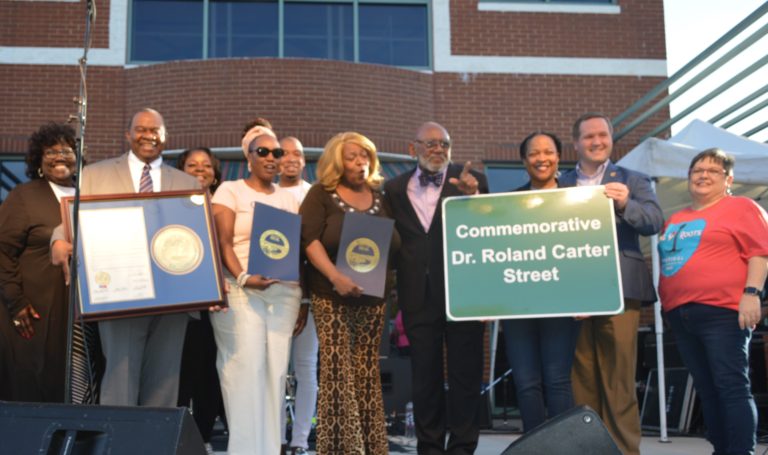
On Sunday, Dr. Roland Carter hurried back to Chattanooga from an out-of-town engagement to conduct a closing performance by the Chattanooga Choral Society for the Preservation of African American Song during the Big 9 Roots Festival. A hometown treasure, the renown conductor, composer, and pianist has directed the local Choral Society for over 20 years.  

Clearly unknowing and to his surprise, Dr. Carter was presented with proclamations from both the City of Chattanooga and Hamilton County governments; And…. a commemorative street sign display by University of Tennessee at Chattanooga officials to be placed on a portion of Vine Street on the campus of UTC where (prior to retirement) he served as the Ruth S. Holmberg Professor of American Music!   

Dr. Carter, in his usual humble demeanor, reflected on his life’s journey and choosing to leave his beloved position at Hampton University and taking the position as head of music at UTC …. where not so long ago…. he could not even attend the then segregated institution!

Tennessee Music Pathways Unveils Marker Honoring Chattanooga’s Bessie Smith

By Camm Ashford 

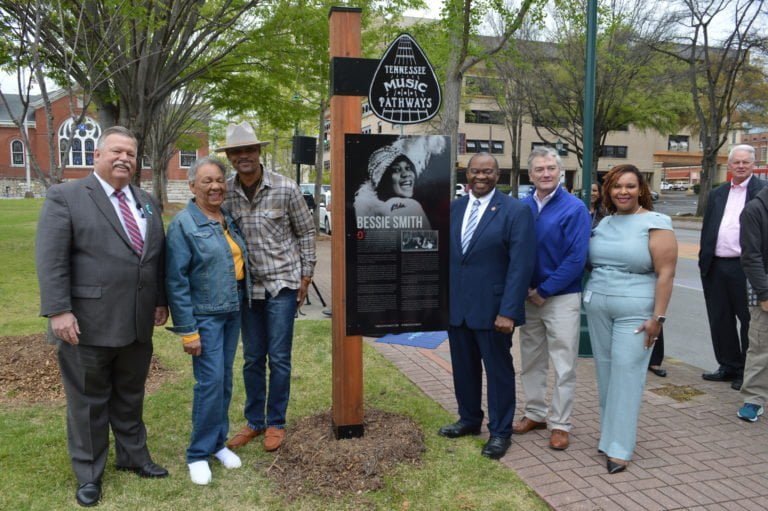
Bessie Smith, one of the most popular African American artists of the 1920s, was honored last Friday with the installation of a “Tennessee Music Pathways” marker.

The event took place in the singer’s hometown of Chattanooga on the front lawn of the Bessie Smith Cultural Center, 200 East Martin Luther King Blvd.

Smith’s granddaughter Beverly Clarke and great-grandson Kevin Clarke were on hand to commemorate the occasion.

Smith’s family said her music wasn’t just entertainment. It was personal.

“You can’t sing the blues unless you lived the blues, and she lived the blues,” noted Beverly Clarke. “She had a hard lot in life, hard knocks. Some very hard knocks, but she always got up and continued to fight.”

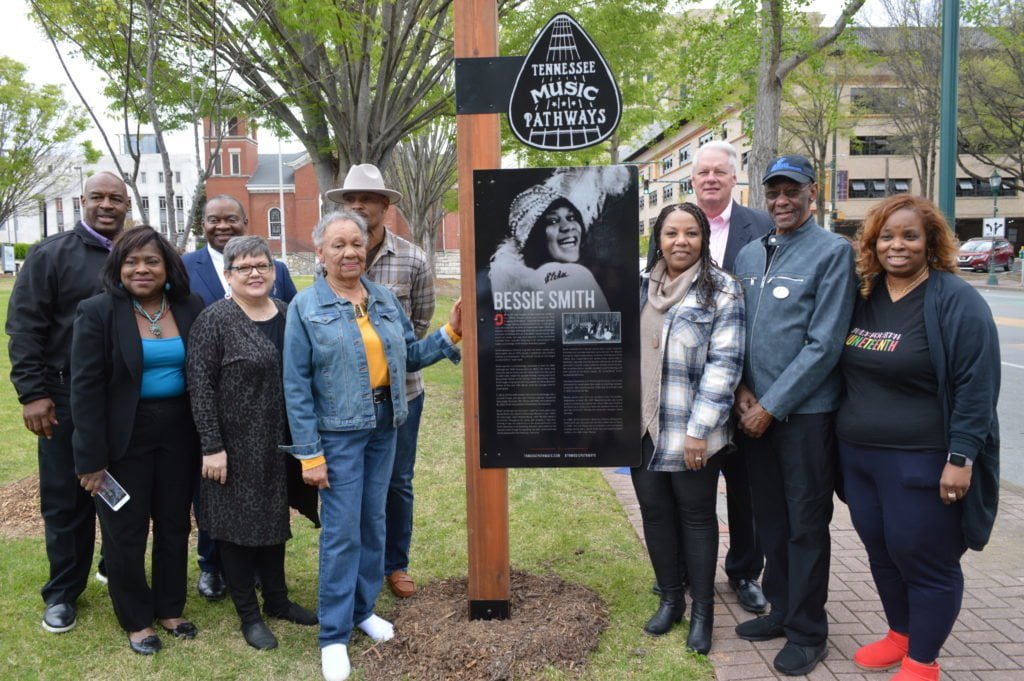
Historical Bessie Smith Marker is surrounded and admired by Bessie Smith Cultural Center (BSCC) Board members and the late Smith’s family members. From left, front row, Varion Walton, Board Member; Paula Wilkes, BSCC President; Beverly Clarke, Bessie Smith’s Granddaughter; Mara-Lynne Payne, Board Member; Maurice Lewis, Board Member; and Presita West, Board Member.  Rear, from left:  Avery Smith, Board Member; Yusuf Hakeem, BSCC Board Chairman; Kevin Clarke, Bessie Smith’s Great-Grandson, and Dr. Jeff Rector, Board Member. (Photo: G.Faye Stoudemire)  

During the reveal, some state and local leaders who discussed the importance of the commemoration: Hamilton County Mayor Jim Coppinger; Donna Elle Harrison, director of Cultural Tourism and Inclusive Marketing at Chattanooga Tourism Co.; District 28 Rep. Yusuf Hakeem; Dave Jones, East Tennessee Division manager Tennessee Department of Tourist Development; Hugh Morrow, Chattanooga Tourism Co. and city of Chattanooga Chief Equity Officer Tamara Steward.

Bessie Smith (April 15, 1894–Sept. 26, 1937) was the most popular female blues singer during the Jazz Age. Known as the “Empress of the Blues,” she developed a commanding, dramatic vocal presence that saw her become among the highest-paid African American entertainers of the 1920s. 

Smith’s music wasn’t just from the 1920s and ‘30s. She influenced jazz, R & B, and even hip-hop in the late ‘80s to mid ‘90s.

Launched by the Tennessee Department of Tourist Development in 2018, Tennessee Music Pathways is an online planning guide that connects visitors to the state’s rich musical heritage at tnmusicpathways.com. 

From the largest cities to the smallest communities, Tennessee Music Pathways stretches across all 95 counties and features hundreds of landmarks from the seven genres of music that call Tennessee home–blues, bluegrass, country, gospel, rockabilly, soul and rock ‘n’ roll. 

Rape by Russian Soldiers in Ukraine is the Latest Example of a Despicable Wartime Crime that Spans the Globe

0

By Mia Bloom

Professor and International Security Fellow at New America, Georgia State University

Shocking images from Bucha and elsewhere in Ukraine revealed what many suspected, that Russian soldiers were apparently committing war crimes. An image of dead naked women under a blanket on the road photographed by Mikhail Palinchak 12½ miles (20 kilometers) outside of Kyiv was tweeted by the Ministry of Defense of Ukraine on April 2. A Human Rights Watch report released the next day and a Guardian story by Bethan McKernan the day after that asserted that Russian soldiers used rape as a deliberate tactic of war.

Such tactics have been called “gendercide” by scholars who study gender and war.

As an expert on rape during ethnic conflict, I know that – like so many other conflicts – wartime gender-based violence has a variety of motivations. They include punishment, torture, extraction of information and the intent to destroy the morale of the other side.

Atrocities appear to be more prevalent in wars when the goal is to terrorize the population and demobilize people so that they will flee in great numbers. In the type of conflict known as an ethnic war, the goal of acquiring and securing territory leads to the most barbarous tactics being used, aimed at reducing the other side’s willingness to fight by using excessive cruelty, torture, terror, displacement and even genocide. Wartime rape functions as part of this strategy.

When wartime rape is a deliberate strategy, as it was in Bosnia, Kosovo or Bangladesh, even the most horrifying acts and atrocities committed during war were supported at the highest levels of decision-making. As U.S. Secretary of State Antony Blinken said on April 5, 2022, “What we’ve seen in Bucha is not the random act of a rogue unit, this is a deliberate campaign to kill, to torture, to rape, to commit atrocities.”

Wartime rape does not only target women and girls. It might also target boys and men – something the victims are extremely hesitant to report because of societal norms.

However, not every war features the deliberate use of wartime sexual violence. The mere existence of variation means that what can be unleashed by the dogs of war can also be controlled or prohibited.

Not random violence

The variation in whether or not rape occurs in war means that these acts are not random. They don’t happen because men are individually unable to control their urges.

Descriptions are beginning to emerge about what happened in Ukraine. McKernan’s story in The Guardian reported that in the wake of Russian troop withdrawal from areas surrounding Kyiv, “women and girls have come forward to tell the police, media and human rights organisations of atrocities they have suffered at the hands of Russian soldiers.” “Gang-rapes, assaults taking place at gunpoint, and rapes committed in front of children are among the grim testimonies collected by investigators,” McKernan wrote.

I have studied the subject of rape during ethnic conflict for over 20 years. Rape as a strategy of war has the effect of undermining the cohesiveness of a community by attacking its very foundation – the women. This is because in many societies rape victims are re-victimized by their own communities, where they are blamed for having been raped.

I believe that the Ukraine conflict is an ethnic war. One of the primary goals of ethnic war is the destruction or deconstruction of culture, and not necessarily just the military defeat of the enemy’s army. The deconstruction of culture is achieved through injuring and destroying human beings. For feminist scholars Elaine Scarry and Ruth Seifert, women are the standard bearers of the society who perpetuate the culture and, therefore, are among war’s first targets.

Historically wartime rape was misconceived as an unintended and unavoidable consequence of war, following from the fact that soldiers were violent, and women – perceived as chattel and property for centuries – were part of the rewards of victory.

Even during the Rwandan genocide, rape was perceived as an unintentional consequence of war: “Rape has long been characterized and dismissed by the military and political leaders as a private crime or the unfortunate behavior of a renegade soldier,” according to a 1996 Human Rights Watch report.

Delay in acknowledging rape’s role

With the prevailing attitude that rape is a natural part of war, it’s not surprising that the Genocide Convention of 1948, which criminalized certain violations after World War II, failed to include rape as a war crime, even though both the Nuremberg and Tokyo war crimes tribunals referred to it.

It wasn’t until 2008 that the U.N. Security Council passed Resolution 1820, stating that rape and other forms of sexual violence can constitute war crimes, crimes against humanity, or one of the contributing factors when determining whether genocide has been committed.

Part of what led to such a long delay in acknowledging rape’s role in war was the “mischaracterization of rape as a crime against honor, and not as a crime against the physical integrity of the victim,” as Human Rights Watch staffers Dorothy Q. Thomas and Regan E. Ralph have written.

The use of rape during war might [reconfigure identities], changing how people and communities see themselves and especially whether they reject the children born of rape or embrace them as members of their community.

‘I’m not a beauty for you’

As a tactic to subdue and control a population in Ukraine, rape may be less likely to achieve the intended results and have Ukrainians flee and never return.

There are several explanations for why this is the case. First, Ukrainians have been able to fend off Russian military advances, and the war has not lasted for months or years – so far. Second, women have been crucial to the Ukrainian resistance and play key roles in Ukrainian military and government. And third, because of the evolution of international law to designate rape as a potential war crime, there is now precedent in the prosecutions of Ratko Mladic, Slobodan Milosevic, Jean-Pierre Bemba and Jean-Paul Akayesu for war crimes and rape that may serve as a deterrent.

Putin described Russia’s invasion of Ukraine in sexual terms, quoting a Soviet-era punk group’s lyrics about rape and necrophilia: “You sleep my beauty, you’re going to have to put up with it anyway.”

The answer to that shocking statement, The Economist reports, has shown up in Lviv, Ukraine. That’s where you can “see posters of a woman in Ukrainian folk costumes pushing a gun into Putin’s mouth.”

“I’m not a beauty for you,” the woman says. (Source:  The CONVERSATION)

Tennessee Highway Safety Office Launches “Slow Down Tennessee” on April 15

0

TENNESSEE – On Friday, April 15, the Tennessee Highway Safety Office (THSO) will join public safety partners statewide to launch Slow Down Tennessee. From April 15 – 29, participating agencies will help increase awareness and enforcement to reduce speeding-related crashes, injuries, and fatalities across Tennessee.

“The purpose of the ‘Slow Down Tennessee’ campaign is to address a variety of speed-related issues,” said Director Buddy Lewis of the THSO. “All we ask of the motoring public is to be considerate of other roadway users and obey the traffic laws, so everyone can make it home safely.”

According to Tennessee’s Integrated Traffic Analysis Network (TITAN), from 2020 to 2022, there were over 28,000 traffic crashes in Tennessee related to speeding, racing, reckless driving, or aggressive driving. Click here to view TITAN’s crash data dashboard.

This campaign includes funding provided by the Governors Highway Safety Association (GHSA), Ford Driving Skills for Life, and AAA – The Auto Club Group. These funds were used to help the THSO’s Reduce TN Crashes program create signage for teens and public citizens to display at high schools and throughout local neighborhoods.

 “Motor vehicle crashes are the leading cause of death for U.S. teens, and speeding is often a significant factor,” said Executive Director Jonathan Adkins of the GHSA. “We must remain steadfast in our commitment to combat traffic fatalities and equip teens with the skills they need to be safe drivers.”

Teens can request Slow Down mascot signs here:

www.reducetncrashes.org/activities/slow-down-signs-your-school. Citizens can request Slow Down Tennessee yard signs by visiting a nearby AAA office. Visit this link to find a local AAA office: www.AAA.com/locations. The Tennessee Department of Tourist Development will display these yard signs at welcome centers statewide to remind visitors and travelers to slow down. The Tennessee Department of Transportation will utilize the digital highway message boards to relay the same message.

“Our traffic safety research consistently reveals a strong ‘do as I say, not as I do’ attitude towards risky driving behaviors – including speeding,” said Tennessee Public Affairs Director Stephanie Milani of AAA – The Auto Club Group. “Drivers know speeding is dangerous, yet they continue to do it. We’re encouraging Tennesseans to stop by their local AAA office to pick up yard signage to display in their local neighborhoods to serve as a reminder for passing motorists to slow down and drive safely.”

The public is encouraged to participate on social media by using #SlowDownTN to help spread awareness. The Tennessee Highway Patrol (THP) and local law enforcement statewide will increase saturation patrols, conduct high visibility enforcement, and utilize other tactics to curb speeding drivers.

“The THP is combatting a drastic escalation in speeding that has led directly to an increase in traffic fatalities,” said Colonel Matt Perry of the THP. “We are asking all drivers to join us in slowing down Tennessee. If you witness dangerous driving behavior, dial *THP (*847) to alert the nearest THP District Headquarters to respond.”

For more information and supporting materials, please visit www.tntrafficsafety.org/speeding.

Chattanooga City and Hamilton County Officials Recognize Sexual Assault Awareness Month

0

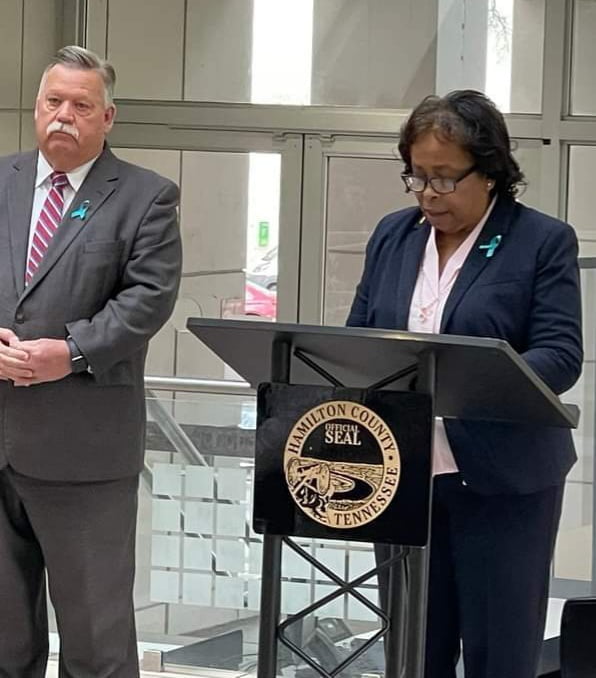
April is the 21st anniversary of the pronouncement of Sexual Assault Awareness Month (SAAM). Sexual violence impacts every community and affects millions of people each year. 

In honor of SAAM, Hamilton County Mayor Jim Coppinger and Dr. Mary Lambert, on behalf of Chattanooga Mayor Tim Kelly, last Friday proclaimed: “April 2022 as Sexual Assault Awareness Month within Chattanooga and Hamilton County, and join anti-sexual violence advocates and support service programs in the belief that all community members must be part of the solution to end sexual violence.”

Dr. Lambert, who currently serves on the Chattanooga-Hamilton County Regional Health Council, is the city of Chattanooga’s director of community health.

The proclamation ceremony took place at the Courts Building, 600 Market St.

Each year during the month of April, state, territory, tribal and community-based organizations, rape crisis centers, government agencies, businesses, campuses and individuals plan events and activities to highlight sexual violence as a public health, human rights and social justice issue and reinforce the need for prevention efforts.

SAAM traces its history to the 1970s, when activists first began organizing on a national scale to reduce sexual assault and violence against women. Advocates fought tirelessly to bring a topic once taboo for public discussion out of the shadows and shed light on the widespread problem of sexual assault.

The theme for this year’s SAAM campaign is “Building Safe Online Spaces Together.” 

According to the National Sexual Violence Resource Center website, “Sexual harassment, assault, and abuse can happen anywhere, including in online spaces. For too long harassment, cyberbullying, and sexual abuse and exploitation have come to be expected as typical and unavoidable behaviors online. ‘Building Safe Online Spaces

Together’ is possible when we practice digital consent, intervene when we see harmful content and behaviors, and promote online communities that value respect, inclusion, and safety. We know that one month isn’t enough to solve the serious and widespread issue of sexual violence. However, the attention April generates is an opportunity to energize and expand prevention efforts throughout the year.”

For further information or help, contact the Partnership for Families, Children and Adults at (423)755-2822, or info@partnershipfca.com. Or call the 24/7 Domestic Violence and Sexual Assault Crisis Hotline at (423)755-2700.