Friday, October 16, 2026
Advertisement
Home Blog Page 118

Kids First Coupon Book

0

The 35th annual Kids First Coupon Book sale begins on Friday, September 9.  For two weeks, students in the Hamilton County elementary schools will be selling the nearly 200-page booklets that cost only $10 and feature hundreds of dollars in savings from area stores, restaurants, attractions, and service providers. See all savings here. 

 During the past 34 years, the Kids First Coupon Book has generated over 12 million dollars in direct revenue to the schools.  Unlike other school fundraisers, Kids First is produced by the non-profit Fund for Excellence.  All proceeds stay in Hamilton County for the benefit of local schools.  The schools keep $7 for every book sold, and the money is allocated according to their individual needs to pay for things like technology upgrades, art supplies, playground equipment, and library books. The remaining 30 percent of coupon book revenue covers program-related expenses.

 For more information, visit www.KidsFirstCouponBook.com or call (423)498-7212.

Tennessee Grocery Tax Holiday Could Be Permanent If Corporations Paid What They Owed

By Jill Weitz, Tennessee for All

NASHVILLE–On last Thursday, the one-month grocery tax holiday in Tennessee ended. Rep. Vincent Dixie had proposed a 6-month suspension of the grocery tax in 2021 that was not adopted. Governor Bill Lee proposed a one-month suspension in March of this year that did pass to soften the blow of inflation.

Most states don’t have a grocery tax, but Tennessee families pay among the highest grocery tax rates in the country. According to the Center on Budget and Policy Priorities, “sales taxes on groceries have an especially harmful impact on income and racial inequities since low-income families tend to spend a larger share of their income on groceries.”

While families are paying high tax rates on sales and groceries, a report from the Economic Policy Institute revealed that more than 60% of corporations in Tennessee are paying nothing in state corporate income tax. The EPI estimates that between $43 billion and $57 billion in national revenue has been lost due to the lack of corporate income tax payments. 

The Tennessee for All coalition says that if corporations paid what they owed, Tennessee families could never pay grocery taxes again.

The Rev. Francisco García, Assistant Chaplain at St. Augustine’s Episcopal Chapel in Nashville, said, “Groceries are one of the biggest expenses for families and it’s not fair that they are paying taxes on basic needs while corporations are not paying their fair share. Getting rid of the grocery tax forever would be a huge help to families across Tennessee.”

“There’s no loophole for me to not pay taxes at the grocery store, I can’t think of any reason a profitable corporation should have a zero in their tax bill,” added Jaime Barks, a mother of two in Chattanooga.

Liv Cook, a teacher from McMinn County added, “I pay taxes on food I buy for school events out of my own pocket because we don’t have adequate funding, but a corporation that makes millions gets to pay nothing, it’s just not fair.” 

Jill Weitz serves as a coordinator at Tennessee for All. According to its website, “Tennessee for All is a statewide coalition of faith, labor, and community organizations representing hundreds of thousands of people from Memphis to Mountain City. We stand united in a long-term mission to eliminate systemic inequalities, hold corporations accountable, and build a better Tennessee.”

Food City Kicks Off School Bucks Challenge

0

Food City to award $700,000 to local schools

ABINGDON, VA (Monday, September 5, 2022) – Food City has once again pledged $700,000 in contributions for the upcoming school year. With Food City’s School Bucks Challenge, it’s easy to earn reward points.  For every $1 you spend, using your Food City ValuCard, you’ll receive 1 point.  

“Our Food City School Bucks Program has provided much-needed support for thousands of schools throughout our market area and our School Bucks Challenge makes points collection easy and efficient,” says Steven C. Smith, Food City president and chief executive officer.

The 2022-2023 School Bucks Challenge begins September 7, 2022 and continues through May 9, 2023.  To ensure your points credit to the school of your choice, simply go online to 

https://www.foodcity.com/schoolbucks to link your Food City ValuCard to your preferred school.

Food City has pledged $700,000 for the upcoming school year. School allocations are based upon the percentage of customer purchases assigned to each school. Schools can monitor their progress biannually online at foodcity.com. 

“Food City is committed to supporting the education of our youth,” said Smith. “Since the program’s inception, we’ve awarded over $21,400,000 in much-needed educational equipment and tools to more than a thousand participating area schools”. 

For more information about the new Food City School Bucks Challenge, please contact your local school, visit foodcity.com or contact the Food City School Bucks Coordinator, Lisa Johnson at 1-800-232-0174. 

Headquartered in Abingdon, Virginia, K-VA-T Food Stores (Food City’s parent company) operates 140 retail outlets throughout southeast Kentucky, southwest Virginia, east Tennessee, north Georgia, and Alabama. 

TVFCU & CHI Memorial Work Together To Provide Mobile Lung Cancer Screenings

0

CHATTANOOGA, Tenn.— CHI Memorial’s Breathe Easy Lung Coach, a mobile space dedicated to taking low-dose CT lung screenings out into local communities,  is working with Tennessee Valley Federal Credit Union (TVFCU) to save lives by detecting lung cancer early. 

On Wednesday, September 21 from 9 a.m. to 2 p.m., the Lung Coach will be set up in the TVFCU Southside Branch parking lot, located at 125 West 20th Street in Chattanooga. Scheduling appointments in advance is highly recommended and can be done by calling 423-495-LUNG (5864).

According to the American Cancer Society, lung cancer is the leading cause of cancer death, killing more people than colon, breast, and prostate cancers combined. In its early stages, it is curable but often displays no symptoms. Therefore, getting preventative screenings is critical to avoid the negative consequences of lung cancer.

Individuals may have little or no payment due if their screening is covered under insurance or grant funds. If the requirements are not met for coverage, a discounted self-pay option of $150.00 will allow anyone over the age of 40 to get screened. People are at higher risk if they have smoked in the past or are currently smoking, but the screening can prove beneficial even beyond the detection of lung cancer.  

“Low-dose lung screening is much more than just finding lung cancer early,” said Dr. Rob Headrick, thoracic surgeon at CHI Memorial Chest and Lung Cancer Center. “It allows doctors to see inside the entire chest, similar to looking under the hood of a car. In addition to the lungs, the image also shows the heart and coronary arteries, allowing doctors to assess the risk of cardiovascular disease.” 

To be ready day of, patients should bring their insurance card (if applicable), photo ID, and COVID vaccination information (if applicable). Paperwork can be filled out upon arrival, so no need to worry about filling anything out prior. The overall experience should only take about 15 minutes.

“Lung screening is key to the prevention of lung cancer,” said Tammy Zumbrun, marketing/community outreach manager. “We are honored to work with CHI Memorial to help bring the mobile lung coach to the Southside community. We hope that many people will take advantage of this convenient, life-saving opportunity.”

For more information about TVFCU’s services, including mortgages, auto loans, checking accounts and other financial accounts, please visit tvfcu.com.

For more information about the CHI Memorial Breathe Easy Lung Mobile, please visit memorial.org.

Pinnacle Named One of America’s Top Companies That Care in People Magazine

0

NASHVILLE, TN, –Pinnacle Financial Partners has again earned a spot on People Magazine’s 100 Companies That Care list, jointly chosen by the publication and Great Place to Work®. Pinnacle came in No. 35 on the list, joining much larger international brands like Target, Salesforce and Hilton, all chosen for the generosity of their company benefits and charitable work, as well as personal accounts of the impact these organizations have made on the lives of their employees.

“There’s no shortage of caring, kindness and compassion among our associates,” said Terry Turner, Pinnacle’s President and CEO. “We are intentional about the care we show to them, our clients and the communities we serve. We are also more committed than ever to taking everybody with us on the path to equitable economic success. This honor recognizes who we are at our core both collectively and individually. Pinnacle may be the name on the list, but it’s the result of work from our associates and hundreds of community partners we are honored to support.”

Pinnacle is committed to being a great place to work and making a significant positive impact on the communities it serves. With a high level of associate engagement, the firm is able to delight clients and drive improvements in its home markets, including the following highlights from 2021 and now.

$1.4 billion committed to investments, lending and grants for low- to moderate-income housing, small business and minority-owned institutions in 2021

Nearly 25,000 associate volunteer hours in 2021

Continued diligence with safety protocols and gradual return to the office to keep associates and clients safe

Intentional increase in mental health resources for associates at a time when mental health issues were increasing significantly

New partnerships with community organizations to further DEI efforts

Rankings are based on more than a million employee survey responses and data from companies representing more than 6.1 million U.S. employees. In that survey, 98% of the firm’s associates said Pinnacle Financial Partners is a great place to work.

Pinnacle Financial Partners provides a full range of banking, investment, trust, mortgage and insurance products and services designed for businesses and their owners and individuals interested in a comprehensive relationship with their financial institution. The firm is the No. 1 bank in the Nashville-Murfreesboro-Franklin MSA, according to 2021 deposit data from the FDIC, is listed by Forbes among the top 25 banks in the nation and earned a spot on the 2022 list of 100 Best Companies to Work For® in the U.S., its sixth consecutive appearance. American Banker recognized Pinnacle as one of America’s Best Banks to Work For nine years in a row and No. 1 among banks with more than $11 billion in assets in 2021.

                Pinnacle owns a 49 percent interest in Bankers Healthcare Group (BHG), which provides innovative, hassle-free financial solutions to healthcare practitioners and other licensed professionals. Great Place to Work and FORTUNE ranked BHG No. 4 on its 2021 list of Best Workplaces in New York State in the small/medium business category.

The firm began operations in a single location in downtown Nashville, TN, in October 2000 and has since grown to approximately $40.1 billion in assets as of June 30, 2022. As the second-largest bank holding company headquartered in Tennessee, Pinnacle operates in 15 primarily urban markets across the Southeast.

Additional information concerning Pinnacle, which is included in the Nasdaq Financial-100 Index, can be accessed at www.pnfp.com.

How Long Will This Recession Last?

0

By Robin Smith 

America is in a recession. Americans knew that before the policymakers finally admitted it! 

The intuition of most when prices go sky high is to cut their spending and to look for bargains,sales and alternatives to costly items. Simply stated, when government-induced inflation ballooned the prices of everything from gas to groceries, consumers responded by changing their shopping and spending habits. 

That inflation is now a recession.

How long will the recession last? What’s next?

It depends. It depends on whether those in positions of leadership are committed to solutions or just political talking points.

Exiting today’s hostile political sniping to find a reasoned response to both inflation and 

recession–a 1975 paper delivered to a Miami monetary conference by a former journalist and author whose focus and research had been devoted to the economy and monetary policy for such publications as the New York Times, Newsweek, the Los Angeles Times and the Wall Street Journal–provides the answer. It’s not a popular answer, which means it may be ignored because politicians typically pander, not problem solve.

Henry Hazlitt, deceased as of 1993, lived in a time when partisan rancor had not reached today’s toxic levels. His writings on the economy expose a very simple cause, effect and correction of both inflation and recession. Let’s see who commits to the fix.

Hazlitt, whose work inspired much of the work of Dr. Thomas Sowell, one of today’s brilliant economic minds, made a simple declaration back when Sony introduced Betamax videos, the popular TV shows included The Six Million Dollar Man, The Jeffersons, Kojak and Good Times and a gallon of gasoline cost 59 cents.

“The direct cause of soaring prices is printing too much paper money; the direct cure is to stop printing it. The indirect cause of inflation is government overspending and unbalancing the budget; the indirect cure is to stop overspending and to balance the budget,” noted Hazlitt.

The printing of too much money means the ease of accessing money through credit and lower interest rates, through government spending, as well as through government spending that’s excessive and beyond its own budget. Henry Hazlitt described completely and embarrassingly simple in 1975, both the cause and the cure for what ails Americans today.

Will the government stop its spending and spending beyond its budget? Most will say loudly and consistently, “No!” 

That means for Americans, the costs of goods and services will remain high and even increase. It also means that the labor market will change because of the pressures on companies to pay workers when their cost of doing business escalates, and consumers become thrifty out of necessity. 

How will the labor market change? There will be fewer jobs and, in some cases, job losses. 

If your skills need sharpening through education, certifications or training, get busy. Make sure to show yourself a valuable employee. 

The days ahead, because the cure is unpopular, won’t produce a rapid economic recovery. So, we’ll all deal with the predicted pain.

On Divine Delays!

0

Here we are 21 years later and the images of the 9/11 terrorist attacks on our nation again surface in our memories. Although our lives since then have been splintered into different directions – tragedies, triumphs, wars, you name it – we remain united by that day as a “where I was then” moment in time.  

Although thousands of lives were lost at the World Trade Center, the Pentagon and in the field at Shanklin, Pennsylvania, the largely untold stories are those who survived the horrors of that day.

Which takes me to a recent church service.

To make a point during his sermon, the pastor rattled off reasons why some escaped with their lives during the terrorist attacks on the World Trade Center that snuffed out the lives of 2750. “Divine delays” is how he rationalized what saved them that awful morning. 

Now there’s a good chance that as you read down his list of “delays,” your reactions will be no different than others in the congregation that morning. Here’s his list, perhaps the most startling nine lines you’ll read in this entire narrative:

A person….

  • missed his taxi 
  • went into labor and delivered a baby
  • got caught in a traffic jam
  • whose alarm clock was set at the wrong time
  • missed his bus
  • returned back home to make a phone call
  • spilled food on her clothes and returned home for a change 
  • was late because he attended his son’s first day at kindergarten
  • walked to work in new shoes, developed a blister on his foot and stopped at a pharmacy to buy Band-Aids
  • A short time later the towers collapsed into a nightmarish heap of concrete, steel, glass, broken bodies, and acrid smoke that permeated the air. 

When the impact of his list sank in, I had a recollection of an American Airlines flight attendant I knew in Boston who missed that ill-fated Flight 93 that plowed into one of the towers because she took a sick day. I thought about an attorney relative who was traveling on business that day when one of the towers fell next to and badly damaged the building that housed her law office.

But let’s turn to a more recent personal history, specifically a frightening “near miss” moment in my life. The year was 2017.

You may recall that five years ago on August 12, 2017, hundreds of far-right extremists descended on Charlottesville, Virginia to protest the planned removal of the Robert E. Lee statue from the city’s center and clashed with police and counter protesters. The “Unite the Right” protest, as it was called, was the largest and most violent public assembly in decades, leapfrogged recently by the insurrection on January 6, 2021. Among the scores of those injured, Heather Heyer, a young paralegal, was run over and killed by an extremist. 

So I arrived at the Charlottesville airport that afternoon, headed south on highway 29 and exited onto interstate 64 on my way to my hometown 33 miles west. Now had I turned to downtown Charlottesville for a bite at Mel’s Place, my favorite soul food restaurant, which I often did on previous trips, I would have run smack into the violence erupting just a few miles away. Fortunately, I had a full course breakfast before leaving Georgia. 

I thought about my Charlottesville near miss after absorbing the pastor’s list of “divine delays.” Contextualizing his list, had I veered off to downtown Charlottesville, the consequences could have been, well, to say the least, dire and you may not be reading this piece.

I thought about that morning on May 3, 2021, when Scott Hudson, a long-time restaurant owner in Georgia died when a tree fell on his vehicle during a thunderstorm on a street that I’d driven down only an hour earlier. There’s not a day that I don’t think about Scott when I drive down that street enroute to the post office. 

So, if you are still reeling from the pastor’s list shared at the outset and my near misses, let me add a few consequences of possible near misses in your life:

  • You passed on a date with someone you would have later regretted.
  • You passed on an investment “opportunity” that you learned that you would have lost lots of money on. 
  • Because of a schedule conflict, you missed a large gathering that turned out to be the source of a large COVID spreader.
  • You were within the speed limit and, unlike others, did not get stopped and ticketed for speeding.
  • You found out that a restaurant you’d dinned at a while ago received recent complaints from customers who had been food poisoned. 
  • You had a colonoscopy you had been putting off, one that found and removed polyps that could have developed into cancer had you waited much longer. 
  • The house you wanted to buy but didn’t had a problem with flooding.
  • The company you applied to but did not get hired went out of business and laid everyone off. 

In the end, I leave you this; be grateful for those positive life-changing delays in your life and, above all, what could have but didn’t happen!

© Terry Howard is an award-winning writer and storyteller. He is a contributing writer with the Chattanooga News Chronicle, The American Diversity Report, The Douglas County Sentinel, Blackmarket.com, co-founder of the “26 Tiny Paint Brushes” writers’ guild, recipient of the 2019 Dr. Martin Luther King, Jr. Leadership Award, and third place winner of the 2022 Georgia Press Award.


Chattanooga Will Rapidly Rehouse Up to 100 Residents Experiencing Homelessness in Partnership with Local Housing Authority

0

New agreement will help alleviate homelessness in some of the city’s most vulnerable neighborhoods

Chattanooga, Tenn.— Chattanooga City Council unanimously approved the use of $60,000 in federal American Rescue Plan funds to help rapidly rehouse up to 100 residents currently experiencing homelessness. The funds will go to the Chattanooga Housing Authority as part of an agreement to provide housing to residents with no income at the cost of $600 per person, per year. Once the residents are housed, the City’s Office of Homelessness and Supportive Housing will provide them with wraparound services and support to help them stabilize and find employment.

“The only permanent solution to homelessness is a home, and thanks to our partnership with the Chattanooga Housing Authority, we’re now able to offer that solution to up to 100 of our city’s most vulnerable residents,” said Sam Wolfe, director of the city’s Office of Homelessness and Supportive Housing. “We are grateful for City Council’s partnership on this effort, and we’ll continue to work every day to find solutions that speed exits from homelessness and empower these residents to take positive steps forward in their lives.”

In addition to covering the $50 per month rental cost of the units, the $60,000 in funding may also be used to cover move-in costs and back rent to the Chattanooga Housing Authority, which are often barriers for residents experiencing homelessness who are seeking housing. 

The city plans to offer the majority of the housing units to residents who vacated the 11th street homeless encampment in early June. All residents of the 11th street encampment were offered a referral to a new temporary sanctioned encampment on 12th street and a referral to work toward permanent housing through the Chattanooga Housing Authority. Those who declined were offered a new tent and relocation assistance.

Studies show a direct correlation between rising housing prices and rising homelessness, particularly when wages do not keep pace. Mayor Tim Kelly has directed the city to undertake a number of initiatives to increase the supply and affordability of housing in the city, which has seen rising demand for housing at a time when few units are available. 

This year’s budget includes an unprecedented $33 million toward a $100 million affordable housing initiative that will create and preserve thousands of homes over the next several years. The city is also undergoing a top-to-bottom zoning code assessment to remove barriers to the creation of housing that Chattanooga residents can afford, and has rolled out incentives for housing providers to rent to low-income families. 

In July, Chattanooga City Council approved Mayor Kelly’s One Chattanooga Recovery and Relief Plan, which includes $7.4 million for initiatives that create and preserve affordable housing, and $5.3 million for homelessness prevention and recovery. These initiatives include, among other efforts, creation of a new low barrier shelter to help transition residents experiencing homelessness into permanent housing and creation of 230 new affordable housing units in partnership with four community-based organizations.

Tennessee Fails To Address Need For More Black Educators

0

By Gabe Hart, Tennessee Lookout 

The end of August begins to bring a sense of normalcy to the awkward tension that always exists at the beginning of each school year, as teachers and students find ways to understand and relate to one another.  

Like any human interaction, trust has to be built for a relationship to grow and, to learn most effectively, students need to be able to relate to their classroom teachers.  

Like many other states, Tennessee is facing a teacher shortage. There are students in school districts across our state who do not have a certified teacher in their classrooms. In some schools, students are taught by a revolving team consisting of substitutes, teacher assistants, and teachers using their planning time to monitor teacherless classrooms.  

But before “teacher shortage” ever made its way into the vernacular of our national narratives, the need for more Black educators–especially in districts whose student populations were largely African-American–was alarming.  

During the 2019-2020 school year, African-American students made up 24% of the student population in Tennessee while only 11% of teachers were Black. What is more alarming, however, is that nearly 80% of students of color were attending schools whose faculty was made up of less than 5% of people of color.  

The majority of minority students in Tennessee will rarely have more than a few educators throughout their entire K-12 educational career who have the same cultural experiences as they have. In a profession where relationships correlate strongly with learning, minority students are at a huge disadvantage.  

Seeing this discrepancy, the Tennessee State Board of Education passed The Educator Diversity Policy 5.700 in 2021. A piece of that legislation reads as follows:

“The Tennessee General Assembly passed legislation to address educator diversity in the state. T.C.A. § 49-1-302(g) requires the Commissioner to recommend, and the State Board to adopt a policy to address educator diversity. According to law, the policy must include:

Strategies for LEAs (local education agencies) to use in the recruitment and retention of minority educators; A requirement that each LEA set a goal for educator diversity that takes into consideration the diversity of the students that the LEA serves; and A plan to monitor educator diversity in the state.”

The piece of legislation was presented and passed based on an overwhelming amount of research that shows that minority students greatly benefit from learning from a teacher of their same race. While some fragile, white teachers may see this as some form of reverse racism, it’s simply common sense–students learn more from teachers in which they can relate to on deep levels. 

In fact, Black students paired with Black teachers in early education have been shown to have up to a 15% greater chance to attend college when they graduate. Beyond academic success, Black males learning under a Black teacher also experience less severe discipline actions and engage in less aggressive behavior in the classroom.  

I taught for 15 years in a school district that was made up of mostly minority students. My classrooms were made up of students who did not look like me or have the same life experiences as I did.  My first few years were a struggle because we didn’t understand each other. By my third or fourth year, though, I came to the realization that there were simply pieces of their lives in which I could not relate or understand.  

In 2018, we were reading an article in an intervention class written by a famous athlete who was an African-American. My intent in reading that article was simply to engage the students in a text–a professional athlete will oftentimes garner more interest than a poem by Robert Frost, and I really just wanted my students to engage in a text that day.  
There was a section of the article that I had unconsciously breezed over because it didn’t affect me one way or the other, but it sparked a conversation that I won’t forget.  
In the article, the athlete described his feelings when he was pulled over for speeding by a police officer. He spoke about how nervous he was; he talked about his heart beating faster and his hands becoming sweaty. Finally, he talked about having to have a conversation with his son about how his son should act should he ever be confronted by a police officer. My students began to say that they had this same conversation with their parents, too.  

My parents surely had never had to have that conversation with me. I’ve never had to think about it myself when I was stopped for speeding or for having a headlight out on my car. It was in that moment–that extreme example–that I realized there were a lot of situations that I could never understand that my students wrestle with on a daily basis.  
I had always known that there were differences in the experiences of my students and the experiences I had when I was their age living in the same town, but I had never realized how much of a relational gap existed because of them.  
Was I–a white man teaching mostly black children–a good teacher?  Yes. I believe I was.  Most of my students would say the same thing. But to say that I could relate to them in the same way a teacher of their own race could relate to them would be ignorant.  
If there was a Black English/Language Arts teacher with a similar understanding of the teaching requirements, I can confidently say that he or she would have done a better job than I ever did. I’m not fragile enough to suggest otherwise.
The General Assembly that passed the policy encouraging the hiring of diverse educators seems to be a far cry from the same group that banned the teaching of Critical Race Theory in classrooms. Like many instances in politics, those are policies that seem to be in direct odds against one another.  
The teacher shortage that we will continue to experience under Gov. Bill Lee’s administration is concerning, but–like most everything in our societal system of operations–it will adversely affect people of color the most.  
Good thing I’m not saying that in front of a class full of students because that’s against the law. 

Gabe Hart is chief communications officer for Haywood County Schools and a former teacher of English and Literature. He also serves on the education committee for the newly formed Jackson Equity Project which seeks to advocate for equity and justice for marginalized, disenfranchised, and oppressed people living in Jackson. Beyond writing and teaching, Gabe enjoys spending time with his 14-year-old daughter, exercising and listening to music.

Phi Beta Sigma Raising Funds for Jackson, Mississippi Water Crisis 

0

The Governor of the State of Mississippi declared a state of emergency for Jackson, the capital city, following a catastrophic failure of the city’s clean water system. The loss of the city’s sole clean water supply plant has created a public health crisis resulting in the closure of all public schools, countless businesses and the interruption of water services for nearly 200,000 citizens. It is unclear when the City’s water plant operations will resume leaving virtually every neighborhood without reliable running water for cooking, flushing toilets, fighting fires or meeting other critical service needs. 

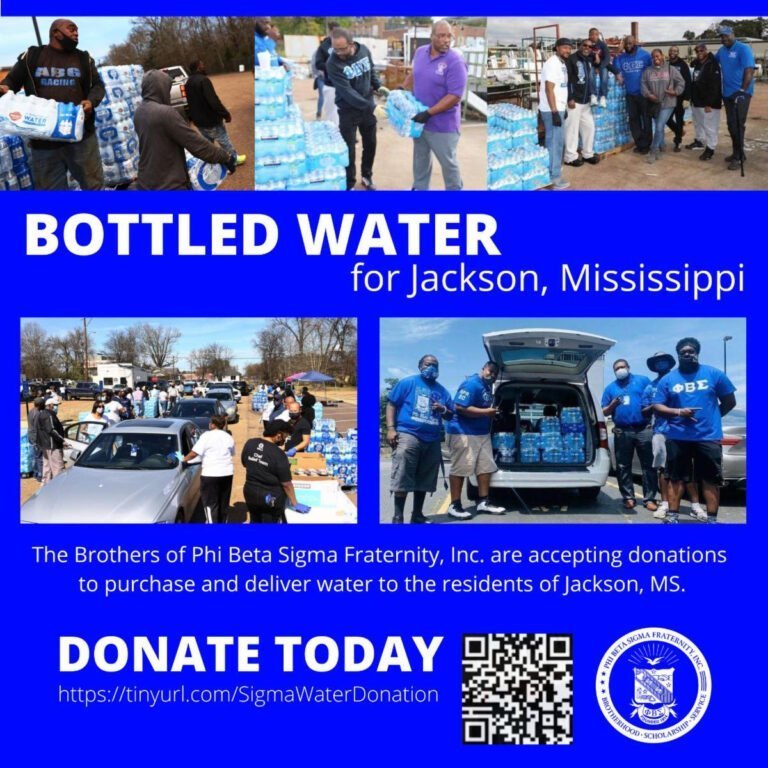
Phi Beta Sigma Fraternity’s three Metro-Jackson chapters have partnered with the local chapters of Zeta Phi Beta Sorority, Inc., the City of Jackson and several other community civic groups to coordinate and facilitate bottled water distribution stations across the city. Managing the logistics involved in these efforts is a labor of love but it requires financial support. Donations from caring Brothers like you will go a long way in letting those local Brothers and Sisters know that we stand with them in this crisis.

Additionally, your support will reaffirm our stance on being consciously aware of how environmental calamities disproportionately impact Black and Brown communities, and when they do, they are deserving of an equitable level of resources during recovery.

The preliminary impact of homes with little or no water pressure, no portable water available, and not being able to purchase water is expected to last approximately three weeks.   

The tentative plan is for the Mu Sigma, Alpha Beta, Beta Rho, Gamma Epsilon Sigma, and Kappa Epsilon Sigma Chapters to host a water distribution site and give away water starting September 3, 2022. This is contingent on their ability to purchase the necessary cases of water and secure delivery for the water to Jackson.  

To Donate – scan the QR code or click the link.  Choose your donation amount and select Blue Axe Contingency Relief.  Donated funds will be used to provide relief to communities that have been affected by disasters.