Friday, October 16, 2026
Advertisement
Home Blog Page 119

Clergy and Community Leaders Show Support After Police Chief Murphy Comes ‘Under Attack’ Over Officer Reassignments

By Camm Ashford 

Members of the clergy, community leaders and concerned citizens gathered last Friday on the steps of City Hall to express their support for Chattanooga Police Chief Celeste Murphy.

The 10 a.m. press conference came in the wake of news that police union organizations had tendered a “lack of confidence” vote in Chief Murphy. The vote came after union officials learned that Murphy had submitted the names of 15 Chattanooga police officers to the U.S. Attorney for their “misrepresentation of facts” in cases that took place prior to her coming to the city.

The officers were reassigned after being notified they would be ineligible to testify in court over sustained accusations of misrepresentation.

The police unions accuse Chief Murphy of violating department policy over the reassignment process.

“Over the past few weeks, Chief Murphy has been under attack because 15 officers have been deemed unreliable for court testimony due to sustained allegations of untruthfulness or misrepresentation,” said the Rev. Dr. Ernest L. Reid, pastor at the Second Missionary Baptist Church of Chattanooga.

“The question that must be raised is not about Chief Murphy’s leadership or credibility, but the credibility of the 15 officers in question. Our purpose for being here is to provide a visible show of support and solidarity for our Chief of Police Celeste Murphy. Once again, the phrase of ‘lack of confidence’ should not be directed towards Chief Murphy. Those three words ‘lack of confidence’ should be directed to those officers whose credibility has been deemed unreliable.”

Dr. Reid said Chief Murphy has been unfairly attacked for her actions.

“Chief Murphy’s credentials while on the Atlanta Police Department were impeccable, and those qualities of leadership have carried over into her role in Chattanooga,” he said. “She has done an excellent job while only being on the job four months. We asked for leadership, and she provides it. We asked for integrity and credibility, and she shows it. We understand that not everyone is receptive of Chief Murphy, but she deserves the time, opportunity and the latitude to execute the duties of her office.”

Jenny Hill, the city councilwoman representing District 2 in Chattanooga, weighed in.

“We have police officers that do a terrific job every day, but when we make mistakes, we have to be held accountable for them,” she said.

District 9 Chattanooga City Councilwoman Demetrus Coonrod said, “We have a united, collective voice among our black people, because we are the ones that have been so fearful of police officers.”

Corliss Cooper, a retired captain from the Chattanooga Police Department said of Chief Murphy, “She’s going to be a good steward for this city, and a good representation as the chief of police, if she’s given the opportunity to do so. I wish I still had time that I was still working there so that I could work for her.”

Dr. Reid said the misrepresentation of facts by police officers not only erodes trust, but also is devastating to innocent citizens. 

“Every day, there are police officers across the country who submit false and misleading statements under oath,” he noted. “These false statements and deceptive statements impact the lives of individuals. Innocent people are sent to jail, and their reputations are destroyed. These false statements have separated families and cause economic pain. Children are without mothers and fathers because of a misrepresentation of the truth.”

The city has not yet released the names of the 15 officers who were involved in the reassignment process, or what they were accused of doing to be reprimanded.

The accused officers have been reassigned to non-enforcement duties with no loss of pay. 

Mayor Tim Kelly said his office has reached an agreement with the officers. An internal committee will review their reassignment, but the ultimate decision will stay with Chief Murphy, he said.

Other community leaders and elected officials who stood on Chattanooga City Council’s front steps last Friday to show support for Chief Murphy were: John Duke Franklin, Rep. Yusuf Hakeem, the Rev. Alan J. Holman Sr., the Rev. Ternae Jordan, Dr. William T. Ladd III, Hamilton County Commissioner Warren Mackey, James Mooreland, Chattanooga City Councilwoman Marvene Noel, John Taylor and Dr. Jeffery T. Wilson, among others.

Tennessee’s First Lady Fights Cancer

By Robin Smith 

“Cancer.” No one wants to hear that in a doctor’s visit. Yet Tennessee’s First Lady, Maria Lee, heard it and is now fighting not just the dread, but the disease.

Through a simple statement on Friday morning, Aug. 26, Governor Bill Lee announced, “Maria and I have learned that she has lymphoma and will begin treatment immediately. While this news is unexpected, her prognosis is good and it is treatable. Maria and I deeply appreciate prayers for healing. We are hopeful and will share more in the days ahead.”

What is lymphoma?

According to MD Anderson Cancer Center,  lymphoma is a cancer of the lymphatic system, which is the network of vessels, tissues and organs that work in tandem to fight bacterial infection and any foreign attack, such as viruses for example. In addition to serving as part of your immune system, the lymphatic system maintains your body’s fluid levels by returning excess fluids back into the circulatory system and removes wastes. 

There are different types and subtypes of lymphoma as classified by cellular distinctions, presentations and symptoms. Essentially, lymphoma is a cancer that is also treated as a immunosuppressive condition.

The prognosis can be very good for patients depending on the type of lymphoma, its staging or spread and the response to therapy. The treatment may include radiation, chemotherapy, stem cell transplants and biological medications which boost the immune system, or any combination supported by research.

The actual cause of lymphomas is unknown. But there are a few things known in this case.

First, as noted by Governor Lee’s statement, this couple believes in the power of prayer and healing works alongside the medical treatment that Maria Lee will undergo. 

Second, this type of cancer has a robust response rate to the researched treatments for patients. Finally, First Lady Maria Lee is a fighter whose desire to serve will bring good from this life event.

Maria Lee helping with tornado clean up.

Whether it’s been pulling debris from a tornado’s aftermath, serving meals to Tennesseans in need or lending a hand to build homes for the working poor, Maria Lee has personified today’s definition of being a Tennessee Volunteer. Within the first few months of Bill Lee’s Administration in 2019, the First Lady and former elementary school teacher launched Tennessee Serves, her initiative as the vehicle “to transform our state through service.” And those are not just empty words or lip service paid for a photo opportunity. 

Life events, such as cancer, frame things beyond the partisan and the political. As Tennessee’s First Lady mounts her fight against cancer, we should serve in her place as hands, arms, feet and smiles to make our communities stronger.

Also, accept the appreciation of Bill and Maria Lee–Tennesseans who believe in more than just politics–by saying prayers for healing and well-being for the First Lady and all who fight to endure illness.

Songbirds Radio Hour

Thursday, Sept. 1 at 7 pm

Come Out and ENJOY the FUN & CULTURE!

The topic of this show will be Bessie Smith and the early days of 9th Street.

BELOW is link to the FREE event:

https://wl.seetickets.us/event/The-Songbirds-Radio-Hour-Episode-1-Bessie-and-the-Big-9/501648?afflky=SongbirdsFoundation

Songbirds

35 Station Street, Chattanooga, TN, 37408

Chattanooga PREP Receives Top School Composite Ranking by the State of Tennessee

Chattanooga, Tenn.- August 20, 2022 – Chattanoopa Preparatory School (Chatt Prep) all-boys charter school in Chattanooga, has been recognized as a Tennessee Value-Added Assessment System (TVAAS) Level 5 composite school for academic growth, the top school ranking by the state of Tennessee for academic growth. The leadership team behind Chat Prep is planning to open a new alll-boys charter school, Knoxville Preparatory School (Knox Prep) in Knoxville in fall 2024.

Tennessee Department of Education Level 5 schools are those with significant evidence that their students exceeded the state growth standard school-wide in all cate subjects. According to the TVAAS website, TVAAS scores measure students’ academic growth over time and the impact schools and teachers have on their students’ academic progress and achievements.

“The key to our success is simple. It lies in our people. From our hard working staff to the many families who have entrusted PREP with their child’s education and future, together, we will continue to build a legacy of excellence and achievement,” says Brad Scott, CEO of Chattanooga Preparatory School. “We are excited about continuing the legacy of PREP in Knoxville and are looking forward to serving families in Knox County by creating a school focused on the unique needs of young men.”

Knox Prep will build on Chatt Prep’s years of experience and positive student outcomes as a model of success for young men in Knox County The school’s goal is to meet the unique educational and social/emotional needs of young men in a rigorous yet supportive environment. The all-boys, tuition-free public charter school will be open to all boys in County with an anticipated opening in fall 2024 with an inaugural sixth-grade class. Knox Prep will add an additional class each academic year until it reaches 12th grade for a total enrollment of 500 students. If approved, Knox Prep would be the second charter school in Knoxville, and the first charter open to high school students.

To learn more about Chatt Prep, visit ChattanoogaPrep.com

August 8 – The History of Emancipation Day in Tennessee

by Stephanie Davis

The Emancipation Proclamation is widely known as the document that declared enslaved people free. Issued by President Abraham Lincoln on September 22, 1862, the Proclamation declared that “all persons held as slaves within any State or designated part of a State, the people whereof shall then be in rebellion against the United States, shall be then, thenceforward, and forever free.” However, it was preliminary in nature, meant to persuade the Confederate states to surrender and therefore end the Civil War. While the document served as a foundation for future legislation, it was itself limited in scope. The Proclamation only applied to Southern states in conflict with the Union. It also exempted some Confederate states, including Tennessee.   

When the Confederates did not stand down, the Proclamation went into full effect on January 1, 1863. As the War continued, whenever Union soldiers gained control of a region, enslaved people were informed of their freedom and the Proclamation was enforced. This meant that emancipation was observed on different days depending on the progression of the War.

Tennessee’s case was unique in that the State’s recognition of emancipation, because of its exception, was not directly dependent on Union victory. Emancipation Day in the state took shape in a different way.

The History of Emancipation Day in 1796: A Journal of Tennessee History – Tennessee Historical Society

Andrew Johnson, Tennessee’s military governor at the time, and later the 17th president of the United States, successfully persuaded Lincoln to exclude Tennessee from the consequences of the Proclamation. This meant that enslaved Tennesseans did not join people in states such as Alabama, Florida, Georgia, and Mississippi in celebrating Emancipation Day on January 1. Seven months after the Proclamation’s implementation, on August 8, 1863, when Andrew Johnson freed his personal slaves at his home in Greeneville, Tennessee, emancipation was finally acknowledged in East Tennessee. August 8 became Emancipation Day, also known as Freedom Day, and was celebrated in Greeneville. Sam Johnson, a man formerly enslaved by Andrew Johnson, was instrumental in having the date observed and celebrated.

Sam Johnson, Courtesy of the Andrew Johnson National Historic Site, National Park Service

Freed slaves from Jefferson Davis’s Brierfield Plantation reaching Union lines, June 1863. (Artist’s impression).

In 1871, Sam Johnson organized the first recorded celebration of Emancipation Day, held in Greeneville. According to the Knoxville Chronicle, a procession was held with Sam Johnson as the officer of the day. He was followed by a band and the citizens of Greeneville. The celebration included an address by then-former president Andrew Johnson and a picnic. A tradition began that day. Every year on August 8, African American residents put on their finest clothes, prepared their best dishes, and met their friends and families for a day of festivities. People would travel from across Tennessee to celebrate in Greeneville. In 1888, it was reported that about 200 people traveled from Knoxville to Greeneville.

Knoxville Chronicle Clipping

Knoxville Chronicle’s coverage of celebration, courtesy of National Park Service

Eventually, the celebration spread to other Tennessee cities. In 1897, an estimated 500 people visited Johnson City from Knoxville. In 1900, “3500 people from Birmingham, Asheville, Bristol and other cities came to Knoxville for the August 8 celebration,” as mentioned on the Beck Cultural Exchange Center’s website. Like Greeneville, Knoxville became a central location for the August 8 celebration. People gathered at Chilhowee Park for dances, games, and performances by musicians like Louis Armstrong. During segregation, August 8 was the only day African Americans were allowed in Chilhowee Park. Emancipation Day celebrations also occurred in Clarksville, Nashville, and Memphis, with thousands in attendance. Sam Johnson’s efforts led to a growing tradition of August 8 being observed as Emancipation Day in Tennessee. He expanded his work by becoming a commissioner for the Bureau of Refugees, Freedmen, and Abandoned Lands, or the Freedmen’s Bureau, a federal agency developed by President Lincoln to help the newly-freed. 

August 8 has since been celebrated in Tennessee and surrounding states like Kentucky, Missouri, and Virginia for over 150 years. There had been a decline its significance with the rise of Juneteenth as the nationwide Emancipation Day holiday, but a recent resurgence has seen August 8 celebrations continue. The Beck Cultural Exchange Center in Knoxville hosts an annual “Eighth of August Jubilee” and Greeneville, where it all began, has an annual “Eighth of August Freedom Day” celebration. African American Clarksville residents have continued to honor the day with events as well. In keeping with the tradition of earlier celebrations, August 8 gatherings usually feature concerts, games, parades, speeches, and other activities.

Recent legislation has also contributed to the date’s significance. House Bill No. 207 was signed in 2007 by former Governor of Tennessee, Phil Bredesen, acknowledging August 8 as “Emancipation Day.” More recently, Tennessee State Representative Rick Staples proposed a bill to have Emancipation Day designated as a legal state holiday. On March 2, 2020, the bill passed the House unanimously. It is awaiting further action in the Senate. Last year on August 8, Governor Bill Lee proclaimed the date as Emancipation Day. Governor Lee said that Johnson’s act of freeing his slaves sparked “celebrations of freedom that continue to this day throughout Tennessee.” Throughout Tennessee, communities continue to honor August 8, confirming the date as a significant time in Tennessee and African American history that symbolized movement toward freedom.

Slavery officially ended in Tennessee when voters ratified an amendment to the State’s constitution on February 22, 1865, about a month after Congress passed the 13th Amendment, which abolished slavery in the United States.

Stephanie Davis is a Tennessee State Museum Community Engagement Educator.

Worried About Back-to-school Inflation? Latest Price Data on Backpacks, Laptops and Kids’ Clothes Offers Some Relief for Parents

0

Jay L. Zagorsky

Senior Lecturer in Markets, Public Policy and Law, Questrom School of Business, Boston University

Families throughout the nation have been planning and purchasing back-to-school items, such as notebooks, backpacks and new clothes.

As an economist who has studied consumer prices for years, I wondered how soaring inflation was affecting the costs of typical back-to-school gear.

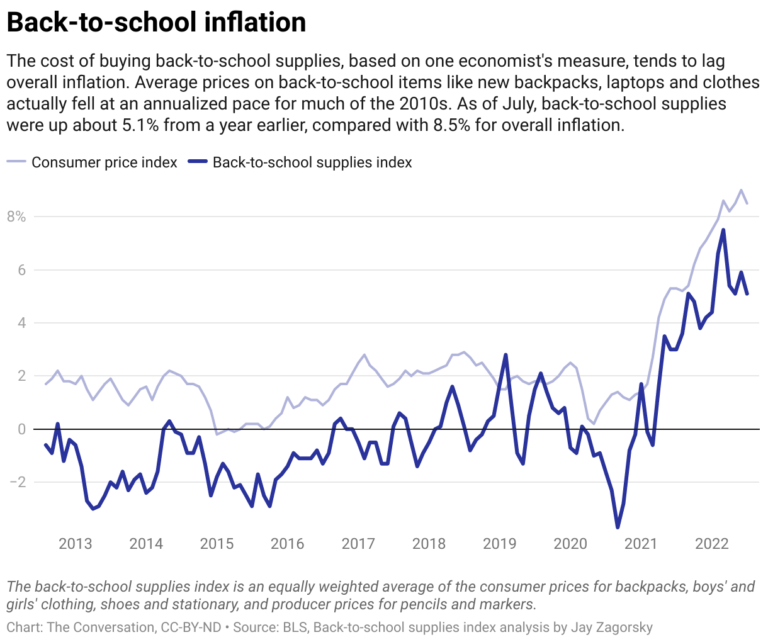
Consumer prices rose by about 8.5% in July from a year earlier, according to the latest data released on Aug. 10, 2022. But this figure is only an average. The price of some items, like airline fares and gasoline, has jumped a lot more than that, while the cost of other items, like the price of televisions and phones, have actually fallen.

To determine how the cost of paying for what school children need has changed, I tracked two sets of prices: First, the cost of back-to-school necessities. Second, the price of school lunches – since learning on an empty belly is hard.

Clothes and backpacks

Children often seem to sprout during summer vacation. This growth typically means they need new clothes for fall’s cooler weather. The U.S. government’s consumer price index has been following the price of both girls’ and boys’ clothes since 1977.

Government data shows the price of girls’ clothing peaked in 1992. The price of boys’ clothes peaked six years later, in 1998. Not only are clothes cheaper today than they were in the 1990s, but over the last 12 months prices for girls’ clothes have increased by less than 2% – compared with overall inflation of 8.5%. The price of boys’ clothes, however, jumped almost 5% last year.

Going back to school also means new shoes, since kids’ feet grow too. The average price for boys’ and girls’ footwear has risen steadily since 1977. In the past year, the price of shoes and sneakers climbed by almost 8%.

As for school supplies, inflation has been a mixed bag. The price of notebooks and paper has soared in the past year, by 11%. And while the consumer price index doesn’t track pencils, markers and crayons, its close cousin, the producer price index, shows retailers are paying 11% more than they did last year for pencils and markers, while art supplies have climbed almost 18%.

The prices of backpacks, on the other hand, increased at a much slower pace, up about 4% in July 2022 from 12 months earlier. And if your child needs a new laptop or tablet, you’re in luck. The price of computers has actually fallen by almost 4% from July 2021.

Putting these categories together into an equally weighted index suggests the cost of going back to school won’t hurt your wallet as much as parents might fear. My back-to-school index rose about 5.1% in July from a year earlier.

The index also shows prices are virtually unchanged from about a decade ago. This is small consolation for parents who didn’t have students in school 10 years ago. However, it does show that the prices of back to school items are not always increasing.

School lunches

Another major cost when going back to school is buying lunch in school cafeterias.

Pre-pandemic data suggests close to two-thirds of students were buying lunch at school. Consumer price data shows the cost of food in urban elementary and secondary school cafeterias was down 43% in May 2022 from a year earlier – the latest figures available.

In fact, the index level is about the lowest since the index began tracking the data in 2005, primarily because there was universal free lunch during parts of the pandemic. That program has now ended, though some states are stepping in, so lunch costs are likely to climb in most school districts in the coming year.

For families who prefer to pack school lunches for their children, the data looks much worse. The average price of food purchased for home preparation surged 13.1% in July from a year earlier, the fastest pace of inflation since 1979.

But since that may not reflect the actual cost of the food in a child’s lunchbox, I did my own calculation based on what my mother packed for me when I was a kid: peanut butter and jelly sandwiches, which remains a staple today – though not for my children.

My lunchbox typically consisted of a PB&J sandwich on white bread, apple slices, a few baby carrots, a bag of potato chips, 8 ounces of milk and a chocolate chip cookie – to keep me happy. Using the U.S. Department of Agriculture’s school lunch buying guide, I found the portions that would provide about 666 calories, a touch more than recommended by the government. My personal lunchbox index jumped by over 13%.

That was mainly driven by the jump in the price of bread, peanut butter, milk and potato chips, which all climbed by more than 14%.

Choosy shopping

While most prices for going back to school are rising more than usual, there are still bargains to be found, such as in children’s clothing and computers.

Or in the lunchbox example, you could add more apples, whose price has climbed only about 5%. Including more apple slices could not only ease your wallet but also improve your child’s nutrition.

Prices on most goods may be a lot higher than a year ago, but it’s important to remember that not everything is undergoing sky-high inflation. With careful shopping, even families on a tight budget can find what they need at a price they can afford. (The CONVERSATION)

Starbucks at Center of Lawsuit for Racist Civil Rights Violations

0

Washington, DC – The American Civil Rights Project (the “ACR Project”) filed suit in Spokane, Washington yesterday against beverage giant Starbucks CEO Howard Schultz and the company’s officers and directors. The suit was filed on behalf of the National Center for Public Policy Research (NCPPR), a long-time shareholder.

NCPPR’s petition argues that Starbucks’ policies violate state and federal civil rights laws, creating material corporate liabilities. It seeks to bar Starbucks’ officers and directors from continuing to implement racially discriminatory policies and to hold them accountable for the harms those policies have done to shareholders.

“The National Center is proud to stand up for the countless small shareholders who feel powerless to challenge Starbucks’ disregard for civil rights,” said Scott Shepard, director of NCPPR’s Free Enterprise Project (FEP). “It cannot be in the best interests of any shareholders for Starbucks’ executives and directors to steer the company into violating a huge array of civil rights law by discriminating on the basis of race. Those officials ought to be ashamed of themselves and must be held liable.”

“Starbucks has set goals for the number of ‘diverse’ – meaning not-white – employees it hires, and those goals are tied to executive compensation. That is outright racial discrimination,”
said Shepard. “All Americans have the same civil rights. Making employment decisions based on race violates those civil rights. Officers and directors who act on such discriminatory policies are violating their fiduciary duties to their shareholders and should be held accountable for those actions.”

“Corporate America has embraced illegal, discriminatory policies that almost all Americans oppose because its decisionmakers get all the benefits while the costs are diffused across lots of unorganized shareholders,” said ACR Project Executive Director Dan Morenoff. “Courts need to change that by putting the decisionmakers on the hook for the harms they do.”

Washington state co-counsel Joel Ard of the Ard Law Group added, “The people of Washington, many of them Starbucks shareholders, want and deserve better from their largest and most recognizable corporate citizens. I am confident that the courts will agree and take this chance to use long-established principles of American corporate law to halt, at the wholesale level, corporate America’s ‘woke’ embrace of illegal, racial discrimination.”

The complaint can be viewed here.

What to Know About the Costs of Traveling for Abortion Care in the Us – Here’s What I Learned From Talking to Hundreds of Women Who’ve Sought Abortions

0

Katrina Kimport, University of California, San Francisco

For many who must travel to get an abortion, the financial burden of the trip can be overwhelming

Abortion travel isn’t new. People have been crossing national and state borders to get abortion care since the 1960s, when air travel became more common and affordable.

The number of people who need to travel and the distances they must travel for care will increase following the U.S. Supreme Court’s ruling in Dobbs v. Jackson Women’s Health Organization, which overturned Roe v. Wade.

As a sociologist who studies gender, reproduction and health, I have interviewed hundreds of women who have sought abortions, many of whom had to travel for care. My recent study on the experiences of people who had to travel across state lines for abortion care can help people better understand what costs abortion patients face when they have to travel.

1. Why do people travel for abortion care?

People travel for medical care for many reasons. In the case of abortion travel, they are typically traveling because abortion is either legally restricted or unavailable in their home area. To get an abortion, they have no choice but to travel.

As of late August 2022, about half of the states in the U.S. have already restricted or are expected to heavily restrict abortion. Abortion seekers in those states may opt to travel to another state where abortion remains legal, as many Texans did following the implementation of their state’s highly restrictive law in 2021.

2. What are the main costs of traveling for abortion care?

Most people rightly anticipate that abortion travel entails expenses like gas money or plane tickets and hotel charges. As research shows that most abortion patients are at or just above the federal poverty line, it is easy to see that these costs alone could represent a substantial burden.

But traveling for an abortion often also includes numerous other costs. For instance, most abortion patients are already parenting children, so they must figure out child care logistics when they have to travel for abortion care. People who do not have access to a reliable vehicle may need to rent a car to make a long-distance drive across state borders.

Abortion funds – nonprofit organizations that provide practical and financial support to people seeking abortion care – can help people who are financially struggling navigate some of these costs. But often this aid isn’t sufficient to cover all costs. There are also real questions about whether funds can meet the growing demand.

And then there is the issue of lost wages during the time a patient must spend traveling. For many people engaged in hourly work, when you don’t work, you don’t get paid.

Abortion travel can also entail emotional costs. I’m currently working on a new study based on interviews with 30 women from around the U.S. about the emotional impacts of having to travel out of state for abortion care. Based on these interviews, I’ve learned that having to travel for abortion care can mean the stress of having to navigate a new place. For some people, this could be their first time in that city or even away from home. It also means being removed from their usual support systems and the physical and emotional comforts of home. This, too, can take an emotional toll.

And, of course, having to travel means having to explain to others – including co-workers and family members – why they are traveling, which can also come at a high personal and emotional cost.

3. Are there any positives to traveling for abortion care?

There is not much work on this question to date. Most research on abortion travel has focused on its negative aspects. But in my research, some of the women who had to travel for abortion care talked about how much they appreciated the emotional support they received in their destination clinic – especially after the hostility to abortion they had experienced in their home communities.

Seeking out nonjudgmental, compassionate care might motivate someone to prefer to travel for abortion care. But in the post-Roe landscape, few will have that luxury. Rather, travel will be a necessity, not a choice. Even with the possibility of emotional benefits, travel for abortion care exacts clear and substantial costs. (The CONVERSATION)

Long COVID or Post-COVID Conditions

0

Post-COVID Conditions

Some people who have been infected with the virus that causes COVID-19 can experience long-term effects from their infection, known as post-COVID conditions (PCC) or long COVID.

People call post-COVID conditions by many names, including: long COVID, long-haul COVID, post-acute COVID-19, post-acute sequelae of SARS CoV-2 infection (PASC), long-term effects of COVID, and chronic COVID.

What You Need to Know

  • Post-COVID conditions can include a wide range of ongoing health problems; these conditions can last weeks, months, or years.
  • Post-COVID conditions are found more often in people who had severe COVID-19 illness, but anyone who has been infected with the virus that causes COVID-19 can experience post-COVID conditions, even people who had mild illness or no symptoms from COVID-19.
  • People who are not vaccinated against COVID-19 and become infected may also be at higher risk of developing post-COVID conditions compared to people who were vaccinated and had breakthrough infections.
  • While most people with post-COVID conditions have evidence of infection or COVID-19 illness, in some cases, a person with post-COVID conditions may not have tested positive for the virus or known they were infected.
  • CDC and partners are working to understand more about who experiences post-COVID conditions and why, including whether groups disproportionately impacted by COVID-19 are at higher risk.

As of July 2021, “long COVID,” also known as post-COVID conditions, can be considered a disability under the Americans with Disabilities Act (ADA). Learn more: Guidance on “Long COVID” as a Disability Under the ADA, Section

About Long COVID or Post-COVID Conditions

Post-COVID conditions are a wide range of new, returning, or ongoing health problems that people experience after first being infected with the virus that causes COVID-19. Most people with COVID-19 get better within a few days to a few weeks after infection, so at least four weeks after infection is the start of when post-COVID conditions could first be identified. Anyone who was infected can experience post-COVID conditions. Most people with post-COVID conditions experienced symptoms days after their SARS CoV-2 infection when they knew they had COVID-19, but some people with post-COVID conditions did not notice when they first had an infection.

There is no test to diagnose post-COVID conditions, and people may have a wide variety of symptoms that could come from other health problems. This can make it difficult for healthcare providers to recognize post-COVID conditions. Your healthcare provider considers a diagnosis of post-COVID conditions based on your health history, including if you had a diagnosis of COVID-19 either by a positive test or by symptoms or exposure, as well as doing a health examination.

Science at CDC

Scientific evidence and studies behind long COVID

Science behind Long COVID

Symptoms

People with post-COVID conditions (or long COVID) may experience many symptoms.

People with post-COVID conditions can have a wide range of symptoms that can last more than four weeks or even months after infection. Sometimes the symptoms can even go away or come back again.

Post-COVID conditions may not affect everyone the same way. People with post-COVID conditions may experience health problems from different types and combinations of symptoms happening over different lengths of time. Most patients’ symptoms slowly improve with time. However, for some people, post-COVID conditions may last months, and potentially years, after COVID-19 illness and may sometimes result in disability.

People who experience post-COVID conditions most commonly report:

General symptoms

  • Tiredness or fatigue that interferes with daily life
  • Symptoms that get worse after physical or mental effort (also known as “post-exertional malaise”)
  • Fever

Respiratory and heart symptoms

  • Difficulty breathing or shortness of breath
  • Cough
  • Chest pain
  • Fast-beating or pounding heart (also known as heart palpitations)

Neurological symptoms

  • Difficulty thinking or concentrating (sometimes referred to as “brain fog”)
  • Headache
  • Sleep problems
  • Dizziness when you stand up (lightheadedness)
  • Pins-and-needles feelings
  • Change in smell or taste
  • Depression or anxiety

Digestive symptoms

  • Diarrhea
  • Stomach pain

Other symptoms

  • Joint or muscle pain
  • Rash
  • Changes in menstrual cycles

Symptoms that are hard to explain and manage

Some people with post-COVID conditions have symptoms that are not explained by tests.

People with post-COVID conditions may develop or continue to have symptoms that are hard to explain and manage. Clinical evaluations and results of routine blood tests, chest x-rays, and electrocardiograms may be normal. The symptoms are similar to those reported by people with ME/CFS (myalgic encephalomyelitis/chronic fatigue syndrome) and other poorly understood chronic illnesses that may occur after other infections. People with these unexplained symptoms may be misunderstood by their healthcare providers, which can result in a long time for them to get a diagnosis and receive appropriate care or treatment.

Tips for talking to your doctor about post-COVID conditions

Health conditions

Some people experience new health conditions after COVID-19 illness.

Some people, especially those who had severe COVID-19, experience multiorgan effects or autoimmune conditions with symptoms lasting weeks or months after COVID-19 illness. Multiorgan effects can involve many body systems, including the heart, lung, kidney, skin, and brain. As a result of these effects, people who have had COVID-19 may be more likely to develop new health conditions such as diabetes, heart conditions, or neurological conditions compared with people who have not had COVID-19.

People experiencing any severe illness may develop health problems

People experiencing any severe illness, hospitalization, or treatment may develop problems such as post-intensive care syndrome, or PICS.

PICS refers to the health effects that may begin when a person is in an intensive care unit (ICU), and which may persist after a person returns home. These effects can include muscle weakness, problems with thinking and judgment, and symptoms of post-traumatic stress disorder (PTSD). PTSD involves long-term reactions to a very stressful event. For people who experience PICS following a COVID-19 diagnosis, it is difficult to determine whether these health problems are caused by a severe illness, the virus itself, or a combination of both.

People More Likely to Develop Long COVID

Some people may be more at risk for developing post-COVID conditions (or long COVID).

Researchers are working to understand which people or groups of people are more likely to have post-COVID conditions, and why. Studies have shown that some groups of people may be affected more by post-COVID conditions. These are examples and not a comprehensive list of people or groups who might be more at risk than other groups for developing post-COVID conditions:

  • People who have experienced more severe COVID-19 illness, especially those who were hospitalized or needed intensive care.
  • People who had underlying health conditions prior to COVID-19.
  • People who did not get a COVID-19 vaccine.
  • People who experience multisystem inflammatory syndrome (MIS) during or after COVID-19 illness.

Health Inequities May Affect Populations at Risk for Long COVID

Some people are at increased risk of getting sick from COVID-19 because of where they live or work, or because they can’t get health care. Health inequities may put some people from racial or ethnic minority groups and some people with disabilities at greater risk for developing post-COVID conditions. Scientists are researching some of those factors that may place these communities at higher risk of both getting infected or developing post-COVID conditions.

Preventing Long COVID

The best way to prevent post-COVID conditions is to protect yourself and others from becoming infected. For people who are eligible, getting vaccinated and staying up to date with vaccines against COVID-19 can help prevent COVID-19 infection and protect against severe illness.

Research suggests that people who are vaccinated but experience a breakthrough infection are less likely to report post-COVID conditions, compared to people who are unvaccinated.

Learn more about protecting yourself and others from COVID-19.

Living with Long COVID

Living with a post-COVID condition can be hard, especially when there are no immediate answers or solutions.

However, people experiencing post-COVID conditions can seek care from a healthcare provider to come up with a personal medical management plan that can help improve their symptoms and quality of life. Review these tips to help prepare for a healthcare provider appointment for post-COVID conditions. In addition, there are many support groups being organized that can help patients and their caregivers.

Although post-COVID conditions appear to be less common in children and adolescents than in adults, long-term effects after COVID-19 do occur in children and adolescents.

 Talk to your doctor if you think you or your child has long COVID or a post-COVID condition. Learn more: Tips for Talking to Your Healthcare Provider about Post-COVID Conditions

Data for Long COVID

Studies are in progress to better understand post-COVID conditions and how many people experience them.

CDC is using multiple approaches to estimate how many people experience post-COVID conditions. Each approach can provide a piece of the puzzle to give us a better picture of who is experiencing post-COVID conditions. For example, some studies look for the presence of post-COVID conditions based on self-reported symptoms, while others collect symptoms and conditions recorded in medical records. Some studies focus only on people who have been hospitalized, while others include people who were not hospitalized. The estimates for how many people experience post-COVID conditions can be quite different depending on who was included in the study, as well as how and when the study collected information. Estimates of the proportion of people who had COVID-19 that go on to experience post-COVID conditions can vary:

  • 13.3% at one month or longer after infection
  • 2.5% at three months or longer, based on self-reporting
  • More than 30% at 6 months among patients who were hospitalized

CDC and other federal agencies, as well as academic institutions and research organizations, are working to learn more about the short- and long-term health effects associated with COVID-19, who gets them and why.

Scientists are also learning more about how new variants could potentially affect post-COVID symptoms. We are still learning to what extent certain groups are at higher risk, and if different groups of people tend to experience different types of post-COVID conditions. These studies, including for example CDC’s INSPIRE and NIH’s RECOVERexternal icon, will help us better understand post-COVID conditions and how healthcare providers can treat or support patients with these longer-term effects. CDC will continue to share information with healthcare providers to help them evaluate and manage these conditions.

CDC is working to:

  • Better identify the most frequent symptoms and diagnoses experienced by patients with post-COVID conditions.
  • Better understand how many people are affected by post-COVID conditions, and how often people who are infected with COVID-19 develop post-COVID conditions afterwards.
  • Better understand risk factors, including which groups might be more at risk, and if different groups experience different symptoms.
  • Help understand how post-COVID conditions limit or restrict people’s daily activity.
  • Help identify groups that have been more affected by post-COVID conditions, lack access to care and treatment for post-COVID conditions, or experience stigma.
  • Better understand the role vaccination plays in preventing post-COVID conditions.
  • Collaborate with professional medical groups to develop and offer clinical guidance and other educational materials for healthcare providers, patients, and the public. (Source: usa.gov/covid.gov/CDC)


Diet Can Influence Mood, Behavior and More – a Neuroscientist Explains

0

Monica Dus

Associate Professor of Molecular, Cellular, and Developmental Biology, University of Michigan

During the long seafaring voyages of the 15th and 16th centuries, a period known as the Age of Discovery, sailors reported experiencing visions of sublime foods and verdant fields. The discovery that these were nothing more than hallucinations after months at sea was agonizing. Some sailors wept in longing; others threw themselves overboard.

The cure for these harrowing mirages turned out to be not a concoction of complex chemicals, as once suspected, but rather the simple antidote of lemon juice. These sailors suffered from scurvy, a disease caused by a deficiency of vitamin C, an essential micronutrient that people acquire from eating fruits and vegetables.

Vitamin C is important for the production and release of neurotransmitters, the chemical messengers of the brain. In its absence, brain cells do not communicate effectively with one another, which can lead to hallucinations.

As this famous example of early explorers illustrates, there is an intimate connection between food and the brain, one that researchers like me are working to unravel. As a scientist who studies the neuroscience of nutrition at the University of Michigan, I am primarily interested in how components of food and their breakdown products can alter the genetic instructions that control our physiology.

Beyond that, my research is also focused on understanding how food can influence our thoughts, moods and behaviors. While we can’t yet prevent or treat brain conditions with diet, researchers like me are learning a great deal about the role that nutrition plays in the everyday brain processes that make us who we are.

Perhaps not surprisingly, a delicate balance of nutrients is key for brain health: Deficiencies or excesses in vitamins, sugars, fats and amino acids can influence brain and behavior in either negative or positive ways.

Vitamins and mineral deficiencies

As with vitamin C, deficits in other vitamins and minerals can also precipitate nutritional diseases that adversely impact the brain in humans. For example, low dietary levels of vitamin B3/niacin – typically found in meat and fish – cause pellagra, a disease in which people develop dementia.

Niacin is essential to turn food into energy and building blocks, protect the genetic blueprint from environmental damage and control how much of certain gene products are made. In the absence of these critical processes, brain cells, also known as neurons, malfunction and die prematurely, leading to dementia.

In animal models, decreasing or blocking the production of niacin in the brain promotes neuronal damage and cell death. Conversely, enhancing niacin levels has been shown to mitigate the effects of neurodegenerative diseases such as Alzheimer’s, Huntington’s and Parkinson’s. Observational studies in humans suggest that sufficient levels of niacin may protect against these diseases, but the results are still inconclusive.

Interestingly, niacin deficiency caused by consumption of excessive amounts of alcohol can lead to similar effects as those found with pellagra.

Another example of how a nutrient deficiency affects brain function can be found in the element iodine, which, like niacin, must be acquired from one’s diet. Iodine, which is present in seafood and seaweed, is an essential building block for thyroid hormones – signaling molecules that are important for many aspects of human biology, including development, metabolism, appetite and sleep. Low iodine levels prevent the production of adequate amounts of thyroid hormones, impairing these essential physiological processes.

Iodine is particularly important to the developing human brain; before table salt was supplemented with this mineral in the 1920s, iodine deficiency was a major cause of cognitive disability worldwide. The introduction of iodized salt is thought to have contributed to the gradual rise in IQ scores in the past century.

Ketogenic diet for epilepsy

Not all dietary deficiencies are detrimental to the brain. In fact, studies show that people with drug-resistant epilepsy – a condition in which brain cells fire uncontrollably – can reduce the number of seizures by adopting an ultralow-carbohydrate regimen, known as a ketogenic diet, in which 80% to 90% of calories are obtained from fat.

Carbohydrates are the preferred energy source for the body. When they are not available – either because of fasting or because of a ketogenic diet – cells obtain fuel by breaking down fats into compounds called ketones. Utilization of ketones for energy leads to profound shifts in metabolism and physiology, including the levels of hormones circulating in the body, the amount of neurotransmitters produced by the brain and the types of bacteria living in the gut.

Researchers think that these diet-dependent changes, especially the higher production of brain chemicals that can quiet down neurons and decrease levels of inflammatory molecules, may play a role in the ketogenic diet’s ability to lower the number of seizures. These changes may also explain the benefits of a ketogenic state – either through diet or fasting – on cognitive function and mood.

Sugar, saturated fats and ultraprocessed foods

Excess levels of some nutrients can also have detrimental effects on the brain. In humans and animal models, elevated consumption of refined sugars and saturated fats – a combination commonly found in ultraprocessed foods – promotes eating by desensitizing the brain to the hormonal signals known to regulate satiety.

Interestingly, a diet high in these foods also desensitizes the taste system, making animals and humans perceive food as less sweet. These sensory alterations may affect food choice as well as the reward we get from food. For example, research shows that people’s responses to ice cream in brain areas important for taste and reward are dulled when they eat it every day for two weeks. Some researchers think this decrease in food reward signals may enhance cravings for even more fatty and sugary foods, similar to the way smokers crave cigarettes.

High-fat and processed-food diets are also associated with lower cognitive function and memory in humans and animal models as well as a higher incidence of neurodegenerative diseases. However, researchers still don’t know if these effects are due to these foods or to the weight gain and insulin resistance that develop with long-term consumption of these diets.

Time scales

This brings us to a critical aspect of the effect of diet on the brain: time. Some foods can influence brain function and behavior acutely – such as over hours or days – while others take weeks, months or even years to have an effect. For instance, eating a slice of cake rapidly shifts the fat-burning, ketogenic metabolism of an individual with drug-resistant epilepsy into a carbohydrate-burning metabolism, increasing the risk of seizures. In contrast, it takes weeks of sugar consumption for taste and the brain’s reward pathways to change, and months of vitamin C deficiency to develop scurvy. Finally, when it comes to diseases like Alzheimer’s and Parkinson’s, risk is influenced by years of dietary exposures in combination with other genetic or lifestyle factors such as smoking.

In the end, the relationship between food and the brain is a bit like the delicate Goldilocks: We need not too little, not too much but just enough of each nutrient. (The CONVERSATION)