I started this piece over a month ago. Really. But the truth is that I reread it for what seems like a gazillion times and lost more than a few hours of sleep wordsmithing it ad nauseam, consumed by the declines in the number of Black newspapers. Although Voltaire wrote, “perfect is the enemy of good,” sorry, but I’m not one who strives for just the good.
Now the culprit behind my desperation in trying to get this darn piece right was a headline that appeared in a Virginia newspaper. I’ll get to it shortly.
You see, for as long as I can remember, my day would start with a cup of coffee followed by plowing through three or more newspapers. The touch and smell of fresh newsprint mixed well with the aroma of fresh coffee. That was before the current trend where many of those newspapers have gone out of business or gone completely on-line. Where once the shelves in places where I’d pick up my papers were stacked with dailies, they’re now occupied with candy, potato chips and Crispy Cream donuts. Literacy lost and Snicker bars won.
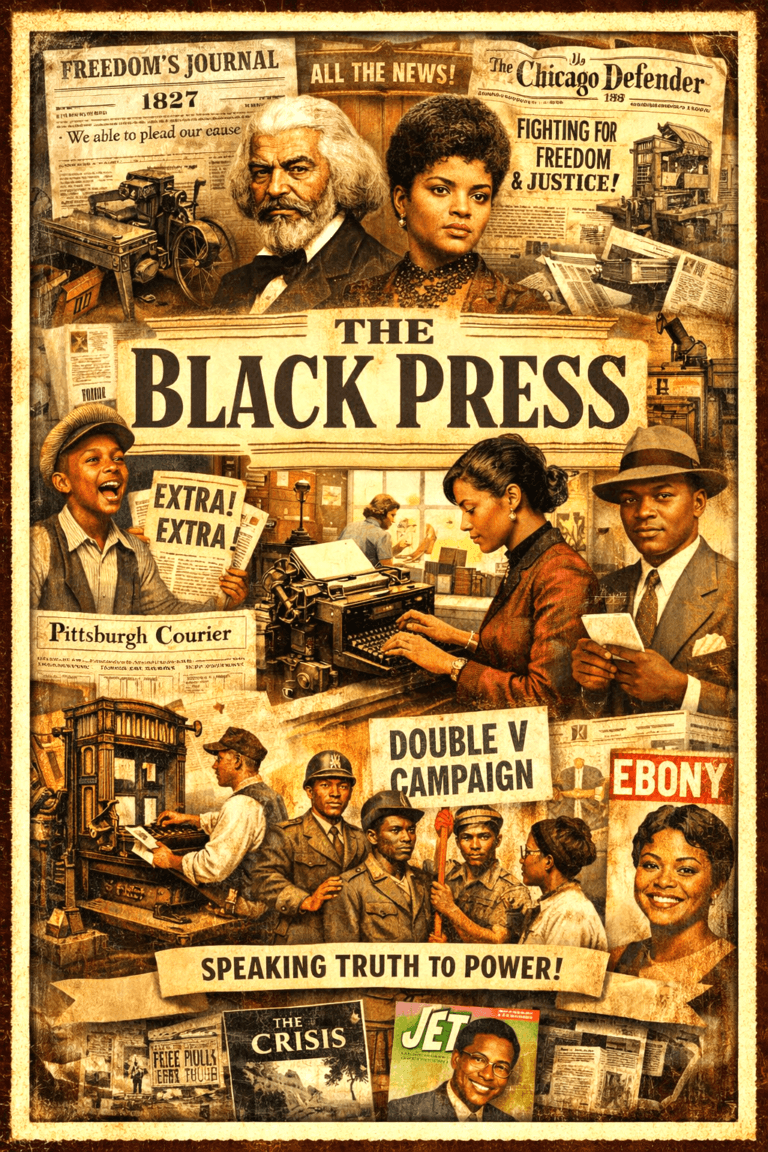
So just like that, my reliance on newspapers beyond reading them – for insulation, stuffing boxes, etc. – had changed forever. As a lifetime reader of Black newspapers – among them the Baltimore Afro-American, Chicago Defender, Pittsburg Courier, New York Amsterdam News, et al – I woke up to the headline, “The Richmond Free Press ceased publication,” a Black newspaper and held onto the fragile hope that someone had played cruel AI hoax on me. I wish I could sit here and say that was the case, but I can’t. Lord knows I can’t.
Now in case you’re interested, The Freedom’s Journal was the first African American paper in the United States founded in 1827 by free African Americans. Today although their numbers continue to decline, 200 Black papers still exist although they face significant financial challenges including declining ad revenue and shifts to digital media. Not to be ignored are the differences in where generations get their news. Gen Z and Millennials rely heavily on social media (Tik Tok, Instagram, etc.) while Gen X bridges the gap and Baby Boomers like me heavily favor traditional newspapers (with a hot cup of coffee within reach).
The Richmond Free Press was (it pains me greatly to use the word ‘was’ here) an independent newspaper in Richmond, Virginia, published on a weekly basis for 34 years focused on covering issues of concern for the Black community. Raymond H. Boone, its founder, started the paper in part because he felt these groups were underrepresented in the mainstream media.
In 2020, the newspaper’s coverage of Black Lives Matter protests in Richmond and the toppling of Confederate monuments, put the paper in the crosshairs of the current administration’s current efforts to weed out anything reeking of DEI, the threat to western civilization as we’ve come to know it, especially if it highlights slavery or the boogey man of all boogey men…race.
To be clear, the cease in publication of the Free Press is just another part of the anti-Black press trend sweeping the nation and impacting both public and private sectors, including corporations, colleges and universities who have for many years put a priority on diversifying their student ranks and workforces. Seemingly overnight the lethal word “diversity” has been scrubbed from internal websites and modes of communication. Hey, we understand that it’s hard for those ugly aspects of our past to stay buried, to rid ourselves of those warts of our history.
Unfortunately, the demise of the Richmond Free Press has also been experienced by the Portland Skanner, a pioneering Black newspaper in Portland, Oregon that ceased operation 50 years after it began publishing. They closed their business due to changing technology facing the same issues that have plagued newspapers for the last decade—advertisers have migrated to social media platforms. But not to be dismissed was their coverage of protests and other issues not to the liking of the current administration.
Inarguably, the Black press has always played an important role in documenting the unfiltered truth, often ignored, distorted, sugarcoated or completely ignored by so-called “mainstream” media. Case in point, I challenge the reader to look beyond the Sports page at how often images of African Americans are portrayed in many (but not all) mainstream media, many times on the front page as frowning gang bangers and criminals. By contrast, many Black newspapers have drawn a line on publishing those caricatures and portrayals. There’s no denying the growing attack on the media aided by vitriolic language coming from ___________ (you can fill in the blank space).
The undeniable truth is that the Black press has had an educated, informed readership of Black readers for decades. Their readership includes doctors, PhDs, CEOs, business owners, college presidents, sports icons, ministers, entertainers, and in every other field. Sinister efforts to cease publication of the Black press are an insult and slap in the face of those and millions of other readers.
So what? Well, if you’re sitting in limbo grappling with what if anything to do to support the future of the Black media, ponder your answers to these questions:
What if you took a seat at your local beauty salon or barbershop waiting for the next available chair and reached for the latest Black newspaper and it wasn’t there?
What if you recently moved into town and looked around for a Black newspaper to find a listing of Black owned businesses, churches, restaurants, etc., and not one could be found?
What if you are the parent of a bright young Black student who aspires for a career in journalism but since mainstream publications offered few if any internships, you hoped that the local Black newspaper had opportunities, but those papers were no longer there?
What if you are the head of an “Equal Employment Opportunity” institution or corporation that has for years placed ads in a local Black-owned newspaper to attract customers and employees but got the message from “higher ups” that that must cease?
What if you are a Black-owned business owner or religious institution who has seen a drop in customers and members who usually find you through ads in the Black-owned newspaper that recently ceased publication?
What if you once promised financial support of a Black-owned publication but never delivered on your promise and now that publication is on the brink of going out of business?
What if after reading this piece, at least one person – perhaps you – or an organization starts a steamroller effect by starting or increasing his/her or its support of the local Black press?
Now setting aside other “what if’s,” the truth is that trusted African American journalism isn’t just a luxury; it’s a vital tool for social justice and providing critical information to an informed community.
Now what? Well, as American author William Faulkner once wrote, “you move a mountain one stone at a time.” …………or (my words) one new ad in a Black newspaper at a time!
Terry Howard is an award-winning writer, a contributing writer with the Chattanooga News Chronicle, The American Diversity Report, The Douglas County Sentinel, Blackmarket.com, recipient of the Dr. Martin Luther King, Jr. Leadership Award, and third place winner of the Georgia Press Award.





The genius of Oscar and Frank!
Sorry to disappoint readers – well, some readers anyway – but today’s narrative is not about the latest in golfer’s Tiger Wood’s “driving” (eh, Land Rovers, not golf balls) skills, the war in Iran, skyrocketing gas prices, Trump vs. the Pope Leo, Kash Patel’s boozing charges, or the guessing game of who’s in the Epstein files. No, this one is about how language can manifest itself in various types of prose to educate, criticize, hyperbolize, tick off or just plain annoy.
But first, today’s narrative is written as comic relief, a breather and short reprieve from the messy world we find ourselves in today where there’s not a day that goes by without a “uh, uh, are you kidding me” head-scratcher. And as important, it’s written to provide some nifty one-liners and comebacks for dealing with those irritating people in your life who make you cuss under your breath, roll your eyes and make a beeline to the nearest exit. (Feel tree to jot down the names of those who immediately come to mind. For some a single page will do; for others you may need a three-ring binder).
So to put this into perspective, a while ago I was rummaging through a box of old books searching for one published a dozen years ago about which I’d recently agreed to write its sequel when I happened across one I’d forgotten that I had in my possession. That book, “I wish I’d said that! The greatest one-liners, comebacks, put-owns, epitaphs, quips, showstoppers, & wisecracks of all times,” was published by Nick Harris in 1984.
Well, so much for my search for the other book because I couldn’t put the Harris one down. In fact, by the end of the next day, I’d plowed through all 160 pages of the book while chuckling or laughing out loud at quip after quip, one-liner after one-liner. But when I burst into uncontrollable laughter after coming across this quote by Mark Twain, “I never wished a man dead, but I have read some obituaries with great pleasure,” my wife poked her head in the door to make sure that I wasn’t in need of immediate medical attention.
So, to give you a bit of the book’s flavor, here’s one by Sydney Smith who was exasperated by Lord Macaulay, who had a chronic habit of being a non-stop talker. She said this about Macaulay; “He has occasional flashes of silence that make his conversations perfectly delightful.” Ouch, does that one ring a familiar bell with any non-stop talkers you know?
Now although I could easily tantalize you with other side-splitting quips from the book, I figured that with the limits of time and space, I’d cherry pick a few by poet Oscar Wilde then complement them with the writing style and substance of columnist Frank Bruni. But in all fairness to them both, this narrative will be a bit more about Bruni and less about Wilde for what should be an understandable reason; Wilde is long dead while Bruni – the literary gift that keeps on giving – is alive and provides us with recurring works of brilliance from which to draw.
Oh, yes, and for what it’s worth, Wilde was, and Bruni is, a gay man although their acceptance in society during their times are dramatically different; Wilde was convicted and spent time in prison for his homosexuality whereas Bruni lives over a century later as an openly gay man.
I’ll begin with Wilde, an Irish author, poet and playwright who became one of the most popular and influential dramatists in London in the early 1890s, He’s regarded by many as the greatest playwright of the Victorian era perhaps best known for his Gothic novel The Picture of Dorian Gray. Known for his biting wit, flamboyant dress and glittering conversational skill, Wilde became one of the best-known personalities of his day. Muffled chuckles tend to evolve into outright laughs when one reads his quotes.
If Wilde was alive today – Lord knows that I wish he was – he’d have a field day with a tantalizing list of public figures to be on the receiving end from his trove of bards and witticism. But even in death, Wilde’s quotes and quips resonate and remain applicable today. Take these for example:
“There’s only one thing in life that’s worse than being talked about and that’s not being talked about.”
“The only thing that ever consoles man for the stupid things he does is the praise he always gives himself for doing them.”
“Experience is simply the name we give to our mistakes.”
“Always forgive your enemies; nothing annoys them so much.”
“True friends stab you in the front.”
Let’s turn to Frank Bruni.
Truth is that I’m a huge fan of columnist and college English professor Frank Bruni. Brilliant is the word that keeps repeating itself whenever I read a Bruni column, each one several times to be honest. The “language matador” that he is, Bruni’s mastery of the dagger sentence and prodigious paragraph have a way of pirouetting just out of the way while plunging lance after lance into the back of a charging bull of contemporary outrageousness and hypocrisy leaving the “bull” (can I say “BS”) destined for a one-way trip to the nearest butcher shop and next steak dinner.
Bruni’s creative use and cutting weaponization of language leaves one salivating for more.
With foot in the mouth retreats into words and acts of homophobia, sexism, racism, other isms and ignorance these days, public figures risk being called out by Bruni at the mercy of his keyboard mastery. Vintage Bruni, his recent, “Donald Trump’s middle finger,” and Attorney General Bondi’s humiliating performance in front of a federal committee are masterpieces in truth about the current state of our fractured trainwreck of a nation.
So, in my opinion, Frank Bruni ranks with the best, among them novelists James Baldwin, Mark Twain, and Pulitzer Prize winning columnists Maureen Dowd and Leonard Pitts, Jr., as the best in courageous prose. With this assembly of talented writers, the reader is strongly advised to have a thesaurus and a yellow highlighter within easy reach because you just may need them.
Now as a connoisseur of awesome quotes, I’ll leave you with one of my favorites….”Don’t let the door hit you where the good Lord split you,” a tongue-in-cheek way of telling someone to leave quickly, implying that they’re unwelcome.
Wait readers, I have a sneaky suspicion that that last quote had yours truly in your mind?
C’mon now, did it?
Terry Howard is an award-winning writer, a contributing writer with the Chattanooga News Chronicle, The American Diversity Report, The Douglas County Sentinel, Blackmarket.com, recipient of the Dr. Martin Luther King, Jr. Leadership Award, and third place winner of the Georgia Press Award.