Sunday, October 11, 2026
Advertisement
Home Blog Page 7

Tennessee Announces $3 Million Commitment to Support Quantum Technologies

NASHVILLE, Tenn. – Last week, Gov. Bill Lee and Deputy Gov. and Tennessee Department of Economic Development Commissioner (TNECD) Stuart C. McWhorter announced a $3 million funding commitment to support National Science Foundation (NSF) X-Labs quantum teams that choose to establish research, commercialization or business operations in Tennessee.

The investment is designed to help winning NSF X-Labs teams accelerate commercialization while leveraging Tennessee’s nationally recognized quantum ecosystem, including Oak Ridge National Laboratory, the Tennessee Valley Authority, EPB, other leading research universities and the state’s growing innovation and manufacturing base.

“Over the past few years, Tennessee has earned the reputation as having one of the strongest quantum ecosystems in the country,” said Gov. Lee. “This investment will help ensure that the companies developing tomorrow’s quantum technologies will choose our state to grow, cultivate high-quality jobs and bring new innovations.”

The Tennessee Quantum X-Labs Challenge will support teams that commit to commercializing their technologies in Tennessee by providing the following resources:

·         Up to $3 million in state support

·         Access to world-class research and testing infrastructure

·         Commercialization support through Tennessee’s innovation ecosystem

·         Partnerships with industry, national laboratories, universities and utilities

·         Workforce development and talent recruitment resources

“Tennessee is uniquely positioned to help quantum companies move from breakthrough research to real-world deployment,” said Deputy Gov. and Commissioner McWhorter. “We’re shifting our economic development strategy from simply recruiting projects to orchestrating ecosystems where companies and innovators can access the partners, infrastructure, and talent they need to succeed, and today’s announcement signals a clear message that we’re ready to do so.”

Beyond the state funds, LaunchTN is adding a package designed to help X-Labs teams put down roots in Tennessee. Any X-Lab awardee that relocates to the state, along with companies that emerge from the X-Labs program, will receive priority consideration for LaunchTN’s SBIR/STTR Matching Fund, which augments federal non-dilutive awards with state capital, and for direct investment through InvestTN to companies that meet program eligibility criteria. Together, these programs give X-Labs teams a clear path from federal award to sustained growth capital, reducing the runway gap that early ventures face and helping them maximize the impact of their NSF funding in Tennessee. This announcement builds on the $43 million investment that was approved and allocated in Gov. Lee’s 2026 budget to further the state’s quantum infrastructure and will ultimately position Tennessee as a leader nationwide in attracting advanced energy, quantum networking, and technology commercialization to every corner of the state.

Honor Vote Initiative Marks America’s 250th with Tribute to Service Members

As Tennessee prepares for the 2026 election season, Secretary of State Tre Hargett is encouraging registered voters to participate in the state’s Honor Vote program, a civic initiative that allows citizens to dedicate their vote in honor of a United States veteran or active-duty service member.

This year’s program carries special significance as participants will receive a commemorative Honor Vote button recognizing America’s 250th anniversary and honoring the generations of military personnel who have defended the nation’s freedoms.

“At a time when our freedoms are on full display, the Honor Vote program offers Tennesseans a meaningful way to recognize those who defend them,” Hargett said. “Casting a ballot in someone’s honor is a simple yet powerful way to express our gratitude to the brave men and women who protect the United States of America.”

The Honor Vote program gives registered voters the opportunity to dedicate their ballot to a veteran or active-duty service member, highlighting the idea that the right to vote was secured through courage and sacrifice.

Participants receive an informational guide and the limited-edition 2026 commemorative Honor Vote button, which they are encouraged to wear when casting their ballot. Those who participate will also have their dedications recognized on the official Tennessee Honor Vote List.

The Secretary of State’s Office is also encouraging participants to share their tributes on social media using the hashtags #GoVoteTN and #TNHonorVote to promote civic engagement and gratitude for military service across the Volunteer State.

The announcement comes as state officials continue efforts to increase voter participation. In Hamilton County, voter turnout during the May 5, 2026, County Primary Election was approximately 10.4 percent, according to the Hamilton County Election Commission. About 22,480 ballots were cast out of approximately 216,060 registered voters, highlighting the importance of encouraging greater participation in upcoming elections.

Eligible Tennesseans must register to vote by Tuesday, July 7, to participate in the Aug. 6 election. Early voting will be held from Friday, July 17, through Saturday, Aug. 1, before Election Day on Thursday, Aug. 6.

Voters interested in participating in the Honor Vote program can register their dedication and learn more at honorvote.govotetn.gov. Information about polling locations, voting hours and election resources is also available through the free GoVoteTN mobile app and at GoVoteTN.gov.

Lieutenant Allen Green Named 2026 CFD Company Officer of the Year

Lieutenant Allen Green of the Chattanooga Fire Department has been named the 2026 Company Officer of the Year, an honor recognizing his outstanding leadership, innovation, and steadfast commitment to community service.

For Green, the award represents more than professional excellence–it reflects a life dedicated to transforming adversity into opportunity and using education as a tool to save lives.

Raised in foster care and group homes with the support of Bethel Bible Village, Green understands firsthand the challenges many young people face. After graduating from Hixson High School, he enrolled at the University of Tennessee at Chattanooga to study chemistry. When his twin sons were born, he put his education on hold to provide for his family, a decision that ultimately led him to the Chattanooga Fire Department.

More than a decade later, Green fulfilled his goal of earning his chemistry degree from UTC while serving as a firefighter, demonstrating the perseverance that has become a hallmark of his career.

Today, Green serves as a fire and life safety educator, where he has helped redefine community risk reduction by focusing on prevention through education. Using research and data to identify neighborhoods at greater risk for residential fires, he develops outreach initiatives that equip families with life-saving knowledge before emergencies occur.

His signature initiative, Read to Succeed, combines literacy with fire safety education. Each month, Chattanooga firefighters visit elementary schools to read with students while teaching essential fire prevention lessons and building positive relationships with children.

The program holds special significance for Green because it began at Calvin Dunson Elementary School–the same school he attended as a child–bringing his journey full circle.

Recognizing the need for engaging educational resources, Green authored the children’s book, Mom! Dad! What Should I Do?, published in 2025. The book teaches families how to develop home fire escape plans, establish outdoor meeting places, and understand the importance of working smoke alarms.

Featuring diverse characters that reflect Chattanooga’s communities, the book encourages children to see themselves not only as learners but also as future first responders. Proceeds support Green’s literacy initiatives and nonprofit organization, PPCH, Inc. (Pain, Perseverance, Character, Hope), which mentors at-risk youth.

Green’s community involvement extends beyond the classroom. Through PPCH and volunteer work with organizations including Bethel Bible Village and Barger Academy of Fine Arts, he has mentored countless young people, helping them overcome obstacles much like those he faced growing up.

His outstanding work previously earned him the Ralph Cothran Civil Service Fire Fighter of the Year Award.

Green’s influence also reaches beyond Chattanooga. As a leader with the Sound Off Initiative, he works with national fire safety advocates to promote working smoke alarms and improve fire safety outreach, particularly for individuals who are deaf or hard of hearing. He regularly speaks at universities, career fairs, conferences, and fire departments across the country, sharing innovative strategies for community engagement and prevention.

Despite his national recognition, colleagues describe Green as a humble servant leader who invests deeply in his crew, mentors aspiring firefighters, and remembers the children he meets through school visits.

“Teaching and educating, for me, is like a ministry,” Green has said. “It’s not just about giving out information. It’s about implementing change and growth.”

The 2026 Company Officer of the Year Award recognizes Green’s vision of modern fire service leadership: one that extends beyond emergency response to include education, mentorship, prevention, and lasting community impact.

By turning his own life experiences into opportunities to uplift others, Lieutenant Allen Green continues to demonstrate that the greatest leaders don’t simply answer the call–they inspire others to rise with them.

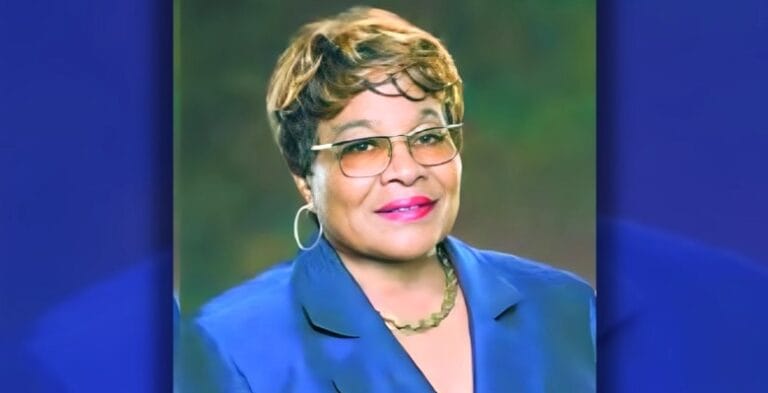
TN Tribune Publisher Rosetta Miller-Perry Succumbs

By Phyllis Qualls and Tennessee Tribune Staff Contributors

Rosetta Miller-Perry, trailblazer, visionary, bridge builder and motivator, passed peacefully Friday June 26, surrounded by family. She was 91.

In a statement shortly after she passed, the family posted a message on the Tennessee Tribune web page. “The Tennessee Tribune family mourns the passing of its founder, publisher and chief executive officer, Rosetta Miller-Perry.” Perry’s remarkable presence and influence extended throughout Tennessee and beyond.

After graduating from high school in Coraopolis, Pennsylvania, she joined the Navy and earned an honorable discharge. She began work in the Pentagon and several government departments that included the Equal Employment Opportunity Commission. She was an observer in Memphis during the Civil Rights Movement. While working at the EEOC, she was assigned to Memphis to observe the sanitation protest. And, during that time, Martin Luther King, Jr. was assassinated. Perry was compromised as well, and in constant danger, yet she was not afraid and continued her work.

She retired from federal government after 25 years of service and established Perry & Perry Associates. She also established Contempora Magazine in 1990 and the Tennessee Tribune in 1991. She could not get a loan, therefore she used her own funds to establish these media outlets, before AI, fax machines and cell phone use was so prevalent. The Tribune is now 35 years old.

At the 30th anniversary celebration of the Tennessee Tribune, NNPA Board Chair Ben Chavis dubbed Perry as “Queen Mother” of the Black press because of her years in journalism and the impact she has had in the industry.

Miller-Perry has been described as a motivator, role model and entrepreneur. She was either a founder or charter member of several organizations. She established the Black Chamber of Commerce, so that Black businesses could be recognized and receive civic and business benefits.

She was also a founding charter member of the Nashville Chapter of Les Gemmes, Inc., a social and civic group with a focus on exposing youth to the arts. It was as rewarding to Mrs. Perry as it was to the youth. Whatever she did, it was done with tenacity and class, because she knew she was right!

Her belief in education was strong and she has scholarships in her name at Tennessee State University, the University of Memphis and Meharry Medical College. She also supports a scholarship for Nashville chapter of the Les Gemmes’ Jewels, who attend the University of Memphis. The Celebration of Life services will be Friday and Saturday, July 10 & 11, in Nashville. The Friday night public viewing will be at First Baptist Church, Capitol Hill, 625 Rosa L. Parks Blvd. Nashville, TN. The funeral will be Saturday, July 11, at Mt. Zion Missionary Baptist Church, located at 2261 Murfreesboro Pike, Nashville, TN 37217.

Is Development turning Chattanooga into Any City, USA?

0

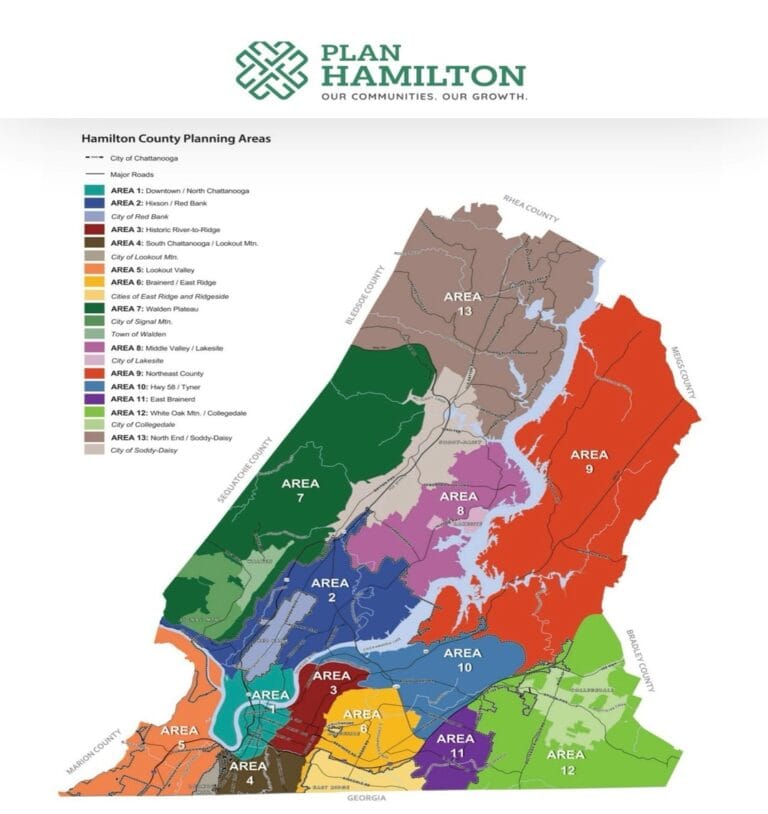
Hamilton County’s Commission narrowly approved Plan Hamilton, a long-range growth plan, by a 6-5 vote. This split exposes a divide among residents who see the fast pace of development and the painfully slow availability of supporting infrastructure, such as roads, schools, and community essentials that support good neighborhoods versus those who gain profit from development or government folks who want the property tax base to expand for revenue.

The County Commission debate has been framed around the challenge: Does infrastructure precede development or should development drive infrastructure.

Take a fire at a Chattanooga 280-unit complex on Sunday, July 5, as just one example. The development located just beyond the Northgate area required 21 of 27 fire units from across the city to respond to an emergency. A Florida-based company built these units with some fire hydrants but the hydrants supplied available from the City of Chattanooga were about a mile away. Unfortunately, 70 residents were displaced. Gratefully, the ingenuity of the Chattanooga Fire Department staging relay trucks every 500 feet assisted in water delivery to the critical scene.

But how does Plan Hamilton impact property rights of individual property owners? You do have a constitutional right to private property. Yes. There are zoning regulations and codes. But your elected officials are to represent you, your rights and interests within the framework of government. A comprehensive plan should serve as a policy guide rather than a mechanism that unnecessarily restricts the productive use of private land. If, however, a government approves development, that government is also making a commitment to support that development.

But does it?

The Chattanooga apartment fit the development model of higher density to prevent spread near a major transportation hub. Yet the infrastructure for public safety was still revealed to be an issue in just this one example.

So who are the winners and losers of Plan Hamilton?

Winners will be:

•             property owners of land that can now be divided under new land regulations into smaller parcels to maximize number for density and profit;

•             developers both locally and from other regions who seek relatively cheap land for purchase and a quick return on investment;

•             individuals either moving into the area or choosing to relocate to a new residence to have greater housing inventory and advertised lower costs (which are not materializing yet);

•             governments seeing single parcels of land developed into numerous parcels for taxing authority for spending and revenue.

Losers will be:

•             existing land or homeowners whose property values may be negatively impacted depending on unelected development board decisions;

•             neighborhoods that are not resourced with roads, expanded road capacity, and other infrastructure like schools, public safety, and essential amenities;

•             those working in schools and other points of professional contact and service that face greater volume and long wait for schools, healthcare, etc. to be built.

Finally, Hamilton County and Chattanooga have long touted our area’s beauty, natural resources, and wildlife. Will we congratulate the progressive development that make us just like Any City, USA?

The Chattanooga Area 250 years ago–Celebrate the History

As America commemorates the 250th anniversary of the Declaration of Independence, it is worth remembering the State of Tennessee didn’t exist on July 4, 1776. The land we now know as Tennessee was officially the western frontier of North Carolina, extending beyond the Appalachian Mountains into a vast, unsettled wilderness sought by varied and diverse groups of people.

Three North Carolinians–Joseph Hewes, William Hooper, and John Penn have their names affixed to the Declaration of Independence as delegates representing the land mass that stretched from the shores of the Atlantic Ocean in the east to the Mississippi River in the west.

The Tennessee landscape was far from empty. For centuries, it was the homeland of the Cherokee, whose towns, trade routes, and culture defined much of East and Southeast Tennessee that would one day become Chattanooga and Hamilton County.

While Philadelphia’s Independence Hall hosted discussions and declarations made of liberty and independence, the Tennessee Valley was the crossroads of another culture. The Tennessee River and its tributaries served as one of the Southeast’s great transportation corridors that linked Cherokee communities across present-day Tennessee, Georgia, Alabama, and North Carolina. The valleys, ridges, and riverbanks were occupied by Cherokee settlements whose history stretched back generations.

Among our local area’s most significant figures during this time was Dragging Canoe, the son of the respected Cherokee Nation’s diplomat Attakullakulla. Even before the Declaration of Independence, Dragging Canoe warned that expanding colonial settlement would transform the frontier into what he famously described as “a dark and bloody ground.” The Cherokee nation was divided–some committed to defend their land; others wanted to compromise with settlers.

The American Revolution with England was not the only conflict of 1776. Warfare erupted across the southern frontier involving the Cherokee, some seeking peace, others engaged in battle. Still most believed that westward settlement of colonists into Georgia, Northern Alabama, and the land that would become Tennessee in 1796, threatened their homeland. The long Cherokee American Wars led to the removal of thousands of Cherokee from their lands to Oklahoma under order of President Andrew Jackson in 1838.

During military expeditions in 1776, Dragging Canoe led a group of followers farther down the Tennessee River to establish new communities along present-day Chickamauga Creek right off Amnicola Highway that traces through Brainerd, splits in East Ridge into West and South Chickamauga Creeks continuing to Walker and Catoosa Counties in Georgia. These settlements were Chickamauga Cherokee towns and the center of resistance for nearly two decades.

Diverse people shaped the landscape long before Tennessee existed as a state with so much life centered around South Chickamauga Creek. The aspirations of the American founders and the enduring legacy of the Cherokee provides a more complete portrait of this region 250 years ago.

History informs us. America’s Constitutional Republic must protect the God-given rights of each citizen. Our area remains diverse and robust in rich heritage. Yes! Keep celebrating the 250th year! Just appreciate all the history.

UTC to Host ‘Beyond the Game’ Event for Parents of College-Bound Student-Athletes

Kyrah McCowan, the Senior Director of Football Administration and Program Relations at the University of Texas Football; and right, McClendon Curtis, an NFL Offensive Guard and former University of Tennessee at Chattanooga Mocs standout.

Local parents looking to navigate the complex world of higher education and athletic recruiting will have access to a free community resource this month.

The panel discussion, titled “Beyond the Game: What Every Parent Needs to Know About Raising a College-Bound Student Athlete,” will take place Monday, July 20, at 6:30 p.m. at the University of Tennessee at Chattanooga (UTC).

Whether a child is an athlete pursuing collegiate sports or a student preparing for higher education, the event is designed to equip parents with the knowledge, resources, and connections needed to help their students succeed.

This community initiative brings together college coaches, athletic professionals, former and current athletes, and college transition experts to provide honest conversations about recruiting; academics; Name, Image, and Likeness (NIL) opportunities; and what colleges seek in prospective student-athletes.

Attendees will also have access to valuable community resources and vendors who specialize in helping families navigate the complex college transition process.

The program’s core mission is to equip every student–regardless of background–with the financial literacy, leadership skills, and real-world tools needed to win in life beyond the classroom and beyond the game.

Discussion topics will seamlessly address what college coaches really look for, recruiting myths versus facts, NCAA eligibility, academic expectations, and NIL opportunities.

Additionally, panelists will discuss how parents can support rather than hurt the recruiting process, ways to prepare students for college life beyond athletics, and general college transition resources for students and families.

The featured guest lineup includes an array of sports and educational professionals. Speakers include Kyrah McCowan, the Senior Director of Football Administration and Program Relations at the University of Texas Football, and McClendon Curtis, an NFL Offensive Guard and former UTC Mocs standout.

They will be joined by Coach Tyrus Ward, the Defensive Ends Coach at the University of Tennessee at Chattanooga; Coach Kenneth White, the Head Basketball Coach at McCallie School; and Coach Jay Price, the Head Men’s Basketball Coach at Chattanooga State Community College.

Kimberly Cooper Thomas, J.D., a college transition and parent resource specialist from Sister in the Shadow, LLC, will also be featured to provide expert guidance.

Whether a student is entering high school, preparing for recruitment, or getting ready to begin college this fall, this event aims to provide practical information, expert advice, and valuable resources to help families navigate the journey with confidence. Families can reserve their spot today and invest in their student’s future by filling out the online registration form  through Google Forms at https://docs.google.com/forms/d/e/1FAIpQLSeLlTXwLsm3B9-jrebLkOz4xEEKBgoZQtgMW6bua5JgLdtxjQ/viewform.

APCD Renames Museum to “Johnny Holloway Educational, Heritage, and Community Museum”

0
Crowd shot view of community participants enjoying the 2026 Juneteenth festivities at the Alton Park Development Corporation (APDC). (CNC photo/F. Stoudemire)

How was life different for Blacks in Chattanooga, Tennessee compared to Galveston, Texas during the Civil War? One might answer, nothing, since Blacks were treated as property with no human rights due to cultural acceptance at the time.

Books could be written on the definitions of culture versus what God says. Let’s stick to the historical facts.

Chattanooga was the southernmost point of the anti-slavery movement with the population divided. The state of Tennessee was the last to separate from the Union to fight with the Confederacy, or pro-slavery states. According to the 1860 census, the entire state of Tennessee had 275,719 enslaved persons, about 25% of the 1.1 million citizens. Hamilton County recorded fewer than 4,000 slaves. East Tennessee reported fewer than 45,000; Middle Tennessee had about 110,000; West Tennessee had approximately 135,000 slaves.

Chattanooga was not a stronghold of the Confederacy–the pro-slave movement. President Abraham Lincoln’s Emancipation Proclamation was announced on January 1, 1863, two years before the Civil War ended in May 1865. By September 1863, Union forces controlled Chattanooga. This meant Blacks in Southeast Tennessee were freed sooner than most southern states, especially Texas.

The anti-slavery forces, the railroad, and the comparatively small number of landowners who owned slaves provided fertile ground for freedom for Blacks in Chattanooga and Hamilton County. Blacks had opportunities for education, leadership in houses of faith, employment, and early observance of the Constitutional rights provided through the 13th, 14th, and 15th Amendments.

Slavery was abolished. Citizenship and equal protection under the law was codified. The right to vote for men regardless of status of free or previous enslavement was established in federal law. Unfortunately, cultural norms in the South continued to push against these rights and human decency, requiring Union forces during the era of Reconstruction from late 1864 through 1877.

During this window of time, history records that Union forces finally reached Texas on June 19, 1865. Union Major General Gordon Granger delivered General Order No. 3 declaring the immediate freedom of all slaves.

The order declared under law and military enforcement the “absolute equality of personal rights and rights of property between former masters and slaves, and the connection heretofore existing between them becomes that between employer and hired labor.”

After more than two years since Blacks in Tennessee experienced freedom, those in Texas went from property to having property rights; they went from forced laborers to workers for wages.

While commemorating Juneteenth this year and every year, consider the Union soldiers fighting the Battle of Chattanooga, a critical engagement between the Union and Confederacy that many cite as one of the turning points of history, where Black troops fought for freedom.

Look at Orchard Knob, Lookout Mountain, Missionary Ridge, the banks of the Tennessee River, and the railroads. Think of the role that Blacks in Chattanooga, and anti-slavery soldiers, played to free all Blacks from a culturally approved sin –slavery.

Let’s forever pray our area stands above cultural approval to keep the Chattanooga Way.

“This year’s Juneteenth celebration is especially meaningful as we honor the legacy of Johnny Holloway and expand our commitment to education, culture, and community advancement,” said Dr. Elenora Woods, DDS, FOI, FPFA, President of the Alton Park Development Corporation.

Families, neighbors, and partners across Chattanooga were invited to attend the Juneteenth celebration activities for a day of unity, empowerment, and cultural pride as well as to visit and support the facility during the year.

Do assumptions have expiration dates? Yes? No?

0

On a flight from St. Louis to Sacramento recently, I found myself scrunched into that dreaded middle seat; my wife sat half asleep in the window seat and a woman seated next to me in the aisle seat. Now 20 minutes after the plane took off, a flight attendant pushed a snack cart down the aisle and stopped to take our orders.

“I’ll have a Coke with ice,” said the women in the aisle seat. “Ice water, please,” I requested.

Wanting to be helpful the woman in the aisle seat leaned over, looked at my half-asleep wife and asked me, “should I order something to drink for your daughter?” After taking a deep breath, I said to her, “That’s very nice of you but the truth is that she’s my wife, not my daughter.”

As the color drained from her face, she cuffed her mouth and responded: “Oh my, I’m so sorry, I uh, didn’t mean to…” she started before I cut her off with a smile, “Well, you certainly made her day, but I cannot say that for mine.”

The flight attendant chuckled and joined us in the ensuing laughter while, I’m sure, she mentally jotted this incident down into her collection of “Tales of a flight attendant.”  For the duration of that flight – and it continues to this day – I thought about the assumptions we sometimes make during our observations about others and how those assumptions can land us in some awkwardly embarrassing situations.

But here’s the deal. Once we emerge from those inevitable “OMIF” (Open Mouth, Insert Foot) moments in life based on assumptions, the question is what learning opportunities are there on the other side? Take, for example, my “you didn’t make my day” response to the embarrassed lady in the aisle seat. Were there situations in our lives when we ruined someone’s day by making erroneous assumptions about them? The question answers itself, doesn’t it?

Now a few things need saying before we go on.

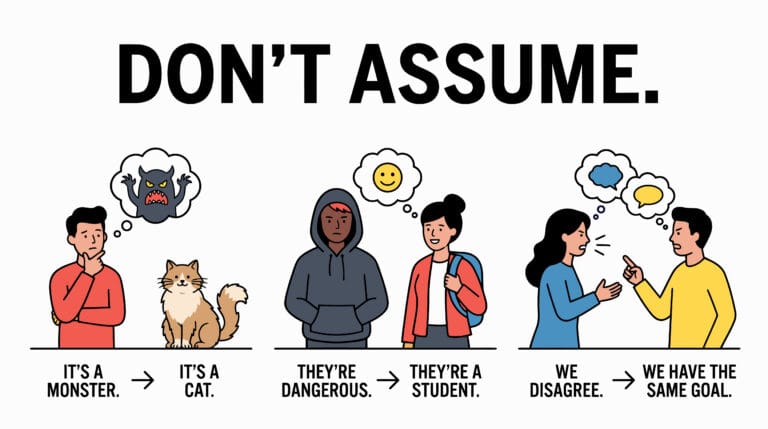
First, and to ensure that we’re on the same definitional page, an assumption is a belief or statement taken for granted without proof. Assumptions can be explicit (clearly stated) or implicit (implied) and are often based on prior knowledge or experiences.

Second, assumptions have no expiration dates. They’re equal opportunity discriminators, hard-wired into our makeup, our DNA, and often hidden until circumstances force them out into the open, unleash them from the cages of our minds into our behaviors and mouths.

So, can we agree that assumptions about others are likely to contain antiquated notions that could possibly offend someone, albeit not by intent? Can we further agree to accept the truism that nobody’s perfect, and rare indeed is the person who wakes up in the morning ruminating on a list of whom he/she could go out and offend that day?

Now with all that said as a framework, let’s put this to test by pivoting to a list of questions for a thoughtful analysis.

1. How important is it for you to receive an occasional “out of the blue” call from someone checking in on your wellbeing? What assumptions do you have about how often you make those calls?

2. What assumptions could you have about younger generations? What assumption could they hold about you?  What would you like to get more of from the younger generation that they’re not telling you for some reason?

3. What are the possible risks, consequences and rewards for adding others of different backgrounds (think race, age, gender, culture, religion, etc.) into your circle of friends? What assumptions do you make about how the group’s dynamics would change?

4. Based on your life experiences, can you describe a contemporary situation or two – ones that bothered or confused you – where you assume that it’s probably best to keep your mouth shut?

5. Based on facts or assumptions, how would those who know more likely than not say about you when you’re not around?

6. How might your childhood learning about others contribute to the assumptions you sometimes make about others?

7. What might be the indicators and your assumptions that someone is talking to you as a member of an identity group (race, age, religion, gender, etc.) as opposed to you as an individual?

8. What have you chosen not to say to someone in your circle of family or friends that you’ve decided not to say, and why? If you decide to say it, what assumptions do you make about what would happen to the relationship?

9. Based on facts or assumptions, what do you feel that you “already know” in a relationship with someone and how might this knowing and assumption hinder your effectiveness and personal development?

10. What assumption could others make about you based on your physical appearance, command of the English language, accent, educational background or political party affiliation?

11. How do the assumptions you make get in the way of things you can’t measure or be certain of?

12. How willing are you to question the assumptions you may have that are derived from social media, books and/or preferred TV programs?

In the end, and short of enrolling in an “assumption reduction” class at a local university or engaging a high-priced therapist, you can break this assuming habit by conducting an “assumption audit”—pausing to separate what you know for certain from your personal projections—and asking open-ended questions to gather real facts. In short, pause for a second and catch yourself in the act of generalizing and making assumptions. 

Above all – and if you leave with nothing else from this narrative – choose to believe that the person’s words and behaviors that may be based on an assumption were not inherently malicious because they rarely are. Allow them to emerge from the experience having learned a valuable lesson with his/her dignity intact. 

Oh, yes, before I go, should I safely assume that you’ll see this narrative on assumptions valuable enough to share it with others? 

Yes? No?

Terry Howard is an award-winning writer, a contributing writer with the Chattanooga News Chronicle, The American Diversity Report, The Douglas County Sentinel, Blackmarket.com, recipient of the Dr. Martin Luther King, Jr. Leadership Award, and third place winner of the Georgia Press Award.

Finally, Maj James Capers is Awarded the Medal of Honor

0

Finally! More than fifty-nine years after a brutal battle in the jungles of Vietnam, retired Marine Corps Major James Capers Jr. finally received the nation’s highest military decoration during a White House ceremony on June 18, 2026. For many veterans, military historians, and supporters, the award represented not only recognition of extraordinary heroism but also the correction of a decades-long injustice.

In early 2025, the Chattanooga News Chronicle featured a look at the hero’s life who was the Marine’s face for recruitment  beginning in 1967, decked out in the crisp dress blues with the taglines declaring, “The Marines are looking for a few good men…who wants to lead?” That image and one other ad were the first to include an African American to be featured on recruitment posters for the US Armed Forces.

Major James Capers’ actions recognized as valorous occurred from March 31 to April 3, 1967, near Phu Loc, South Vietnam. The young Force Reconnaissance officer–the first Black man to serve as officer in special forces–led a nine-man reconnaissance patrol deep into enemy territory in search of a North Vietnamese regimental base camp. The mission quickly turned into a desperate fight for survival when his team was ambushed by a much larger enemy force.

Despite suffering multiple gunshot wounds, 17 severe shrapnel injuries, and a broken leg, Capers continued to lead his Marines under intense enemy fire. He directed air support, coordinated the defense of his team, and helped ensure the evacuation of his wounded men. According to official accounts, every member of the patrol except one ultimately survived the engagement.

The remarkable aspect of the ceremony was not merely the valor being recognized, but the extraordinary delay in recognizing it. Capers had reportedly been recommended for the Medal of Honor shortly after the battle in 1968. Caper’s commanding officer was killed before the recommendation paperwork could be completed, delaying the process. However, his nomination was never approved due to failure within bureaucracies.

In March 2025, after decades of being overlooked with blame shifted from one to another agency, a specific bill was written and passed as law after the signature of President Donald Trump to waive normal time limitations for review and to reauthorize the nomination of Marine Corps Major James Capers, Jr.

During the White House ceremony, Capers, 88 years old, stood alongside fellow Medal of Honor recipients and family members of other honorees. President Trump acknowledged that the nation had kept Capers waiting “far too long,” while praising his courage and sacrifice. Capers, in response, emphasized that the recognition had to be shared with the Marines who fought beside him at Phu Loc.

Let this serve as a reminder that valor does not expire. More than half a century passed before Major James Capers Jr. received the recognition that so many knew was due him. Ultimately, Major Capers was awarded the Medal of Honor for extraordinary leadership, courage, and self-sacrifice reflecting the very highest virtues that have literally made America.