Wednesday, October 14, 2026
Advertisement
Home Blog Page 66

UTC sophomore lands Public Education Foundation scholarship

0

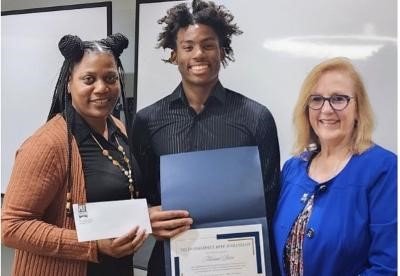
University of Tennessee at Chattanooga sophomore Michael Barr is the recipient of the Public Education Foundation’s Empowerment Book Scholarship for his community involvement and unwavering commitment to his academic success.

The scholarship was created to recognize the outstanding contributions of Dr. Yancy Freeman, a former Public Education Foundation (PEF) board member and UTC vice chancellor of enrollment management and student affairs who is now the chancellor at the University of Tennessee-Martin.

PEF is a Chattanooga-based non-profit organization that provides training, research and resources to teachers, principals and schools in Hamilton County and surrounding areas.

“Michael Barr is an impressive, hard-working, accomplished young man,” said Dr. Dan Challener, the PEF president. “PEF is delighted to recognize him; it is especially fitting that our award for Michael also honors Yancy Freeman, who did so much for PEF, UTC and our community.”

Barr, a 2022 graduate of Central High School, is pursuing a degree in accounting with aspirations for a doctorate in the field. He is a participant in PEF’s Gateway Scholars, a pioneering mentorship program that pairs high school students from seven target schools (Brainerd, Central, East Ridge, Hixson, The Howard School, Red Bank and Tyner Academy) with college advancement mentors who support the students to and through college success. These mentors provide tailored services to students as they transition to college and throughout the first year, promoting self-advocacy, a growth mindset, and academic, social and emotional learning.

“Now that I am a recipient of the PEF Empowerment Book Scholarship, I can focus more on my education,” Barr said. “This scholarship will serve as a reminder of my support network and an inspiration as I continue with my studies.”

Barr said his “giving back to the community” mindset is a value instilled in him by his parents. He regularly volunteers with The Nehemiah Project, a local organization providing school supplies for low-income children, and Second Missionary Baptist Church. In addition to pursuing his accounting degree, he works at Delta Airlines as a ramp agent.

“Michael is smart and well-rounded,” said Anne Choyce, Barr’s PEF college advancement mentor from PEF. “He’s engaged in his community, hard-working in his job and driven to succeed at school. It’s been a joy to watch him figure out how to succeed in college and make the adjustments he needs to make to reach his goals.”

Freeman, who began his tenure as UT Martin chancellor in August 2023, served on the PEF board from 2018 to 2023. Upon concluding his five years of service to PEF’s board, his commitment to student success inspired the creation of the Empowerment Book Scholarship.

The scholarship aims to alleviate the financial burden of textbooks and educational supplies, particularly for students whose costs pose a significant obstacle to post-secondary success. “I am so honored that this scholarship inclusively supports rising young professionals like Michael Barr to help him realize his incredible potential,” Freeman said. “He will go far, and I’m glad this scholarship can support his journey.”

UTC Special Collections Wins Federal Grant to Process Dr. Tommie Brown’s Personal Papers

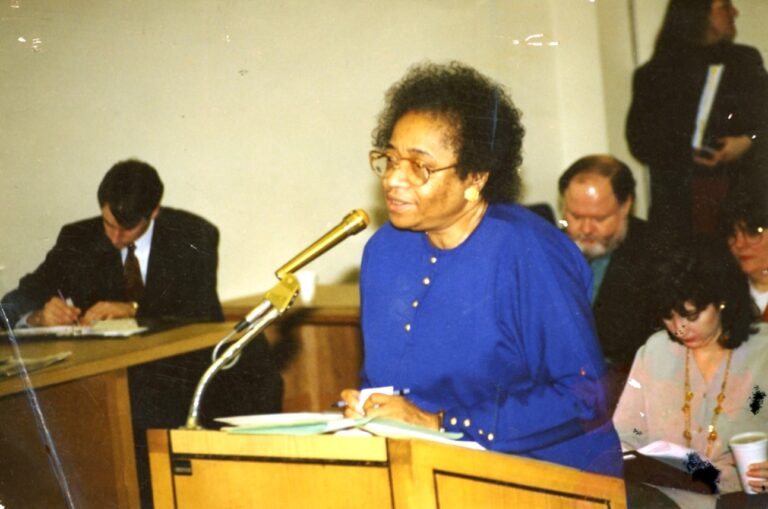
CHATTANOOGA—A $144,049 grant has been awarded to University of Tennessee at Chattanooga Special Collections by the National Historical Publications and Records Commission (NHPRC) to process the papers of Dr. Tommie Brown, a former UTC professor, department head and state legislator.

Brown, who donated her papers to Special Collections in March 2023, was a professor of social work at UTC from 1971-1998 and a Democratic legislator in the Tennessee House of Representatives from 1992-2012. She created the social work program at UTC and, in 1980, became the first Black woman to head an academic department at the University.

According to Carolyn Runyon, assistant head of collection services for the UTC Library and director of Special Collections, this is the first large-scale federal grant the library has received since she came to UTC in 2013.

“I’m excited the federal granting agency saw how important this collection is,” Runyon said. “It’s nice to have that external recognition.”

She said to win the award, the papers needed to be approved by an anonymous peer review, the NHPRC and the Archivist of the United States.

Brown’s papers, which are kept in individual boxes, stretch up to about 125 feet—all of which need to be processed. The grant, Runyon said, will pay for a full-time professional archivist, a student assistant, acid-free boxes, folders to protect the materials and additional equipment.

Runyon explained what acquiring Brown’s papers means to the UTC community and those who will one day be able to view the documents.

“Even though she’s long retired from public service, when I think about her work here on campus and in the community, she has been an outstanding mentor—especially in the Black community in Chattanooga,” Runyon said.

Runyon also acknowledged the broader impact of the NHPRC award and how it will help the library’s mission to preserve history.

“It is recognition, not only of the significance of her papers, but that Special Collections can responsibly and ethically curate and steward these materials,” she said.

“King Can Read: Inspiring Young Minds through Books”

0

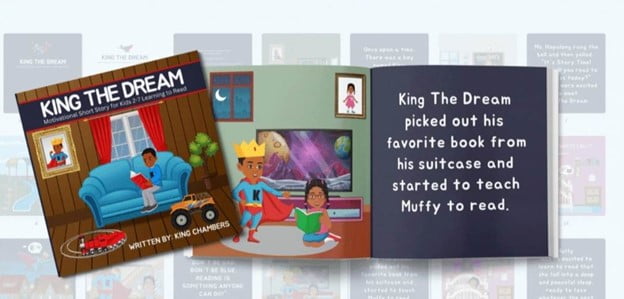
At just five years old, King Chambers has already left an indelible mark on the world of literature as the youngest author in Chattanooga, Tennessee. With his book, “King The Dream,” this young prodigy is not only showcasing his love for reading but also inspiring hundreds of children to pick up books and dive into the world of imagination and knowledge.

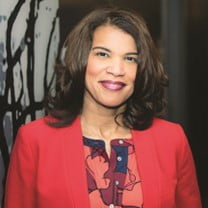
What’s even more remarkable is that King penned his book at the tender age of four, demonstrating his exceptional talent and passion for storytelling. With his mother Jennifer Ellis by his side, King embarked on a journey of creativity and expression, resulting in a captivating children’s book that has captured the hearts of many.

“King The Dream” isn’t just any children’s book; it’s a testament to King’s love for storytelling and his desire to share that passion with others. Since its release, the book has reached over 200 children, igniting a spark for reading in each one of them.

When asked what he loves about reading, King simply replied, “There’s some cool books.” His enthusiasm for the written word is infectious, and he’s on a mission to share that excitement with as many children as possible. King’s goal? To reach 1800 kids with his book, “King The Dream,” spreading the joy of reading far and wide.

But King’s journey doesn’t stop there. Now at the age of five, he’s already dreaming up ideas for his next book, eager to continue inspiring young minds with his imaginative storytelling. With his boundless creativity and love for words, there’s no doubt that King will continue to make waves in the literary world.

Aside from his literary pursuits, King has a passion for art and STEM (Science, Technology, Engineering, and Mathematics). His love for these subjects showcases his well-rounded talents and insatiable curiosity about the world around him.

To learn more about King and his literary endeavors, visit his website at www.kingcanread.com.

King Chambers is more than just a gifted child prodigy; he’s a beacon of inspiration for children everywhere. Through his books and his infectious love for reading, King is proving that age is just a number when it comes to making a difference in the world.

As King continues to chase his dreams and inspire others along the way, one thing is clear: the future of literature is in very capable hands. With young minds like King’s leading the way, the possibilities are endless.

Capitol Hill puts special attention on prison sentences 

By Reginald Stuart

WASHINGTON, DC — President Biden sprinkled a dose of holiday cheer upon a few households across the nation this past holiday season with a surprise announcement he was using his executive powers to commute the federal prison sentences of nearly a dozen non-violent federal drug law offenders and to pardon the convictions of hundreds more for marijuana possession and use on federal lands.

Details of Biden’s actions were expected over the coming months and was hailed this week by activists in the calling for reversal of the mandatory minimums, highlighted by a screening of a new movie about Kemba Smith, a Richmond, Virginia college student who became deeply involved as the girlfriend and drug mule of a notorious illegal drugs dealer on the East Coast who was widely sought and placed on the government’s 10 most wanted list. 

The boyfriend was eventually killed in Seattle in a drug-deal gone sour. Shortly before, Smith went back home, pregnant with a baby and surrendered to federal authorities. Soon, she was convicted and sentenced in federal court to 24 and 1/2 years with no chance for parole, despite being a first time, non-violent offender. Smith became a poster child in the early 1990’s, boosting the chorus of people calling for justice in the courts and a reversal of federal mandatory minimum laws. 

In his final weeks in office, then-President Bill Clinton freed Smith, commuting her prison sentence to 6 1/2 years’ time served. He yielded to bi-partisan efforts and appeals from the NAACP Legal Defense Fund, private attorneys, the Washington-based Sentencing Project, HBCU leaders and Families Against Mandator Minimums (FAMM) 

The actions by Biden, one of the authors of the tough illegal drug laws of the late 1990’s while in the Senate, represented expansion of on again-off again efforts by Congress and the Justice Department to slow the run -away law and order train led by  politicians of all political stripes. The stiff laws caused thousands of incidental non-violent offenders to be sentenced to federal prisons for much of their adult lives.

Today, there are several million Americans in prisons across the country.  

“This is a positive step forward.” said Smith, now Kemba Smith Pradia, who visited Capitol Hill Monday for a screening of the new movie “Kemba,” hosted Congressman Bobby Scott , D-Va.  Pradia, now spouse and proud mother of two, was accompanied at the movie showing by her mother and father who stuck with her during her ordeal of growing up and their relentless teamwork seeking fair sentencing for the crimes in which she was involved.

More than 400 attended this week’s movie showing in a Congressional meeting hall. On hand were dozens of colleges and high school students, and representatives of myriad organizations that rallied behind efforts to roll back the prison sentences for thousands who had been swept away under the new, tougher federal drug laws. 

Among those on hand were the representatives of the NAACP Legal Defense Fund, which lead the legal efforts for Kemba, the Lawyers Committee for Civil Rights Under Law, the Divine Nine, an association of major collegiate Greek Letter societies, the LINKS and the National Council of Negro Women. 

 The so-called RICO laws that treat all suspects charged with racketeering in organized crime operations (RICO) regardless of their roles, imposed stiff mandatory drug sentences with parole and eliminated trial judges discretionary sentencing. Kemba Smith was among those receiving tough sentences for her minor roles as a “drug mule.”  The Capitol Hill showing was facilitated by the National Park Service’s 400 Years of African American History Commission.

CoreCivic Partners with The B.R.A.V.E. Effect to Help Incarcerated Individuals Prepare for Reentry

CoreCivic has partnered with Chattanooga-based non-profit The B.R.A.V.E. Effect to give returning citizens at CoreCivic’s Trousdale Turner Correctional Center in Hartsville,Tenn., a fresh, new perspective on reentry preparation.

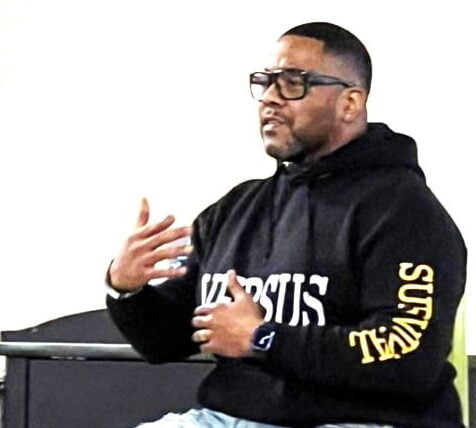
The B.R.A.V.E. (Building Relationships and Valuable Encounters) Effect was founded by Joe Jenkins, who was once incarcerated himself. During his time in prison, Jenkins became determined to never return, so he started planning for his reentry. His successful reentry inspired him to establish The B.R.A.V.E. Effect so he could help others who are transitioning out of incarceration.

“Our partnership with CoreCivic marks a pivotal moment in reentry support,” Jenkins said. “Together, we’re empowering individuals to thrive and contribute to stronger communities.”

The B.R.A.V.E. Effect program teaches residents how to cultivate strategy and positioning, replacing the former “survival” mindset that incarcerated individuals typically maintain as a result of past trauma and criminal patterns.

“A lot of times our community and those who are coming from a criminal lifestyle have been surviving, so I can get people and their households in a position to prosper,” Jenkins said. “Survival can be ‘by any means necessary,’ which in some cases means a crime will be committed.”

The program starts by giving participants a Reentry Guide to help shift their mindset. Participants then brainstorm a set of goals, write them down, and create a roadmap for how they want to achieve these goals and live their lives in a positive way outside of prison.

The B.R.A.V.E. Effect also provides mentorship during and after incarceration. These mentors provide one-on-one coaching and connect newly released individuals with local businesses and non-profits to help them find jobs. Mentors also provide resources to help maintain stability, counseling, and mental health support.

Jenkins said The B.R.A.V.E. Effect has a vision of helping create strong families and communities that are uplifted by these individuals’ renewed sense of purpose.

Those who participate in The B.R.A.V.E. Effect are welcome to continue participation as long as they want or need. Jenkins said sometimes after receiving help in prison, it can be difficult to continue to find that same help after release. That’s why The B.R.A.V.E. Effect provides continued support, helping these individuals stick to their goals and steer away from reoffending. “Even after eight weeks or six months you still have the opportunity to stay on board with us and stay in positioning,” he noted. “You can even stay as part of the team. Most people that find something good want to be a part of that. They love it so much, it gives them a sense of being, so they want to stick around.”

Tina Short: Park Ranger

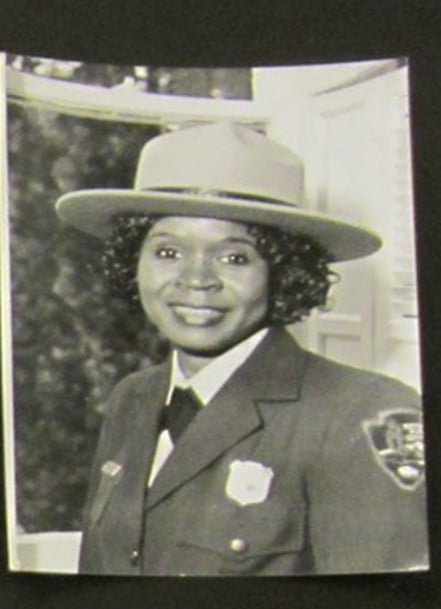
Tina Short was one of the first African American women to serve as a Park Ranger in the NCR.

The National Capital Region (NCR)’s national parks tell a wealth of African American stories. They range from the life of abolitionist Frederick Douglass at his Washington, D.C., home to the archeology of enslaved and free African Americans at Monocacy and Manassas National Battlefields. These histories also include stories of the Civil Rights Movement and protest on public lands and National Historic Landmarks across the nation’s capital.

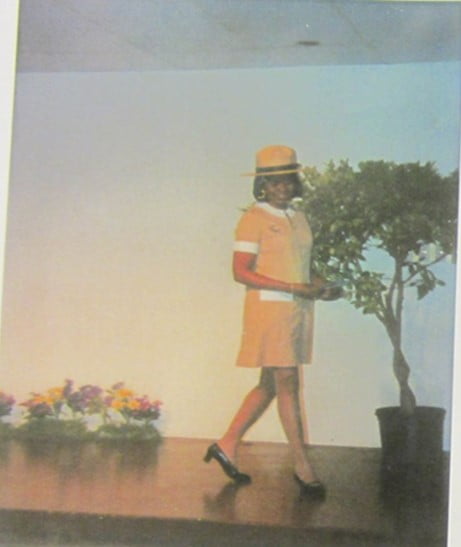
National Park Service employees are more than the stewards and storytellers of American history – they are part of it. Tina Short was one of the first African American women to serve as a Park Ranger in the NCR. In 2014, as part of its effort to document the service’s own untold stories, the national Park History Program conducted an oral history interview with Ms. Short as part of its Centennial Voices Initiative. The story she shared offers lessons for us today as she reflected on finding creative and thoughtful ways to make urban parks relevant to their communities.

(PHOTOS: Top, Tina Short. Above: When Tina Short joined the National Park Service in the 1970s the agency offered uniforms to women that mimicked the uniforms of airline stewardesses. Courtesy of Tina Short)

A native of Washington, D.C., Ms. Short spent her career at Fort Dupont Park, the very place she had attended as a day camper and became a Junior Ranger. She vividly remembered meeting a mounted ranger.

“I went running up to him,” Ms. Short said. “All the kids were running to him, and I wanted to pat the horse. I was so adamant about the fact that was what I wanted to be when I grew up–I wanted a horse and a hat.”

When she expressed a desire to become a park ranger herself, she also remembered someone telling her: “Sweetheart, they don’t have colored people and they sure don’t have ladies.”

In the 1970s, the National Park Service began diversifying its work force, and Ms. Short decided to follow her childhood dream. She joined the ranks of rangers after completing courses at American University, obtaining her Bachelor’s Degree. After applying and being accepted to the rigorous 10-week Ranger Skills Training at Albright Training Center at the Grand Canyon, Arizona, she learned to rappel, conduct search and rescue, create interpretive programs, and complete administrative duties.

Upon returning to Washington, D.C., she was offered an assignment as Supervisory Park Ranger at Fort Dupont Park. On her home turf, Ms. Short planned and developed interpretive programs attuned to community needs. “We never told the community what to do,” she observed. “They always had a voice in all we did.”

Short became a well-known figure in the neighborhood, building programs that are still popular to this day. Carrying on the spirit of the 1968-1978 “Summer in the Parks” community engagement program long beyond its official end, she helped direct a summer music series, Fort Dupont Summer Theater, that attracted jazz performers from all over the country and thousands of listeners. She continued community gardens for seniors, which were a joy and open to the seniors throughout the city. Ms. Short re-created the day camp program for youth—and again responded to community needs. “I used to say that many of my kids came to the park knowing they were safe, as the Metropolitan and United States Park Police Officers visited daily. The kids had loads of fun (ice skating, roller skating, swimming, etc. and taking trips to other monuments and memorials), aside from the fact there was always a good free lunch and afternoon snacks. For many of the kids, this was the only entertainment they would get all summer.” Ms. Short counts this as one of her greatest successes, increasing the growth and development of kids from the inner city who attended this camp and after school programs.

There’s an even more personal legacy. Ms. Short’s daughter, Kym Elder, followed in her footsteps and eventually became Park Superintendent at Ford’s Theatre. She is currently Program Manager for the Civil War Defenses of Washington.

A career with the National Park Service gave Ms. Short the opportunity to take short-term assignments throughout the United States and abroad, as well as temporary duties as a firefighter and a member of search and rescue teams. She served two months with the Army Corps of Engineer’s Katrina Disaster Team.

“You name it, I’ve done it with the Park Service,” she said. “I’ve had one of the most exciting and vigorous careers anyone could imagine. Everyone knew, I absolutely love the park service and not that many people can say that about their jobs. It was just a great place to work. Good people. Good hearted people. Good pay, just an absolutely wonderful career.”

Oral history allows veteran National Park Service personnel like Tina Short to pass along their wisdom and experience to future generations of NPS employees. To listen to podcasts from the Centennial Voices project at SoundCloud. (Source: Tina Short & NPS)

About a third of employees have faced bullying at work – here’s how to recognize and deal with it

0

By Jason Walker, Adler University; Deborah Circo, University of Nebraska Omaha

The phenomenon of bullying, harassment and sexual abuse in workplaces throughout North America is widespread and harmful to both individuals and organizations. In fact, bullying at work affects up to 30% of workers over time.

As practitioners and researchers who study workplace violence, including bullying, harassment and sexual abuse, we define workplace bullying as harmful acts of mistreatment between people that go beyond incivility and cross the line to intentionally causing harm.

Bullying behaviors range from verbally insulting or socially excluding someone to sabotaging the victim’s work, inflicting psychological terror and engaging in sexual abuse or physical aggression. Manipulation and provocation also play a role in bullying dynamics, and cyberbullying has emerged as a new form of workplace harassment. Research suggests the impacts of workplace bullying affect employee health and safety and the workplace overall.

In a grocery store line, if someone invades your space, shoves you aside or threatens physical harm, the police may intervene, potentially resulting in an arrest. However, in the workplace, incidents involving bullying, assault, sexual abuse or other forms of violence are typically addressed through internal investigations. Our research suggests that treating workplace bullying as a matter of public health rather than employment law is necessary to protect those being targeted.

Workplace bullying results in real harms – Targets of workplace bullying often experience serious repercussions, including stress and burnout, along with other diagnosed mental health issues and, in extreme cases, suicide.

Bullying can affect physical health, with symptoms including sleep disturbances, cardiovascular diseases, body aches and pain, loss of appetite and headaches. Targets often describe an inability to concentrate; since they’re spending time worrying about what is going to happen to them next, job performance suffers. The negative impacts can spill over to a target’s personal life and affect their relationships with family and friends.

It’s not unusual for targeted workers to feel uncomfortable coming forward and talking about their experiences. But suffering in silence can lead to an even more toxic climate at work that can undermine your victims’ sense of security, with long-term consequences for their well-being.)  Read Part 2 in next CNC issue for: Personality traits of bullies and their targets; Are you being bullied?; How to respond to an ongoing situation. (The CONVERSATION)

National Urban League Notes Near-Record Low Black Unemployment

0

NEW YORK – National Urban League President and CEO Marc H. Morial issued the following statement in response to the December Jobs Report the Department of Labor issued last month.

“December’s near-record low unemployment rate for Black workers is a vital sign of a strong economy that continues to defy expectations. At 5.2%, the lowest rate since April’s all-time low of 4.7%, the Black unemployment rate is 48.6% – still unacceptably high, but a significant narrowing from the traditional 2:1 ratio. The overall unemployment rate has remained below 4% for nearly two years, one of the longest streaks in U.S. history.

“Another significant indicator of the economy’s strength over the last year is the record-high labor force participation rate for mothers with children under five. But this progress is fragile as pandemic-era relief has expired and childcare costs continue to rise. Without long-term investments in childcare, parents will be forced back out of the labor market, which would slow economic growth and erode economic security.

“Working families are seeing a much-needed rise in their income and wealth. However, high interest rates challenge families struggling to meet their mortgage payments and continue to hinder the construction of new homes.

“To build a more comprehensive and fair economy, we must continue to invest in crucial programs such as housing, childcare, and other initiatives that can help strengthen our economy and communities. We must also ensure delivery of those programs to the underserved communities that need them most.” (Source: TN Tribune)

New Legislation Targets Human Trafficking in Tennessee with TBI’s Support

0

Nashville, TN – State Representative Antonio Parkinson has taken a bold step to intensify the fight against human trafficking in Tennessee. A new bill, recently filed by Rep. Parkinson, mandates all adult-oriented businesses in the state to display human trafficking hotline information that would be overseen by the Tennessee Bureau of Investigation (TBI). The information would be posted at the entrances and in the restrooms of the establishments. This initiative is part of Tennessee’s ongoing efforts to recognize January as Human Trafficking Awareness Month and to strengthen the state’s response to this critical issue.

This proposed legislation (HB1848) is pivotal in raising public awareness and providing immediate access to help for victims. The TBI-operated hotline is a lifeline, offering confidential assistance and support. By ensuring that hotline information is visibly posted in adult-oriented businesses, the bill aims to reach individuals who are most at risk and provide a direct link to the necessary resources.

State Rep. Parkinson, advocating for stronger community protection, remarked, “The horror of human trafficking requires our unwavering attention and action. This bill, with the support of the TBI’s hotline, is a testament to our commitment to eradicate this plight from our state. It empowers victims and the public to take a stand against trafficking.

Tennessee has consistently demonstrated leadership in addressing human trafficking, with comprehensive laws and dedicated initiatives. This bill represents another significant measure in safeguarding the rights and freedoms of all individuals within the state.”

The Memphis Democrat urges his legislative colleagues and the public to back this essential legislation. “With the collective efforts of our communities and the support of the TBI, we can make a meaningful impact. Our unity is our strength in this fight against human trafficking,” Rep. Parkinson added.

For more information, please contact Ken Jobe at ken.jobe@capitol.tn.gov or (901) 277-0606.