Sunday, October 18, 2026
Advertisement
Home Blog Page 146

“Greater Is Coming” – In the Huddle

TODAY’S SCRIPTURE

(Psalm 71:20–21, NLT)

YOU have allowed me to suffer much hardship, but…YOU will restore me to even greater honor and comfort me once again.

TODAY’S WORD

We all face setbacks in life that we don’t understand. When we go through loss and disappointment, it’s easy to get discouraged and think that’s the way it’s always going to be. But our GOD is a GOD of restoration. HE doesn’t keep us from every challenge. But in today’s SCRIPTURE, HE promises that although HE allows us to go through hardships, HE will pay us back for the wrongs and restore what was taken away. The suffering is a setup, not to make you miserable but to restore you to greater honor. GOD never brings you out the same. HE makes the enemy pay for bringing the trouble. When you’re in tough times, remind yourself that the loneliness, the bad break, or the anxiety is not how your story ends. Greater is coming–greater joy, greater strength, greater relationships. The setback in your finances didn’t stop your purpose. Greater opportunities are coming. Greater favor. Greater influence. The enemy meant it for your harm; GOD is turning it to your advantage.

PRAYER FOR TODAY

FATHER, thank YOU that there is a purpose for whatever hardship comes my way, and YOU only allow what YOU know will work for my good. Thank YOU that YOU are a GOD of restoration and that greater is coming–greater honor, joy, and opportunities. I believe that YOU will turn it to my advantage. In JESUS’ Name, Amen.

BIDEN Addresses Nation

Compiled: F. R. Edwards

The ideology of ‘white supremacy’ has no place in America

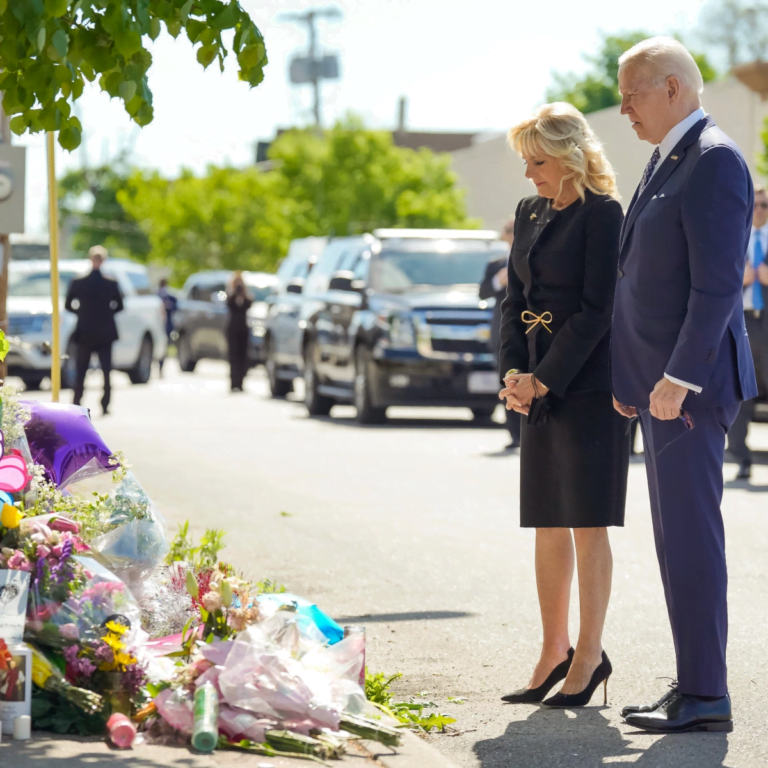
President Joe Biden and first lady Jill Biden traveled to Buffalo on Tuesday and laid flowers on the makeshift memorial near TOPS market. After visiting the area near Saturday’s mass shooting, in which 10 people died and three were injured, they met privately with relatives of the victims. 

 The Bidens then spoke emotionally to a large crowd, which included victims’ family members, lawmakers, and numerous media. President Biden offered  words of comfort to the families and friends of the shooting victims. 

President Biden also addressed the issue of  hate, racism and gun violence that has become all too common in America. Biden condemned those who spread white supremacist lies “for power, political gain and for profit”.  The US president was close to tears as he recalled the victims’ lives, then became angry as he described forces of hatred that have haunted his administration.

He called the buffalo shooting a murderous, racist rampage.  America’s President then said “In America, evil will not win, I promise you.”  “Hate will not prevail and white supremacy will not have the last word.”

While President Biden and First Lady Dr. Jill  Biden were in Buffalo, White House press secretary Karine Jean-Pierre on Tuesday blasted unnamed public figures for pushing the racist so-called “replacement theory,” saying they “should be ashamed of themselves.” 

For a second consecutive day, Jean-Pierre refused to name names when reporters on Air Force One asked if anyone specific may have inspired the mass murder of 10 people at a Buffalo supermarket Saturday by suspected white supremacist Payton Gendron, 18.

“The people who spread this filth know who they are and they should be ashamed of themselves,” Jean-Pierre said. “But I’m not going to give them or their noxious ideas they’re pushing the attention that they desperately want.”

Of the 13 people in total who were shot, 11 were black and Gendron outlined his bigoted views in a 180-page manifesto.
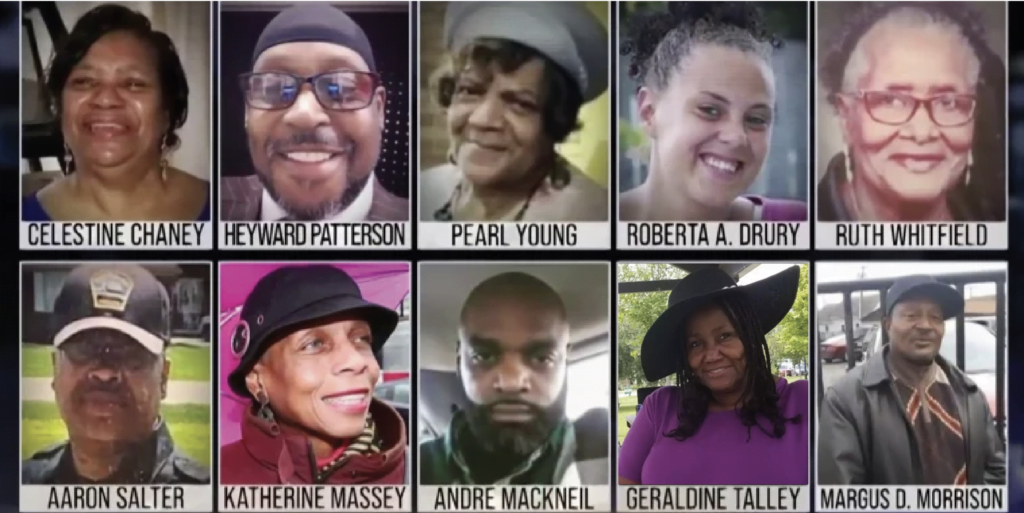
Honoring & Remembering the Victims of the Buffalo shooting

Remembering and Honoring the lives of

Aaron Salter was a beloved community member and security guard who knew the shoppers of Tops Friendly Market by name. When they came under attack from a gunman with a rifle, he sprang into action.

Salter, a retired Buffalo police officer, fired multiple times at the attacker, who was wearing an armor-plated vest. The attacker was struck at least once but the bullet didn’t pierce his vest. Salter, 55, was shot and killed.

“He’s a true hero, and we don’t know what he prevented. There could have been more victims if not for his actions. He’s been retired for several years. He’s been a beloved member and employee of Tops here, working security and he went down fighting. We’re sure he saved lives yesterday.” Buffalo Police Commissioner Joseph Gramaglia 

 Andre Mackneil, 53, of Auburn, New York, was in town visiting relatives and was picking up a surprise birthday cake for his grandson.

“He never came out with the cake,” Clarissa Alston-McCutcheon said of her cousin. She said this sort of surprise was typical for him. He was “just a loving and caring guy. Loved family. Was always there for his family.”

Ruth Whitfield was the 86-year-old mother of retired Buffalo Fire Commissioner Garnell Whitfield. The “beloved wife, mother and grandmother was the primary caretaker of her husband and was coming back visiting him at a nursing home when she was killed in the shooting.”

Garnell said, “It’s very difficult. This is just surreal. We are in a place that we never expected to be. My mother was the glue that held us together.”

Pearl Young, 77, was a member of Good Samaritan Church of God in Christ for over 50 years.James Pennington described her as someone who enjoyed being happy and enjoyed making other people happy.

 AMANDA DRURY /Roberta Drury had recently returned home to live with her mother, Dezzelynn McDuffie, who told The Buffalo News that the 32-year-old woman — the youngest of the people slain — had walked to Tops to pick up some groceries Saturday afternoon. Soon, McDuffie saw horrifying videos circulating on social media that appeared to show the gunman shooting her daughter just outside the store.
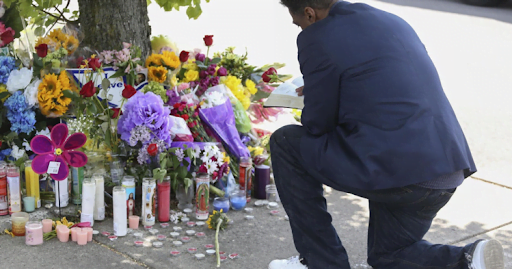
A man reads scripture at the site of a memorial honoring the victims of Saturday’s shooting on Sunday, May 15, 2022, in Buffalo, N.Y. 

She had recently been helping her brother recover from a bone marrow transplant.

 Katherine Massey was 72. Her sister, Barbara Massey, called her “a beautiful soul.”

Heyward Patterson, 67, was a deacon at a nearby church. He’d gone by the church’s soup kitchen before heading to the supermarket, where he offered an informal taxi service driving people home with their bags.

“From what I understand, he was assisting somebody putting their groceries in their car when he was shot and killed,” said Pastor Russell Bell of State Tabernacle Church of God in Christ.

 Celestine Chaney,  65, was a breast cancer survivor, prompting her family to ask people to wear pink ribbons in her honor. She shopped twice a month with her only son, Wayne Jones.

Margus Morrison was 52 and for the last four years worked as a bus aid for First Student.

“He loved kids and kids gravitated to him. He loved his job and would almost never call in,” recalled Regina Patterson, Morrison’s companion for 25 years and with whom he had three children.

Geraldine Talley was 62 years old and from Buffalo.

News Anchor Latrice Currie to Speak at Scenic City Women’s Network May Luncheon May 26 at Mountain City Club

CHATTANOOGA, Tenn.  – Scenic City Women’s Network (SCWN) welcomes LaTrice Currie, News Anchor, Local 3 News, as guest speaker for the SCWN May Luncheon on May 26, noon, at Mountain City Club (729 Chestnut Street in Chattanooga). A delicious plated menu and refreshments will be served.

Currie is from Nashville, Tenn., and is the Noon Anchor for Local 3 News at Noon and 5:30 pm Co-Anchor. She also serves as the Eye On Health Reporter for Local 3 News and is the host of Trends on 3, a weekly public affairs show taking a closer look at issues facing the community. 

Currie serves as ambassador for Go Red For Women and has served on various boards. Some of her many awards include Chattanooga Woman of Distinction, Chattanooga Times Free Press Best of the Best Local Newscast, Hamilton County Outstanding Citizen, just to name a few.

 She says she relies on her faith in her daily decisions, and that she tries to live her life with integrity and carry herself in a positive manner to set a good example for other young ladies who may be watching. Currie is the proud mother of one son and she is married to Darryl Leslie.

Registration is open to the public. Space is limited and registration ends May 24. Register online at SCWN.org, or call (423) 698-6262 for cost and additional details.

The Johnson Group Welcomes Teresa Caro as President

0

Capitalizing on impressive growth and longevity, the award-winning agency is forging a path with fresh leadership to guide future innovation and engagement

Chattanooga, TN– Founded more than 25 years ago in Chattanooga, Tenn., the award-winning marketing, advertising and creative agency, The Johnson Group, announces the addition of Teresa Caro as president. Caro brings three decades of global experience to the firm and will lead the acceleration of the firm’s success in digital innovation. Caro is an expert growth driver and proven leader who has delivered results for multiple companies on the cusp of transformation. 

 “Here at The Johnson Group, we work in concert with clients to deliver results that integrate data, analytics and our proprietary tools to craft effective marketing campaigns,” said Joe Johnson, Chief Executive Officer, The Johnson Group. “Teresa brings a fresh perspective, incredible leadership and bold thinking to ensure we continue to stay ahead digitally and creatively.”

 Caro will guide and motivate new thinking and cutting-edge brand marketing with The Johnson Group team. As an experienced thought leader, Caro plans to build on The Johnson Group’s culture of collaboration to develop employee leaders who deliver exceptional client service and forward-looking creative campaigns. 

 “My entire career has led me to this inflection point,” said Teresa Caro, president, The Johnson Group. “I’ve taken well-established brands and have been that trend-spotter to help them achieve growth targets while keeping who they are at the core. And at the core, The Johnson Group is a receptive and tenacious team. We are ready to roll up our sleeves together to do the work and excel for this agency.” 

With an astute marketing background, Caro leads agency transformation by first understanding what makes each firm uniquely successful for clients and defining what that means for the company now and into the future. As the leader of The Johnson Group, Caro will leverage the team’s strengths in data, digital and creative to forge a path forward. 

Statement on Mass Shooting in Buffalo, NY

0

Brothers,

Anger and disbelief are the first two words and emotions that come to mind as I watch countless hours of coverage about the cowardly acts of one domestic terrorist that have forever changed the lives of 10 families and their community, our community. 

It’s clear that racism and the rise of white supremacy groups in America will continue to threaten the way of life for all of us whose skin is not a certain color. When will the hatred stop? When will the fear of punishment begin to deter individuals from committing such heinous acts?

Unfortunately, I do not have the answers to any of these questions, but I am hopeful that by working together to understand the value of our differences in this dynamic world, instead of allowing those differences to build barriers and manifest hatred, we will one day be able to eclipse hate with love. Love for our family, friends, neighbors, and strangers alike.

Therefore, our programming in our communities around education, economic empowerment, social justice engagement and mentoring is more important now than ever before.  The work of Phi Beta Sigma men must be felt in every corner of our neighborhoods around the world.

But, today, in the aftermath of a different reality, we stand in solidarity with our Brothers in Buffalo, New York as they support the victims and families impacted by the mass shooting at Tops Friendly Market on May 14, 2022. We pray for strength and healing for each person who has been impacted by these horrible events in Buffalo and countless cities around the nation.

I’ve instructed our International Social Action Director, Bro. Malwan Johnson to work with our Social Action leaders throughout the fraternity to help craft an engagement strategy that all chapters and brothers will be able to get behind as we continue to deal with the rise in violent crimes and gun violence in our communities.  

Brothers, let us stand unified and pray for peace for the families and the victims.  We must BELIEVE in our collective power and be the change agents for our communities deserve.  

In Truth and Service,

A picture containing chainDescription automatically generated

Chris V. Rey, J.D.

International President

UTC, Cleveland State Sign Articulation Agreement for Applied Leadership Program

CHATTANOOGA—A new agreement between the University of Tennessee at Chattanooga and Cleveland State Community College offers an easier way for students to pursue a bachelor’s degree.

The articulation agreement for the UTC Bachelor of Applied Science: Applied Leadership program allows Cleveland State students who receive an associate of applied science degree in advance business to seamlessly transfer those credits to the University.

From there, they can continue their studies toward a bachelor of applied science leadership degree. Students can complete the online, accelerated program in 18 months once they meet admissions requirements for UTC.

“The partnerships, the focus on serving the community that we’ve had here, it has had a real impact. We appreciate the opportunity to provide options for students,” said UTC Chancellor Steven R. Angle.

Having a four-year university close to Cleveland State gives students “the most economic and affordable way to complete a bachelor’s degree,” said Cleveland State President Bill Seymour.

The articulation agreement is especially important to students who are employed, Angle said.

“It is an affordable option which, in terms of time, they can take if they continue working,” he said.

Finding the Light to Drive Out Hate

0

Statement by Dr. Gail C. Christopher, Executive Director of National Collaborative for Health Equity, on Buffalo Shootings

WASHINGTON – “Hate always terrorizes. That’s the intention. As an African American woman who came of age during the Civil Rights era, I know at heart how hate works to harm some and paralyze or, at least, to immobilize others. But movement is life. It’s certainly the way forward if Democracy is to survive and its aspirational tenets of equality are to be actualized. This is why we must see hateful acts, and their progenitors, hate speech on all forms of media, as threats to our collective health, well-being and future existence.

We must mobilize as a nation, come together to deny the expression of hate permission to continue expanding, unchecked on multiple airways across this nation. Sociologists probe whether the rises in hate speech can be directly linked to racial violence. This is not about free speech, it’s about freedom to live healthily and permission for democracy to thrive. Communities in Buffalo, El Paso, Atlanta, Charleston and Charlottesville know this in their bones. Their minds and hearts are forever imprinted with the devastating and horrific memories of violence and lives lost loss simply because of their racial or other identities.  

Racial hatred denies our right to exist, to live in loving relationship with ourselves and with one another.  No entity, human or corporate, can be allowed to have or to proliferate that misguided right. Ending racism, in all its forms, is a public health and a national imperative. Governmental action to regulate social media through new mechanisms and to enforce existing laws is urgently needed, now.

But more is required 

The 21st century has ushered in new understanding about how molecular and cellular biology works to sustain life. Chemicals find receptors on our cell membranes before they can enter and catalyze action. No receptor, no effect. We need a parallel in our body politic.  For example, the life-saving drug Narcan, prevents and reverses opioid overdoses by competing at the nine opioid cellular receptor sites. What are the interventions that can knock out receptors for hate? Available research tells us that authentic human engagements and positive meaningful interactions with perceived “others” can reduce fears and biases and, help counter receptivity to hateful narratives and rhetoric. We must mobilize, with clear intention, so hate can no longer find receptors in our hearts and body politic. This work will also help generate the public and political will needed to expedite essential regulatory and enforcement actions that are urgently required. As Dr. King prophetically told us decades ago, “Darkness cannot drive out darkness, only light can do that. Hate cannot drive out hate, only love can do that.”

71-Year Old Man Graduates From USC With a Masters Degree in Teaching

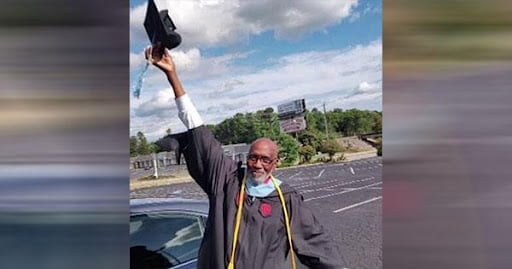
Nationwide — Leroy Harley, a 71-year old African American man from Bowman, South Carolina, has recently graduated from the University of South Carolina after completing his master’s degree in teaching.

It was only 2 years ago when Harley decided to go back to school. In the past years, he has been moving around trying out different career paths since 1993. But when her mother suggested that he try working at a school, he applied at Bethune-Bowman Elementary School where he then worked as a teacher’s aide.

“I immediately got interested in teaching. Like I say, if it’s something new, I am going to try it and see where it takes me,” he told WLTX.

That’s when Harley thought of going back to college to pursue a teaching degree.

“I thought, ‘Why am I going back to school at this age? I should be sorta coasting into retirement,” he said. “But I went on and did it anyhow.”

He credits his success to his own hard work as well as the support from his family, especially his sister Patsy Rhett.

“I am elated at the fact that Lee, after all these years, decided to follow his heart,” she said. “He has. Education has always been a strong part of his life.”

Harley, who is proud of himself and his achievement, encourages others who are also thinking of changing their careers even at a late age.

“I say go ahead and do it, I mean, because… you bring a lot to the table, OK?” he said. “There’s a lot you have to learn at the table but you bring a lot to the table.”

Moreover, Harley plans to teach in the next few years and has no plans to retire yet.

It’s Impossible to Determine Your Personal Covid-19 Risks and Frustrating to Try – but You Can Still Take Action!

0

Malia Jones

Scientist in Health Geography, University of Wisconsin-Madison

“How risky is being indoors with our 10-year-old granddaughter without masks? We have plans to have birthday tea together. Are we safe?”

That question, from a woman named Debby in California, is just one of hundreds I’ve received from concerned people who are worried about COVID-19. I’m an epidemiologist and one of the women behind Dear Pandemic, a science communication project that has delivered practical pandemic advice on social media since the beginning of the pandemic.

How risky is swim team? How risky is it to go to my orthodontist appointment? How risky is going to the grocery store with a mask on if no one else is wearing one and my father is an organ transplant recipient? How risky is it to have a wedding with 200 people, indoors, and the reception hall has a vaulted ceiling? And on and on.

These questions are hard to answer, and even when we try, the answers are unsatisfying.

So in early April 2022, when Anthony Fauci, the president’s chief medical advisor, told Americans that from here on out, each of us is going to have to do our own personal risk assessment, I put my head down on my desk.

Individualized risk assessment is not a reasonable ask, even for someone who does risk assessment for a living, let alone for the rest of us. It’s impossible to evaluate our own risk for any given situation, and the impossibility of the task can make us feel like giving up entirely. So instead of doing that, I suggest focusing on risk reduction. Reframing in this way brings us back to the realm of what we can control and to the tried and true evidence-based strategies: wearing masks, getting vaccinated and boosted, avoiding indoor crowds and improving ventilation.

A cascade of unknowable variables

In my experience, nonscientists and epidemiologists use the word “risk” to mean different things. To most people, risk means a quality – something like danger or vulnerability.

When epidemiologists and other scientists use the word risk, though, we’re talking about a math problem. Risk is the probability of a particular outcome, in a particular population at a particular time. To give a simple example, the chances that a coin flip will be heads is 1 in 2.

As public health researchers, we often offer risk information in this format: The probability that an unvaccinated person will die of COVID-19 if they catch it is about 1 in 200. As many as 1 in 8 people with COVID-19 will have symptoms persisting for weeks or months after recovering.

To embark on your personal risk assessment, as Fauci casually suggested, you first have to decide what outcome you’re talking about. People often aren’t very specific when they consider risk in a qualitative sense; they tend to lump a lot of different risks together. But risk is not a general concept. It’s always the risk of a specific outcome.

Let’s think about Debby. First, there’s the risk that she will be exposed to COVID-19 during tea; this depends on her granddaughter. Where does she live? How many kids at her school have COVID-19 this week? Will she take a rapid test before she comes over? These factors all influence the granddaughter’s risk of exposing Debby to COVID-19, but I don’t know any of them and likely neither does Debby. Given the lack of systematic testing, I have no idea how many people in my own community have COVID-19 right now. At this point, our best guess at community rates is literally in the toilet – monitoring sewage for the coronavirus.

If I assume that Debby’s granddaughter does have COVID-19 on the appointed day, I can start thinking about Debby’s downstream risks: whether she’ll get COVID-19 from her granddaughter; the chances that she’ll be hospitalized and that she’ll die; and the probability that she’ll have long COVID. I can also consider the risk that Debby will catch COVID-19 and then give it to others, perpetuating an outbreak. If she gets sick, the whole hierarchy of risks comes into play for everyone Debby sees after she is infected.

Finally, there are competing risks. If Debby decides to skip the party, there may be risks to her own or her granddaughter’s mental health or their relationship. Many skipped celebrations in many families could negatively affect the economy. People could lose business; they could lose their jobs.

Each of these probabilities is influenced by a cascade of fickle conditions. Some of the factors that shape risks are in your control. For example, I decided to get vaccinated and boosted. Therefore, I’m less likely to end up in the hospital and to die if I get COVID-19. But some risks are not in your control – age, other health conditions, gender, race and the behavior of the people all around you. And many, many of the risk factors are simply unknowns. We’ll never be able to accurately evaluate the whole volatile landscape of risk for a particular situation and come up with a number.

Taking charge of what you can

There will never be a situation where I can say to Debby: The risk is 1 in 20. And even if I could, I’m not sure it would be helpful. Most people have a very hard time understanding probabilities they encounter every day, such as the chance that it will rain.

The statistical risk of a particular outcome doesn’t address Debby’s underlying question: Are we safe?

Nothing is entirely safe. If you want my professional opinion on whether it’s safe to walk down the sidewalk, I will have to say no. Bad things happen. I know someone who tore a tendon in her hand while putting a fitted sheet on a bed last week.

It’s much more practical to ask: What can I do to reduce the risk?

Focusing on actions that reduce risk frees us from obsessing over unanswerable questions with useless answers so we can focus on what is within our control. I will never know precisely how risky Debby’s tea is, but I do know how to make the risks smaller.

I suspect the question folks are really asking is: How can I manage the risks? I like this question better because it has an answer: You should do what you can. If it’s reasonable to wear a mask, wear one. Yes, even if it isn’t required. If it’s reasonable to do an at-home antigen test before you see your vulnerable grandparents, do that. Get vaccinated and boosted. Tell your friends and family that you did, and why. Choose outdoor gatherings. Open a window.

Constantly assessing and reassessing risks has given many people decision fatigue. I feel that too. But you don’t need to recalibrate risks of everything, every day, for every variant, because the strategies to reduce risk remain the same. Reducing risk – even if it’s just a little bit – is better than doing nothing. (The CONVERSATION)