NASHVILLE, Tenn. – The deadline for Tennessee voters to request a ballot to vote absentee by-mail for the Aug. 4 State and Federal Primary & State and County General Election is Thursday, July 28.
“County election commissions are accepting absentee by-mail requests now for the Aug. 4 election,” said Secretary of State Tre Hargett. “If you meet one of the reasons under Tennessee state law to vote absentee by-mail and plan to do so, I encourage you to request and return your ballot early to ensure you meet the upcoming deadlines.”
Voters must meet one of the 14 reasons under Tennessee law to vote absentee by-mail. One of the most common reasons is being 60 years or older. Other reasons include being outside the county where you are registered during early voting and on Election Day or being hospitalized, ill or physically disabled. For the complete list of legal reasons to vote absentee by-mail see the Guide to Absentee Voting on sos.tn.gov/elections.
To receive an absentee by-mail ballot, voters must submit a written request to their local election commission by mail, fax or email. Voters can find the contact information for their county election commission on the Secretary of State’s website, tnsos.org/elections/election_commissions.php.
Instructions for requesting an absentee by-mail ballot and a printable absentee by-mail ballot application are available in the Guide to Absentee Voting on sos.tn.gov/elections. Voters submitting their request by email must attach a scanned copy of their signature.
For the August election, voters casting their ballot absentee by-mail must also request either a Republican or Democratic primary ballot in order to cast a ballot in a primary election. You will only receive the general election ballot if a party is not specified.
Completed absentee by-mail ballots must be returned by mail to your local county election commission. Ballots must be received before the polls close on Election Day, Thursday, Aug. 4. Voters must provide proper postage to return their ballot. Please consult with your county election commission or the U.S. Postal Service to determine the postage needed.
Tennessee voters can easily and securely track the status of their absentee by-mail ballot using the Secretary of State’s Absentee By-Mail Ballot Status Tracker tool. Through this tool, voters can track their absentee by-mail ballot’s status, starting when the county election commission mails your ballot to you and ending when the county election commission has received your completed ballot. Visit the Absentee By-Mail Ballot Status Tracker at tnmap.tn.gov/voterlookup/.
For the latest information on the Aug. 4 election, follow the Secretary of State’s social media channels Twitter: @SecTreHargett, Facebook: Tennessee Secretary of State and Instagram: @tnsecofstate.
For more information about voting absentee by-mail or tracking your ballot, go to GoVoteTN.gov, contact your local county election commission or call the Division of Elections toll-free at 1-877-850-4959.
Allstate and the American Football Coaches Association (AFCA) today announced the nominees for the 2022 Allstate AFCA Good Works Team®. The nominees are 114 student-athletes with exemplary community service, academic dedication and impact on and off the field.
Senior offensive lineman and Chattanooga native McClendon Curits is one of 114 student-athletes nominated for the honor. He is the lone nominee from the Southern Conference
“For 31 years, the Good Works Team has recognized the inspirational work of thousands of young men off the football field,” said Troy Hawkes, executive vice president and general manager, Allstate Sales and Distribution.
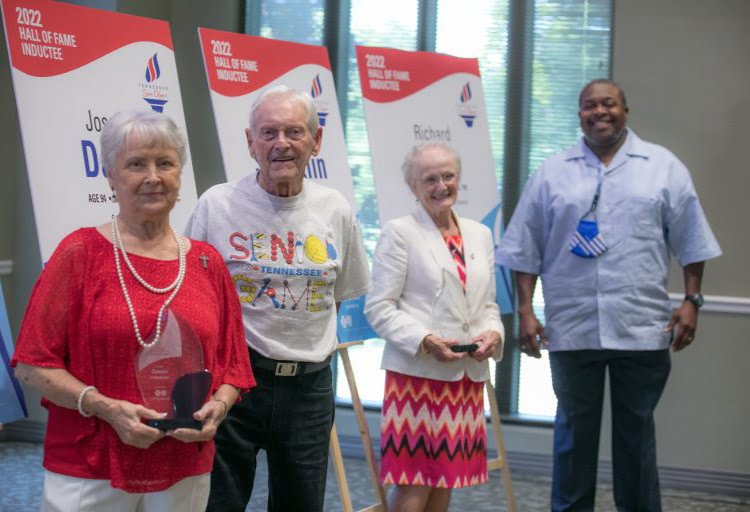
Richard West was one of four athletes and organizers recently inducted into the 2022 Tennessee Senior Olympics (TSO) Hall of Fame during a ceremony held in Franklin, Tenn.
West, 59, is a member of the Chattanooga Parks and Outdoors staff who has dramatically increased athlete participation from the Chattanooga area and has helped with the state finals for more than 30 years.
“When I joined the parks department in 1988, we had very limited participation in the games–just a few team sports with a total of about 40 athletes,” West explained. “My supervisor challenged me to reach out to a wider group of seniors and to build support for them to participate in a larger number of sports. We now have seniors participating in every sport and have about 400 athletes joining our district events.”
West has worked every state final since 1990, and brings a staff of 6-12 to help run the games.
“When I attended my first state finals, I was amazed at the senior athletes, their athleticism and the fun they had at the games,” he said. “At that time, we didn’t have a true senior program at any of our centers. The Senior Olympics inspired me to change that because I saw firsthand, not only was it possible to compete after the age of 55 (the minimum age back then), but it was also necessary for us to better serve our senior population by offering them avenues to compete. And almost everyone was humble in victory and gracious in defeat. I’ve also built great friendships through the games that I will cherish for the rest of my life.”
Photo: (L to R) The 2022 Tennessee Senior Olympics Hall of Fame inductees: Joan Conant (81), Joe Daws (95), Carol Stricklin (78) and Richard West (59).
Besides West, this year’s other inductees into TSO’s 5th class include former nurse Joan Conant of Kingsport, 81; Navy veteran Joe Daws of Nashville, 95; and 78-year-old Carol Stricklin of Arlington, a member of the Age Defyers basketball team.
Each year, four individuals who have demonstrated their long-term commitment to and participation in the games are inducted into the TSO Hall of Fame.
Since 1981, thousands of the state’s top senior athletes have competed in sanctioned District Olympics which are dedicated to promoting healthy lifestyles for seniors through fitness, sports and an active involvement in life. The games feature 20 sports, including basketball, swimming, track and field, tennis, bowling, and pickleball.
The championships are held each spring in greater Chattanooga, Nashville, Knoxville, Memphis, Jackson, Johnson City, Crossville, Columbia, Martin and Athens. TSO’s largest state finals attracted almost 2,000 participants for the week-long sports celebration.
Tennessee Senior Olympics, Inc. is a member of the National Senior Games Association, the largest sporting group in the United States. A 501c3 non-profiit organization, it is endorsed by the Tennessee Recreation and Parks Association. Its mission is “to contribute to the vision of healthy, active, and vital senior adults.”
BlueCross BlueShield of Tennessee has been a sponsor of the Tennessee Senior Olympics for more than 40 years, and established the Hall of Fame program in 2017.
Jacqueline Charles, who has reported on Haiti and the English-speaking Caribbean for the Miami Herald for more than a decade, is the National Association of Black Journalists’ 2022 Journalist of the Year, NABJ announced Friday.
Charles is the first person to win the honor twice, the initial time in 2011 after covering the catastrophic 2010 earthquake in the country that killed thousands.
NABJ’s announcement did not state its reason for Charles’ selection, including it among a list of all of the special honors it plans to present at its Aug. 3-7 convention in Las Vegas.
But Garry Pierre-Pierre, founder and publisher of the New York-based Haitian Times, told Journal-isms, “Jackie has single handedly made the Haiti story relevant. She is a tireless reporter with sources at every level of Haitian society and the international community. She writes with empathy and authority and has run circles around the competition. She is committed to the beat and has rebuffed efforts by larger media outlets to get her to leave The Herald.”
In fact, Charles messaged, “I had a crazy year, including dodging bullets under a table while writing on deadline because of shootings.”
Her body of work in the last year included coverage of the assassination of Haitian President Jovenel Moïse on July 7, 2021, and its aftermath; an earthquake five weeks later and the border crisis in Del Rio, Texas, in which the world saw photos of U.S. Border Patrol agents on horseback using whips to prevent Haitians from entering the banks of the Rio Grande.
“In between there was [an] exclusive with [an] illegally jailed Haiti Supreme Court judge accused by Jovenel in February of trying to kill and overthrow him and later the stories about the kidnapping of 16 Americans and a Canadian missionary,” Charles messaged.
She added, “When you’re honored by your own it always takes on a special significance because it means that my fellow journalists of color truly understand and appreciate what I bring to the table as a journalist. I’m a past chapter president and a longtime NABJ member. NABJ has always been ‘home’ for me. It’s where I listened to other foreign correspondents talking about what it takes to do what I do, so today I’m deeply honored by this recognition and grateful to NABJ and Miami Herald Executive Editor Monica Richardson who supported what was an incredible but tough year on my beat.”
Reproductive health care, including access to birth control and safe and legal abortion care, is an essential part of your health and well-being. While Roe v. Wade was overturned, abortion remains legal in many states, and other reproductive health care services remain protected by law. The U.S. Department of Health and Human Services (HHS) has created a page with accurate and up-to-date information about access to and coverage of reproductive health care and resources. Read the information you need to know below:
(Photo by David McNew/Getty Images)
Check Your Information Sources
Every state has crisis pregnancy centers that pose as abortion clinics or women’s healthcare providers who target people seeking information about pregnancy, birth control, and abortion.
Terminology like “pregnancy resource center” or “crisis pregnancy center” in a business’s title may indicate a fake women’s health clinic. These outfits are technically legal but don’t meet the standards for women’s healthcare. They also don’t present patients with the full range of options — especially not abortion — and offer limited information in a misleading way.
Some websites also position their content as “holistic” without giving information about abortion. For instance, the American Pregnancy Association claims to support pregnancy and wellness on its website and hotline, but does not provide information on the full range of options for terminating a pregnancy.
Resources like the Crisis Pregnancy Center Map and Expose Fake Clinics have searchable lists of predatory crisis pregnancy centers. Check to make sure a clinic isn’t on the list before making an appointment.
Planned Parenthood recommends that you trust your gut: “If something seems fishy, it probably is. And if you ever feel uncomfortable at a clinic, you have the right to leave at any time.” If you want to verify a website you’re unsure about, you can check with Planned Parenthood.
Be Aware of Digital Security and Privacy
Before you begin searching for information about abortion or contraception, you may need to be careful about how and where you search. In some cases, your digital footprint could be used against you.
Use encrypted messaging platforms, such as Signal, when talking to loved ones about birth control or abortion.
Consider using public computers, such as at a library, when researching abortion.
Use internet browsers with added privacy, such as DuckDuckGo.
Turn off location sharing on your phone or computer.
Don’t consent to police searches of your phone. Only a judge can legally compel you to turn over a phone, and it requires a subpoena.
If you usually use Face ID, turning off your phone will disable this feature and require your password, preventing police from accessing your data even if your phone is confiscated.
Remember Abortion Pills
Birth control can fail. Condoms can break. If you miss a period and realize you’re pregnant and don’t want to be, act fast. You can use an abortion pill in the first 13 weeks of pregnancy — about three months. If you’re not sure how long you’ve been pregnant, you can check using this pregnancy calculator from Aid Access.
The abortion pill is also referred to as medical abortion or “Plan C.” The medication is a combination of the drugs mifepristone and misoprostol, and is sold under multiple brands. The nonprofit organization also called Plan C can help you find emergency contraception in your state. If you are unsure of the abortion resources in your area, check this state-by-state guide to abortion guidelines from Abortion Finder. When in doubt, talk with your doctor about birth control and abortion.
Your Reproductive Rights
Below you will find information on your right to access care and have it covered by your insurance or other health care coverage if you have it, where to go if you don’t have coverage, and how to get information if you don’t know.
Most health coverage – whether you have public (e.g., Medicaid) or private health coverage (e.g., coverage through the Affordable Care Act Marketplace or through your employer) – cover family planning counseling, birth control and other preventive services at no cost to you.
Your Right to Birth Control
Under the Affordable Care Act, most health plans are required to provide you with birth control and family planning counseling with no out-of-pocket costs. This includes:
Hormonal methods, like birth control pills and vaginal rings
Implanted devices, like intrauterine devices (IUDs)
Emergency contraception, like Plan B® and ella®
Barrier methods, like diaphragms and sponges
Patient education and counseling
Sterilization procedures
Your Right to Access Abortion Services
Following the Supreme Court decision to overturn Roe v. Wade, access to abortion will depend on the state you live in even more than before.
Medication abortion has been approved by the FDA since 2000 as a safe and effective option. Federal regulation permits medication abortion to be dispensed by telehealth and sent by mail via certified prescribers and pharmacies, in addition to in-person dispensing in clinics, medical offices, and hospitals.
Under federal law, Medicaid will cover abortion services only in the circumstances of rape, incest or if the patient’s life is in danger.
If you need help paying for an abortion, abortion funds may be able to provide financial assistance. Information about abortion funds and resources to help are available at AbortionFinder.org exit disclaimer icon.
If you need information on your state’s laws or legal help, you may consider this website: AbortionFinder.org exit disclaimer icon
Your Right to Access Other Preventive Health Services
Under law, you have the right to access other preventive health services with no out-of-pocket costs under most health insurance plans. Most health insurance plans are required to cover women’s preventive health services, including:
Well-woman visits to screen your health at any time, including a pap smear, breast exam, and regular checkup; *Counseling and screening services; *Breast and cervical cancer screenings;
*Prenatal care, which is care you would receive while pregnant; *Breastfeeding services and supplies; *Interpersonal violence screening and counseling (e.g., sexual assault evidence collection exams); *HIV screening and *STI counseling. (Source: BlackDoctor.org by J.A. Casiano)
Have you ever heard of the slave who voluntarily enlisted in America’s fight for independence and was a critically valuable spy?
Once independence was declared by the 13 original colonies in 1776, the Revolutionary War was fought until 1783. The battle had commenced in 1775, a year earlier, as British troops stationed in Massachusetts had engaged with militias mobilized in Lexington and Concord.
King George III liked the colonial annexes for taxes collected, the lucrative trade, and British power. But he didn’t tolerate any notion of representative government, as suggested by the Declaration of Independence by advancing the “consent of the governed.”
Economic oppression overwhelmed the colonists. England’s new territories brought rich resources and new reasons to tax their consumption for the Crown. Soaring taxes commenced in 1763 to help England pay its debt and continued for over a decade with no colonial representation within the British government.
In 1770, citizens of Boston (population of 16,000 at the time) fed up with 2,000 British troops roaming their streets enforcing the tax laws, witnessed a brawl escalate to a riot called the Boston Massacre. Economic oppressions, met with colonists’ anger, moved the British government to disarm the colonists.
In this churn of conflict, ordinary men and women stepped up, regardless of station in life, to do their part in establishing these United States of America. One such individual was James Armistead Lafayette.
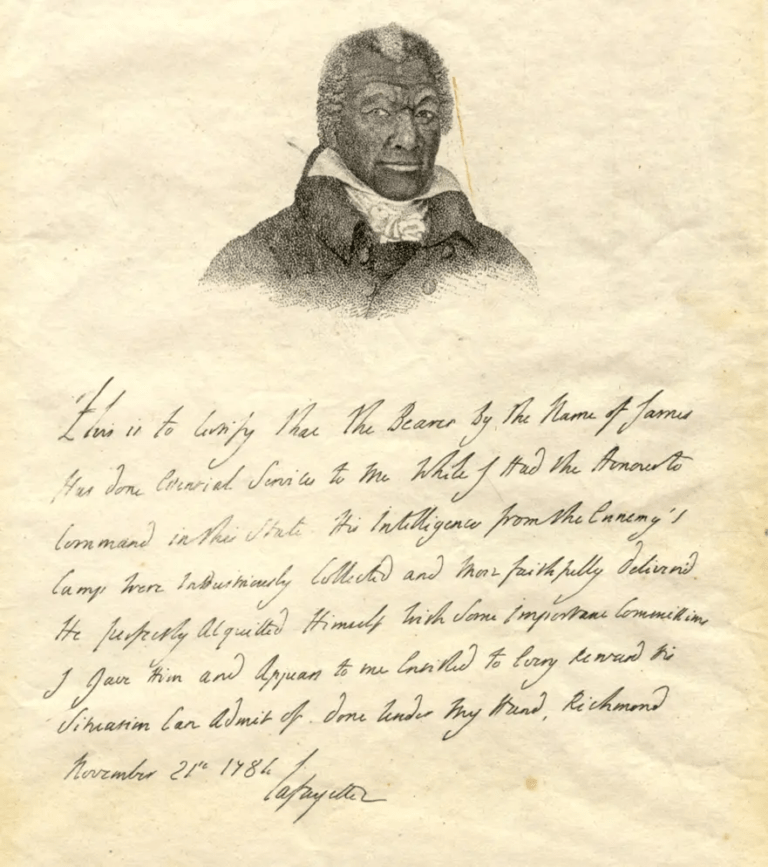
Born into slavery in 1748, in New Kent, Virginia, James Armistead offered his service during the Revolutionary War. The Continental Army stationed Armistead in 1781 to his post, not as a valet or servant, but as a spy.
Stationed within the allied units from France, which joined the colonists to fight Britain for America’s independence, Armistead was under the command of a young man who volunteered his own services to the Continental Army in 1777 as a 19-year-old. His aristocratic name was shortened to Marquis de Lafayette, yet he grew as one of the closest confidantes of General George Washington, who led America to victory.
Armistead was sent by Lafayette directly into the ranks of the British, posing as a runaway slave who was supposed to be spying on the foes of America. Armistead used his masquerade to feed false information directly to the inner circle of General Charles Cornwallis to trick the British, as well as to freely travel back to his own original camp bringing valuable details.
Critical information provided by Armistead to George Washington and Lafayette of British movements led to victory at the Battle of Yorktown, the turning point of the Revolutionary War. James Armistead’s acts of bravery were very much part of America’s victory to be an independent republic.
Following the Revolutionary War, Armistead petitioned the Virginia General Assembly for his freedom. Upon learning of his effort, Marquis de Lafayette penned a testimonial in gratitude for his faithful service. After receiving his freedom– for which he personally fought and established–James Armistead, in tribute, took the surname of Lafayette which he used until his death.
Former Chattanooga City Councilman Moses Freeman said the Minority Health Fair saved his life.
“If I had never gone, I’d probably be dead,” recalls the 84-year-old husband and great-grandfather.
Doctors found three different blood pressure readings in his arms and ankle. The problem alerted him to blockages in his arteries that could have resulted in stroke or death had they not been detected at the event.
The 21st Annual Minority Health Fair is scheduled for Aug. 6, from 9 a.m. to 2 p.m., at the University of Tennessee at Chattanooga’s University Center.
It is the first time in three years that the health fair is meeting in person and it is the first minority health fair since the deaths of organizers Dr. Michael Geer and Chris Ramsey, who will both be honored at the event.
Urinalysis; HIV, allergy, diabetes, cholesterol and blood pressure testing; and body mass index will be among dozens of free medical tests and information available. Register at minorityhealthfair.com for screenings.
The goal is to make healthcare more accessible to everyone, said Tony Sammons, minority health fair organizer.
Compared to whites, blacks in Hamilton County are four times more likely to die from hypertension or hypertensive renal disease, 35 percent more likely than whites to die from stroke, and 30 percent more likely to die from heart disease, according to the Hamilton County Health Department’s 2019 Picture of Health.
It’s been more than 15 years since workers at the health fair noted Freeman’s different blood pressure readings, but he still shares his story to encourage attendance.
Moses Freeman
He celebrates his 85th birthday on Aug. 2 and credits the health fair for extending his life.
“Get up enough courage and energy to check yourself out,” said Freeman. “You won’t regret it.”
What: 21st Annual Minority Health Fair
When: 9 a.m. to 2 p.m. Aug. 6
Where: UTC University Center
Admission: Free
Register online at https://minorityhealthfair.com/
Hey readers, with African American history top of mind, does the name “Barbara Johns” ring a familiar bell with you? If not don’t feel bad, you’re not alone. You see, when African American history comes up there are two realities; first, it gets compressed into February (or recently Juneteenth) and, second, it typically cites the well-deserved names as its founder Carter G. Woodson, Dr. Charles Drew, Rosa Parks, George Washington Carver, W. E. B. DuBois Dr. King and others. So, I figured that perhaps the Barbara Johns’ story of profound unprecedented courage, the focus of this narrative, may pique your interest.
But first for context, consider the following imaginary scenario.
Imagine that you, a 16-year-old, was shaken awake early one morning by your parents who told you to get dressed immediately and ready to leave the house. Within 30 minutes they took you to the bus station and whisked you off to live with relatives in another state 500 miles away. Why? Because the student protest you organized and led in opposition to the recent Supreme Court’s striking down legal abortions led to a fierce backlash, including vile phone threats to your parents and vandalism to your house.
Now put that image aside for now. Let’s shift back to Barbara Johns.
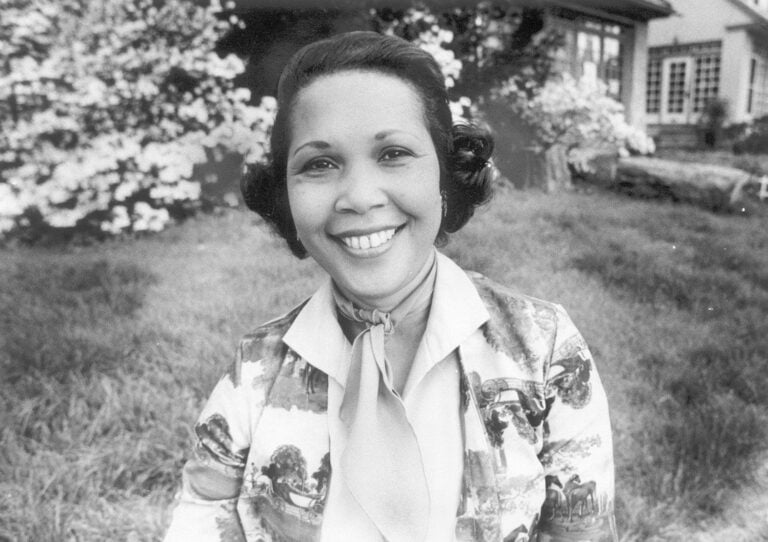
Barbara Johns Powell was born in New York City in 1935. Her family had roots in Prince Edward County, Virginia, where they returned to live. Powell’s uncle Vernon Johns was an activist and minister best known as the pastor who succeeded Dr. Martin Luther King Jr. at Dexter Avenue Baptist Church in Birmingham. Vernon was widely known for his scholarship in the classics, intellect, and outspoken sermons on race, which were ahead of his time. When he visited the family in Virginia, he would ask the children questions about Black history which motivated Barbara to study Black history.
In 1951, 16-year-old Barbara Johns was a junior at the all-Black Moton High School in Farmville. Across town was another school, open exclusively to white students. The resources available to each school and the quality of the facilities were unequal. Barbara’s sister Joan described the conditions at the Black school.
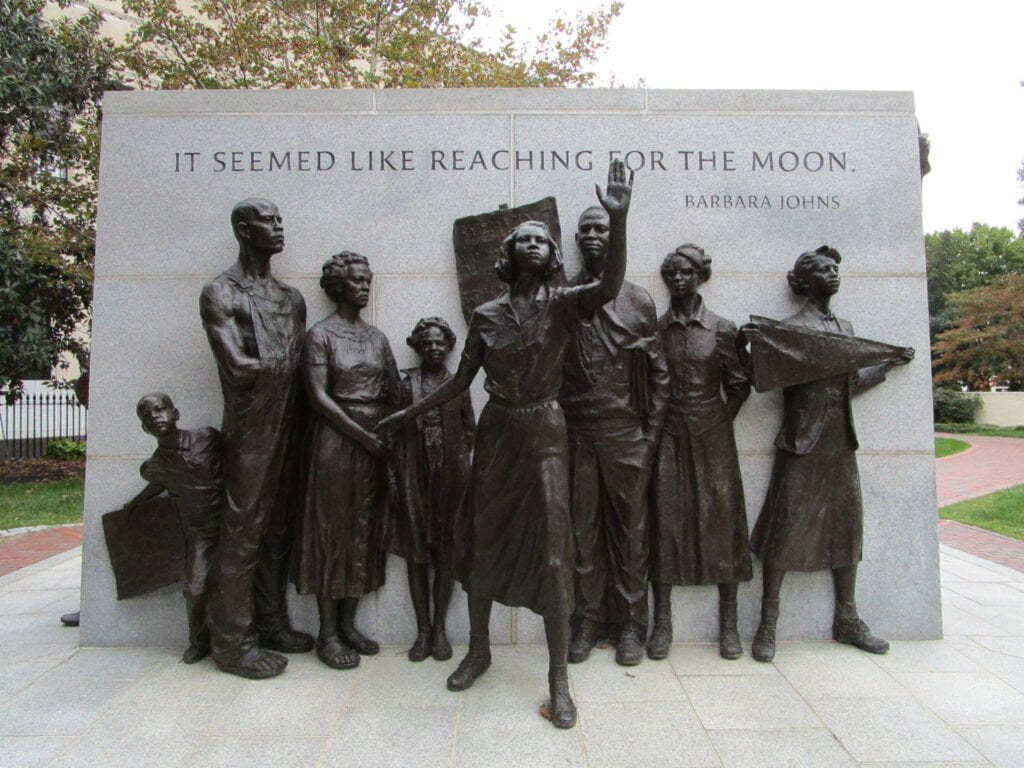
The Virginia Civil Rights Memorial opened in 2008, with Barbara Johns and several other young students prominently featured on one side.
“In winter the school was very cold. And a lot of times we had to put on our jackets. When it rained, we would get water through the ceiling. It was a very difficult setting for trying to learn.”
Parents of the Black students appealed to the all-white school board to provide a larger and properly equipped facility. As a stopgap measure, the board erected several tar paper shacks to handle the overflow of Moton students.
After years of frustration Barbara took her concerns to a teacher who asked, “Why don’t you do something about it?” After months of contemplation, she formulated a plan and met with classmates who agreed to a student strike. On April 23, 1951, the plan Johns initiated was put into action.
They marched to the county courthouse to make officials aware of the differences in quality between the schools and picketed with placards proclaiming, “We want a new school or none at all” and “Down with tar-paper shacks.”
That year lawyers from the NAACP (National Association for the Advancement of Colored People) arrived to help the students. A month later, the NAACP filed Davis v. County School Board of Prince Edward County in federal court. However, the court upheld segregation in Prince Edward County. Not to be deterred, the NAACP appealed successfully to the U.S. Supreme Court, a decision that contributed to the civil rights movement.
For her part in the movement, Johns was harassed and the Ku Klux Klan burned a cross in her yard. Her parents, fearing for her safety, sent her to Montgomery, Alabama to live with her uncle Vernon.
After the strike Barbara later received a degree from Drexel University, married, raised five children and lived for the rest of her life in Philadelphia. She died in September 1991.
The Library of Virginia honored Barbara in 2005 by naming her one of their Virginia Women in History. In a 2017 interview with CBS This Morning, Governor Terry McAuliffe spoke about the Unite the Right rally in Charlottesville, Virginia, with a portrait of Barbara Johns in the background. He called the white supremacists cowards and said:
“Over my shoulder is Barbara Johns who at 16 years old led the revolt at Prince Edward County, Virginia, when we had white schools and Black schools. She said, “Our schools are inferior,” and led a revolt of 400 students in the ‘50s. That is what we need as leaders.”
In 2020, Virginia’s Commission on Historical Statues voted to recommend that a statue of Barbara Johns represent Virginia in the National Statuary Hall in place of the one of Robert E. Lee.
Now… back to the imaginary scenario presented at the beginning. Imagine that that 16-year-old depicted is today your daughter, potentially the next Barbara Johns, who is about to lead a protest against, say, the National Rifle Association; violence against Jews; Muslims; gay people; or appear before millions as a witness to the January 2021 violent insurrection at the nation’s capitol.
…but the angel said, “Don’t be alarmed. You are looking for JESUS of Nazareth, who was crucified. HE isn’t here! HE is risen from the dead!… Now go and tell HIS disciples, including Peter, that JESUS is going ahead of you to Galilee.”
TODAY’S WORD:
When JESUS was on trial before HIS crucifixion, Peter denied that he knew JESUS three times. Peter was so bitterly disappointed in himself, so ashamed of being a coward. Soon after that, they crucified JESUS. Peter never had the chance to tell HIM he was sorry. He had to live with the guilt. But when three women found JESUS’S tomb was empty, an ANGEL told them to go tell HIS disciples and Peter that HE was alive. The only disciple specifically pointed out was Peter. GOD was showing us, “I don’t define you by your mistakes. I don’t cancel your destiny because you’ve failed.” And fifty days later, it was Peter who gave the inaugural message that birthed the CHURCH. You may have made mistakes and failed, as Peter did, but you have to learn to forgive yourself. Quit remembering what GOD has forgiven and forgotten. HIS mercy is bigger than any mistake you’ve made. GOD is saying, “Get back in the game. You can still do what I called you to do.”
PRAYER FOR TODAY:
FATHER, thank YOU that when I make mistakes and fail that YOUR mercy still covers me. Thank YOU that YOU forgive and forget my sins the moment that I ask YOU. I am saying good-bye to the guilt and the shame of the past and believing YOU have something awesome in my future. In JESUS’ Name, Amen.
HAMILTON COUNTY, TN – The Hamilton County Health Department wishes to alert the public to the continued rise in positive COVID cases in our community. Over the past week, Hamilton County averaged 135 new COVID cases per day and is currently classified as having a “high” community transmission level, according to the CDC.
When a county has a high level of transmission, it is recommended that individuals wear masks while indoors in public places, regardless of vaccination status. To protect others, it is extremely important that if you experience or exhibit any symptoms to be tested quickly. Masking continues to be an important tool in slowing the spread of COVID. Masks help slow the spread of illness by reducing the number of virus droplets that may come from someone by sneezing, coughing, singing, talking, or breathing. It is especially important to wear masks because ill individuals may not show symptoms (asymptomatic). Masks also help by reducing the inhalation or breathing in of these droplets by the person wearing the mask; therefore, the overall benefit of wearing masks comes from the combination of reducing the droplets that are spread and protection from breathing them in.
Additional COVID precautions are needed for people at high risk of severe illness, during this time of high community transmission. Because masks have been proven to reduce the spread of COVID, it is of utmost importance to wear masks around friends and loved ones who may be at high risk of severe illness or death from COVID infection. To learn if you or someone you know is considered “high-risk,” please click here. As always, it is important to follow the CDC recommendations for isolation and quarantine, including getting tested if you are exposed to COVID-19 or have symptoms of COVID-19.
The Health Department continues to offer free, take-home COVID test kits at all of our facilities. To see where the Health Department is giving away free test kits, visit us at testing.hamiltontn.gov.
Additional Information & Resources
Masks must be worn inside all Hamilton County Health Department facilities.
Call the Health Department’s COVID-19 hotline at 423-209-8383 if you have questions about vaccinations, testing locations, or if you need isolation or quarantine guidance.