Friday, October 16, 2026
Advertisement
Home Blog Page 101

Barbara Jordan

1936-1996

By Kerri Lee Alexander, NWHM Fellow | 2018-2020

While the world watched during the Impeachment hearings of President Richard Nixon, Barbara Jordan boldly took center stage. As a lawyer, a congresswoman, and a scholar, Jordan used her public speaking skills to fight for civil and human rights. In 1972, Jordan became the first African American woman to be elected to Congress from the South since 1898.

Barbara Charline Jordan was born on February 21, 1936 in Houston, Texas. The daughter of Arlyne and Benjamin Jordan, Barbara was the youngest of three children. Her mother was a public speaker and her father was the pastor of Good Hope Missionary Baptist Church. After attending Roberson Elementary School, Jordan attended Phyllis Wheatley High School and graduated in 1952. Upon graduation, she went to Texas Southern University and earned her bachelor’s degree in 1956. She then went to Boston University to get her law degree. Once she passed her law exam called the “bar,” Jordan began practicing law in Houston Texas. For her first job, she worked as an administrative assistant for a county judge. That same year, she began working on the John F. Kennedy presidential campaign.

In 1962, Jordan began her political career and ran for the Texas House of Representatives. Although she lost the race, she ran again in 1964. However, she lost again so in 1966 she decided to run for the Texas Senate instead. This time, Jordan won and became the first African American woman ever elected to that office. Also, she was the first African American state senator in United States since 1883. During her time as senator she worked to establish a minimum wage law, antidiscrimination statements in business contracts, and a Fair Employment Practices Commission. She was elected president of the Texas Senate on March 28, 1972, making her the first black woman in America to oversee a legislative body. During this time, Jordan was also running for Congress. Winning by 81 percent, she became the first African American in the 20th century to be elected to Congress from the South.

While in Washington, D.C. as a congresswoman, Jordan served on various committees. Starting in 1975, she served three terms on the Judiciary Committee. Jordan quickly became a prominent voice on the Judiciary Committee. As the committee began the impeachment process against President Richard M. Nixon, Jordan gave the opening remarks. In her speech, she stated her reasons for supporting President Nixon’s impeachment and her faith in the Constitution. After her powerful speech, many people surrounded her car, and sent her letters and phone calls to congratulate her. President Nixon resigned from office on August 9, 1974. Following this, Jordan continued to advocate for civil rights protections for many Americans. In 1975, she sponsored legislation that expanded the Voting Rights Act of 1965 to include Latinx, Native, and Asian Americans. A year later, she became the first African American and the first woman keynote speaker at the Democratic National Convention. Jordan continued her political career and began heavily campaigning for Democratic presidential candidate James Earl (Jimmy) Carter. In 1977, Carter won the presidential election against President Gerald Ford. During his term, President Carter interviewed Jordan for the Cabinet position of U.S. Attorney General, but he did not offer her the position. The next year, Jordan decided not to run for re-election to Congress. Instead, Jordan became a professor at the University of Texas in Austin as the Lyndon Johnson Chair in National Policy. She taught in the LBJ School of Public Affairs at the University until the early 1990s. In 1992, she delivered the keynote speech at the Democratic National Convention from a wheelchair because she suffered from multiple sclerosis. Two years later, President Bill Clinton selected her to lead the Commission on Immigration Reform. However, Jordan’s health continued to decline. Although she was very quiet about her private life, many historians suggest that her caregiver Nancy Earl, was also her life partner. Earl was an educational psychologist that traveled with Jordan for nearly thirty years. On January 17, 1996, Barbara Jordan died from pneumonia, a complication of leukemia.

What’s the difference between a Form W-2 and a Form 1099-MISC or Form 1099-NEC?

0

Answer:

Although these forms are called information returns, they serve different functions.

Employers use Form W-2, Wage and Tax Statement to:

•             Report wages, tips, and other compensation paid to an employee.

•             Report the employee’s income and social security taxes withheld and other information.

Employers furnish the Form W-2 to the employee and the Social Security Administration. The Social Security Administration shares the information with the Internal Revenue Service.

Payers use Form 1099-MISC, Miscellaneous Information or Form 1099-NEC, Nonemployee Compensation to:

•             Report payments made of at least $600 in the course of a trade or business to a person who’s not an employee for services, payments to an attorney, or any amount of federal income tax withheld under the backup withholding rules (Form 1099-NEC).

•             Report payments of $10 or more made in the course of a trade or business in gross royalties or broker payments in lieu of dividends or tax-exempt interest or $600 or more made in the course of a trade or business in rents or for other specified purposes (Form 1099-MISC).

•             Report sales totaling $5,000 or more of consumer products to a person on a buy-sell, a deposit-commission, or other commission basis for resale (Form 1099-NEC or Form 1099-MISC).

•             Report payment information to the IRS and the person or business that received the payment. (Source: IRS.gov)

Ms. Shirley’s Christmas Toy and Clothing Drive

Giving Back to Our Community is the mind and heart-set of Mrs. Shirley Gordon 

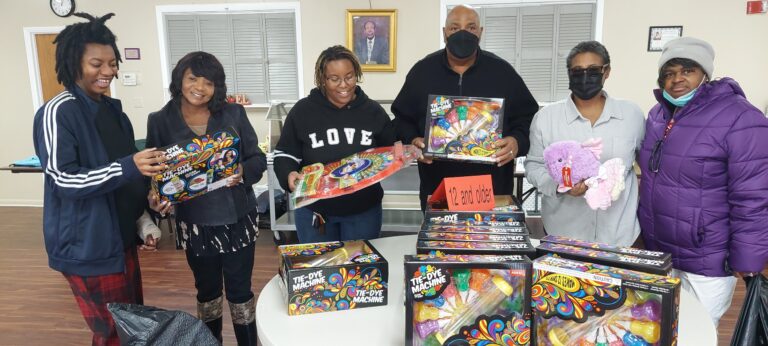
2022 marked the 12th year of Ms. Shirley’s Christmas Toy and Clothing Drive.  This act of love and kindness was started as an honor and tribute to Ms. Shirley’s mother, Bessie Redmond, “a single mother who raised 11 children alone and depended greatly on the help of the community.  She was grateful for assistance in times of need and taught us to ‘give back’ for the help we received” proudly stated Ms. Shirley.

“This event is in its twelfth year and started in my hair salon, ‘Hair Logic’.  Approximately, three years ago a friend and I presented the idea to Pastor Anthony Williams at my church, Greater Friendship MB Church.  He loved the idea and offered the church for me to use as a giveaway location. With the assistance of my church family, as well as contributions from friends and community entities, I have gone from serving 25 families to being able this year 2022 to serve over 100 families!  We make children smile and help mothers provide for their children…just the way the community helped and did for my family when I was growing up.” Families received new toys for both boys and girls  as well as clothing: coats, hats, socks, scarves, etc. 

Inflation, unemployment, the housing crisis and a possible recession: Two economists forecast what’s ahead in 2023

Are we headed for a recession in 2023?

Brian Blank: The consensus view among most forecasters is that there is a recession coming at some point, maybe in the middle of next year. I’m a little bit more optimistic than that consensus.

People have been calling for a recession for months now, and this seems to be the most anticipated recession on record. I think that it could still be a ways off. Consumer balance sheets are still relatively strong, stronger than we’ve seen them for most periods.

I think that the labor market is going to remain hotter than people have expected. Right now, over the last eight months, the labor market has added more jobs than anticipated, which is one of the strongest streaks on record. And I think that until consumer balance sheets weaken considerably, we can expect consumer spending, which is the largest part of the economy, to continue to grow quickly.

[But this] doesn’t mean that a recession is not coming. There’s always a recession somewhere down the road.

Rodney Ramcharan: Indeed, yes, there’s a likelihood that the economy is going to contract in the next nine months. The president of the New York Fed expects the unemployment rate to go up from 3.5% currently to somewhere between 4% to 5% in the next year. And I think that will be consistent with a recession.

In terms of how much worse it can be beyond that, it’s going to depend on a number of things. It could depend on whether the Fed is going to accept a higher inflation rate over the medium term or whether it’s really committed to getting the inflation rate down to the 2% rate. So I think that’s the trade-off.

Will unemployment go up?

Blank: [Unemployment] hasn’t risen much, and maybe it’ll pick up to somewhere close to 4%. Many are expecting something like four and a half percent. And I think that’s certainly possible. And I think that we can see small upticks in the coming months.

But I don’t think it’s going to rise as quickly as some people are expecting, in part because what we’ve seen so far is a lack of labor force participation. Until more people enter the labor market, I think there are going to be plenty of jobs to go around.

What is your outlook on interest rates?

Ramcharan: As people find it more and more difficult to find jobs, or to get jobs as they begin to lose jobs, I think that’s going to dampen spending. And we’re seeing that now as the cost of borrowing has gone up sharply, and the Fed is expecting that.

The expectation is the federal funds rate will go up to 5% by next year. If you tack on another couple of points, because of the risk involved, then the cost to borrow to buy a home could potentially get up to 8% for some people. And that could be very expensive.

And the flip side of this for businesses is there’s potentially going to be a slowdown in cash flow. If consumers are not spending, then the revenues that businesses depend on to make investments might not be there.

The additional piece in this puzzle is what the banks will then do. I think banks are going to begin to curtail the extension of credit. So not only will interest rates go up for the typical consumer and the typical business, it’s also likely that they are more likely to experience denial of credit, and so that should together begin to slow spending quite a bit.

After massive increases in housing prices, what caused them to suddenly drop?

Ramcharan: As the Fed lowered interest rates, there was a massive shift among the population for various reasons. They decided that housing was the right investment or the right thing. And so when 50 million people all collectively decide to buy homes, the supply of homes is reasonably constrained in the short run. And so that led to this massive increase in house prices and in rents.

In the last three months, the housing market has cooled sharply. We’re now seeing house prices beginning to fall. I would imagine, going forward, the housing market cooling is going to be a major driver behind the slowdown in the inflation rate and in real estate investment trusts. So that’s positive.

Our recent election just changed the composition of Congress. How will that affect the economy?

Blank: Certainly, when we have a divided Congress, we’re less likely to see decisions made that involve passing legislation that might support the economy. And I think it’s likely the Republican House is going to become a little bit more conservative with spending.

And so if we do start to see a downturn, I think you’re less likely to see legislation that might help support an economy that could be in need of it. That is going to make the job of the Federal Reserve more important.

How certain are these predictions?

Ramcharan: I just want to be careful here and let your viewers know that we’re making these statements based on theory, because the inflation that we’re experiencing now comes about from a pandemic, and there really is no evidence, there’s no data available, that people can look to to say, “What happens to an economy after a pandemic?” That data does not exist.

So we’re trying to piece together the data we do have with the theories we do have, but there’s a huge band of uncertainty about what’s going to happen. (The CONVERSATION)

With the current U.S. inflation rate at 7.1%, interest rates rising and housing costs up, many Americans are wondering if a recession is looming.

Two economists discussed that and more in a recent wide-ranging and exclusive interview for The Conversation. Brian Blank is a finance professor at Mississippi State University who specializes in the study of corporations and how they respond to economic downturns. Rodney Ramcharan is an economist at the University of Southern California who previously held posts with the Federal Reserve and the International Monetary Fund.

Both were interviewed by Bryan Keogh, deputy managing editor and senior editor of economy and business for The Conversation. Below are some highlights from the discussion. Answers have been edited for brevity and clarity.  (Watch the full interview here.) (The CONVERSATION)

The Scenic City Announces Litter Efforts

0

Chattanoogans, be prepared to see efforts to keep our streets and neighborhoods less cluttered with litter in response to public complaints heard for several months.

“Tennessee Trash” was a 1976 public service campaign launched to shame those who carelessly littered. The anti-littering campaign featured a driving beat and lyrics that left no question as to the public persona of litterers. This PSA was referenced twice in the Chattanooga City Council Agenda Session by the Parks and Public Works Committee Chairman, Councilman Isaiah Hester as something that may again be needed.

Chattanooga is still referenced as “The Scenic City.” Yet many of our roadsides traveled by citizens and visitors alike are more similar to the images seen in the Tennessee Trash video referenced by District 5’s Councilman Hester. During the report regarding the City Council’s Parks and Public Works Committee, Councilwoman Carol Berz was first to speak to the “tremendous amount of litter around” while pinpointing locations where panhandlers stand for visibility being among the worst.

Spokesmen for the Public Works Department noted that the 311 system was still best to report such isolated incidences but cautioned that many roads in question were owned and maintained as state roads by the Tennessee Department of Transportation. The Council learned an operational agreement with TDOT was not renewed due to insufficient reimbursement for the services rendered for state roads like East Brainerd Road, Lee Highway, Hixson Pike, and Highway 58.

Councilwoman Jenny Hill, representing District 2, shared an anecdotal incident of witnessing garbage thrown from a car stopped at a street intersection in North Chattanooga. Her thoughts were, “Who raised you?” Well, the Tennessee Trash ad may, indeed, be in order, as Councilman Hester observed.

The PSA opened with “He’s a little bit of you, he’s a little bit of me” bringing the issue of littering to the level of who creates the problem – citizens who litter rather than properly dispose of waste. The toe-tapping ditty declared, “Lord, there ain’t no lower class than Tennessee Trash” followed by the chorus, “Tennessee Trash! Messin’ up the highways! Tennessee Trash! Junkin’ up the byways!” as a disheveled man drives an open-air rolling wreck with garbage of all sorts is tossed, leaving a wake of rubbish.

The response of the Public Works Department is to revive a program from twenty years back which resumed January 30 that sets a schedule for pickups rotating throughout the city limits in addition to the 311 system.

Mr. Rick Colston provided an update before the Council outlining the resurrected program that divides the geography of Chattanooga into four areas with each area assigned specific dates for the collection of bulk items, leaves, brush, as well as roadside litter pickup.

Find your area and the scheduled dates for pick up by clicking and navigating the interactive map provided and expect to see signs in your neighborhood the week prior to your pickup dates.

Chattanooga should always be the Scenic City. It will be up to us to keep it that way. (R. Smith/2023)

Brush, Leaf, and Bulk Trash (chattanooga.gov)

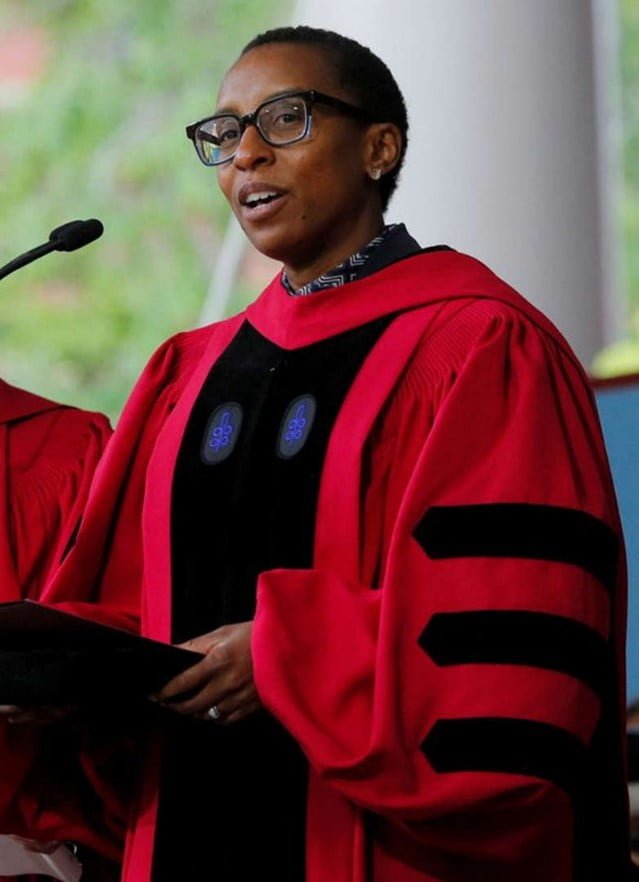
Harvard names new president, first Black woman to hold top job

0

BOSTON (Reuters) -Harvard University on Thursday named Claudine Gay, the school’s dean of Faculty Arts and Sciences, as its 30th president, the first Black person and only the second woman to hold the job.

Gay, the daughter of Haitian immigrants who joined Harvard as a professor in 2006, succeeds Lawrence Bacow as president of the prestigious, nearly 400-year-old Ivy League university. She will take over in July 2023.

“Claudine is a remarkable leader who is profoundly devoted to sustaining and enhancing Harvard’s academic excellence” Penny Pritzker, secretary of the U.S. Commerce Department under President Barack Obama and chair of the search committee, said in a written statement.
Gay, 52, will step into the job in Cambridge, Massachusetts as the university faces challenges to its admissions policies.

The U.S. Supreme Court has agreed to consider a 2014 lawsuit claiming that Harvard violates the U.S. Constitution and discriminates against Asian students by considering the race or ethnicity of applicants. Many legal experts believe the conservative-leaning top court will agree.
Harvard argues that eliminating race as a consideration would hamper its efforts to create a more diverse student body.

The university has also been criticised for so-called legacy admissions favouring children of alumni, big donors or athletes.
“With the strength of this extraordinary institution behind us, we enter a moment of possibility, one that calls for deeper collaboration across the University, across all of our remarkable Schools,” Gay said in a written statement.

“There is an urgency for Harvard to be engaged with the world and to bring bold, brave, pioneering thinking to our greatest challenges,” she said.
Harvard’s website lists tuition for full-time students as$54,768 per year, although many students are eligible for grants or scholarships.

The university, with an endowment for 2022 of $50.9 billion, was founded in 1636 and is the oldest higher learning institution in the United States. It counts eight U.S. Presidents among its alumni, including Obama.

(Reporting by Ross Kerber and Dan Whitcomb Editing by Diane Craft and David Gregorio)

What to do if you’re arrested abroad

By Christopher Elliott
Albert Schilf did not think the small can of pepper spray in his jacket would become such a big problem when he drove from D.C. to Quebec City in September.

“When I emptied my pockets to go through security at the provincial capital, I notified the guards about the spray,” he says. “I thought they might confiscate it, which they did. But they also arrested me.”

Pepper spray is an illegal weapon under Canadian law. Violators can face up to 10 years in prison. Schilf, a retired federal employee from Columbia, Md., says police released him after questioning. But it doesn’t always end so well.

For example, there is the case of Marc Hilliard Fogel, the American teacher arrested in Russia for possessing medical marijuana. And, of course, there’s Brittney Griner, the WNBA star finally released last week in a prisoner exchange after being detained in Russia for about 10 months.

Griner had been arrested for having vape cartridges with a small amount of cannabis oil. Many of these cases involve countries with regimes hostile to the United States, including Iran, Russia and Venezuela.

Every year, experts say, thousands of Americans like Schilf are arrested abroad for unknowingly violating another country’s laws.

In Schilf’s case, he says he brought pepper spray to Canada for self-defense. “I carry it in my pocket when my wife and I go for walks,” he says. “Happily, I have never had to use it.”

The experience with Canadian authorities was not unpleasant, he says. “They were very polite,” he recalls. “They took me into a small room, where I was detained and questioned for more than an hour, so they could get information for their report.”

Schilf says police told him they would probably drop the charges but would notify him by mail. The process, he adds, could take months.

“I don’t know what will happen,” he says, “but I think people should be warned: Always check your pockets before you cross the border.”

What to do if you’re detained overseas

If you get arrested, ask local authorities to contact the nearest U.S. Embassy or Consulate. It can send you a list of English-speaking attorneys and reach out to family or employers to let them know about your situation.

State Department representatives visit detained U.S. citizens to ensure they are getting adequate medical care and provides reading material and vitamin supplements where appropriate. You can find a full list of services on the State Department site.

But the State Department generally can’t get you out of jail or cover your legal expenses, experts say.

“Only in extraordinary circumstances is it possible that they will help with the expenses,” says Richard Brandenstein, a New York attorney specializing in administrative law.

You should always remain calm if you’re detained.

“If you are arrested, be respectful,” says Bob Bacheler, managing director of the medical transport service Flying Angels. “As a rule, unless there is a reason for the local authorities to make an example of someone, they are looking to clear their docket.”

If authorities can collect a fine and send you home, that’s usually their preference. That’s particularly true for countries that host a lot of foreign students. The last thing they want is a reputation for arresting visitors for minor violations, he says.

Under the Vienna Convention on Consular Relations, you have the right to have your home consulate notified when you’re detained.
“Usually, this means that the arresting state will call the consulate and let the home state know the person is under arrest,” says Michael Benza, a senior instructor at Case Western Reserve University’s law school.

What could get you arrested while abroad

Atkins, the attorney in Philadelphia, recently handled two cases where Americans were arrested at the airport in Mumbai because of their phone. Possessing certain satellite phones without approval is illegal for foreign nationals under Indian law. He says that, without immediate legal assistance, both travelers would have faced long incarcerations.

Even having cannabis remaining in your bloodstream is illegal in some countries. For example, in the United Arab Emirates, the presence of drugs in a blood or urine test is treated the same as possession.

A minor traffic accident can also land you in jail. For example, if you get into an accident with your rental car in Mexico and there’s a physical injury, authorities may arrest the drivers of both cars. An innocent tourist could be jailed until authorities could sort out the case, Atkins says.

How to avoid legal problems on vacation

You can take a few steps to prepare for legal problems abroad. One is to register for STEP, the State Department’s Smart Traveler Enrollment Program. Sharing a few details about your trip allows the government to contact your next of kin if you’re arrested.

Some travel insurance plans offer personal liability coverage that can pay for third-party bodily injuries and property damage that you cause. They may also include 24/7 legal consultation and referral to a local attorney for arrests or other legal problems. An umbrella insurance policy can help cover your defense costs when someone sues you for damages to their property or injuries caused to others in an accident.

“But read the policy carefully to make sure it doesn’t exclude claims from abroad,” says Chiranth Nataraj, founder of the insurance company Visitor Guard.

There are international travel legal assistance services that can help. A basic plan from Legaroo costs $5 a day and includes five hours of legal assistance for up to two events.

Alex Thompson, CEO of Legaroo, says his company kept busy during the pandemic dealing with fake coronavirus tests. Now that the pandemic has eased, the problems have returned to normal.

“It’s traffic tickets, car crashes, loss of documentation, smoking marijuana, bar fights,” he says.

ouble is by following the law. The State Department’s country information pages list most rules and regulations that could land you in prison.

Research your destination’s laws, paying close attention to restrictions on medications, the amount of cash you can bring in and out of a country, and cultural norms.

“No jumping in Roman fountains or naked photos at temples,” warns Christina Tunnah, a general manager in marketing and brands at World Nomads.

Christopher Elliott is an author, consumer advocate, and journalist. He founded Elliott Advocacy, a nonprofit organization that helps solve consumer problems. He publishes Elliott Confidential, a travel newsletter, and the Elliott Report, a news site about customer service. If you need help with a consumer problem, you can reach him through his consumer advocacy site or email him at chris@elliott.org. This story originally appeared in the Washington Post.

U.S. Postal Service Honors the Late Civil Rights Leader Rep. John Lewis With a Stamp

0

By Vanessa Romo
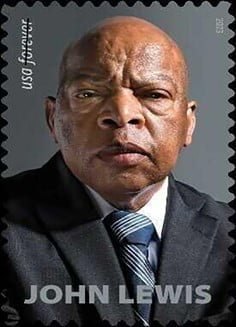
WASHINGTON, DC — Civil rights giant and former U.S. Rep. John Lewis, who spent decades fighting for racial justice, will be honored with a postage stamp next year.

In a recent announcement, the U.S. Postal Service said the stamp “celebrates the life and legacy” of the leader from Georgia, who risked his life protesting against segregation and other injustices in the violent Jim Crow-era South.

“Lewis spent more than 30 years in Congress steadfastly defending and building on key civil rights gains that he had helped achieve in the 1960s. Even in the face of hatred and violence, as well as some 45 arrests, Lewis remained resolute in his commitment to what he liked to call ‘good trouble,’” USPS said in a news release.

In March of 1965, then-25-year-old Lewis led a march across the Edmund Pettus Bridge from Selma to Montgomery alongside other civil rights leaders, including Martin Luther King Jr. The peaceful protest calling for equal voting rights came to be known as “Bloody Sunday” after Alabama State Troopers descended on the non-violent demonstrators in a brutal attack that left Lewis with a cracked skull.

His public service career spanned nearly 60 years. As a young student he joined lunch-counter protests; later, he became a member of the Freedom Riders; and at 21, he was the youngest speaker at the March on Washington. After serving on the Atlanta City Council, Lewis was elected to Congress where he spent more than 30 years representing the Atlanta area in the House of Representatives.

He died at age 80 in 2020 after suffering from advanced-stage pancreatic cancer.

USPS said the stamp features a portrait of Lewis taken by Marco Grob for Time magazine.

Violated and betrayed….Voices of HBCU parents!

0
Terry Howard

Winston-Salem State University (WSSU), a HBCU (Historically Black College and University), my alma mater, was in the headlines recently, and not for all the right reasons.

But first, what do the following people have in common with yours truly? Pro basketball superstars Earl “The Pearl” Monroe, the Phoenix Sun’s Chris Paul, and TV sports announcer Stephen A. Smith?

The answer? Although I’m separated from them by millions of bucks, we all graduated from WSSU.

Now while on the subject of WSSU, tack on the name of one of its current students, Lellia Hamoud, the protagonist in a recent bruhaha at WSSU who ended up hand-cuffed and forcibly removed from a classroom by a white policeman after a disagreement with a white professor. The video evoked national outrage.

But to cast that incident into a broader racial context, consider this: According to November FBI statistics, more than 57 HBCU schools have received bomb threats this year. I repeat, 57 institutions…this year alone. Among those well-known universities are Tuskegee, Howard, Morehouse, Spelman as well as the lesser known. (Doubtful readers should go to Google to see the entire list of those schools).

Now to be fair, predominately white, and faith-based institutions have received bomb threats as well but for reasons other than race.

To broaden the perspective of what’s going on these days it was not that long ago when a busload of female athletes from Shaw University, another HBCU, was stopped and searched in South Carolina on the way to an event in Georgia. Nothing illegal was found in a search of the girls’ luggage ….NOTHING!

And more recently, a white professor at Tennessee State, another HBCU school, was caught on tape leaning over and yelling “get out of my class” to a Black student.

So with all that said, I reached out to several African American graduates and parents of former or present young people now attending HBCU schools; “Wali” a Morehouse graduate with two daughters today at Spelman; “Lewis,” whose daughter graduated from North Carolina A&T State University; “Kelly,” whose daughter attended Bennett College, a son who also attended A&T, and a daughter who attended WSSU. Here’s what they told me after they watched the video:

WALI: Because of its location near the inner-city, we had to deal with crime on campus when I was at Morehouse. But if you fast forward to today, we’re dealing with an entirely different enemy, another layer of threats posed by white supremacists. The difference now, unlike back then, is that racism is at the core of what’s happening today.

LEWIS: I watched that clip of the incident and could not shake the image of my daughter being treated that way when she was at A&T. Although she had the grades to get into any school she wanted to, one of the reasons she chose a HBCU school was because we all thought she’d be safe there. Now this.

KELLY: Sickening. I live in Winston-Salem not far from WSSU. I feel betrayed by what I saw on that video and feel that the situation could have been handled differently. It was no worse than a home invasion because for many students the HBCU is their home away from home. Can you imagine the pain her parents, the ones who worked hard to pay her tuition, felt watching their daughter being humiliated that way?

WALI: As Black fathers, we dread one day receiving a terrifying call about something bad that happened on campus to one of our kids. One of the main reasons HBCU schools have drawn so much recent interest from talented African American students, some of whom were accepted by elite Ivy League schools, was to avoid mostly white schools where they are sometimes subjected to racism. You would think that HBCUs would be a refuge, but not anymore.

LEWIS: We live not far from the Howard University campus, so I was shocked to hear about the spikes in bomb threats there. And yes, I heard that they narrowed the threats as coming from a few teenagers. But if that’s true it begs the question of the culture in this country that made them behave that way. No, I’m not willing to let the culture or the parents who raised those kids off the hook.

KELLY: I believe that the incident at WSSU will have a negative impact on the school’s ability to attract Black students. Can you imagine hard-working parents having to worry not only about the physical safety of our kids but the potential for acts of hate we never thought would happen on HBCU campuses?

NOTE: The Biden administration has beefed up support for HBCUs in the aftermath of bombing threats with funds to beef up campus security measures and bomb threat training for staff and administration.

But what else could we do? I posed that question to Wali, Lewis, and Kelly.

WALI: At a minimum, I encourage parents of potential HBCU students to exercise due diligence when making college decisions. Unfortunately, since there’s the possibility that Black kids may experience hate on both predominately white and HBCU campuses, you may have to “pick your poison” in making a choice. But that’s where we are today.

LEWIS: I agree with Wali and suggest that parents should research the location of the schools and incidents of crime on the campus and nearby communities and factor those results into their decision.

KELLY: I say this partly in jest but seriously, parents should make sure that their kids are armed with phone cameras so that they can immediately snap pictures of perceived acts of bigotry. As we saw in the George Floyd case, videos don’t lie and can be the best weapon for calling attention to acts of hate.© Terry Howard is an award-winning writer and storyteller. He is also a contributing writer with the Chattanooga News Chronicle; The American Diversity Report; The Douglas County Sentinel; Blackmarket.com; co-founder of the “26 Tiny Paint Brushes” writers’ guild; recipient of the 2019 Dr. Martin Luther King, Jr. Leadership Award, and 3rd place winner of the 2022 Georgia Press Award.

UTC, Hamilton County Schools Collaborate to Create University High

0

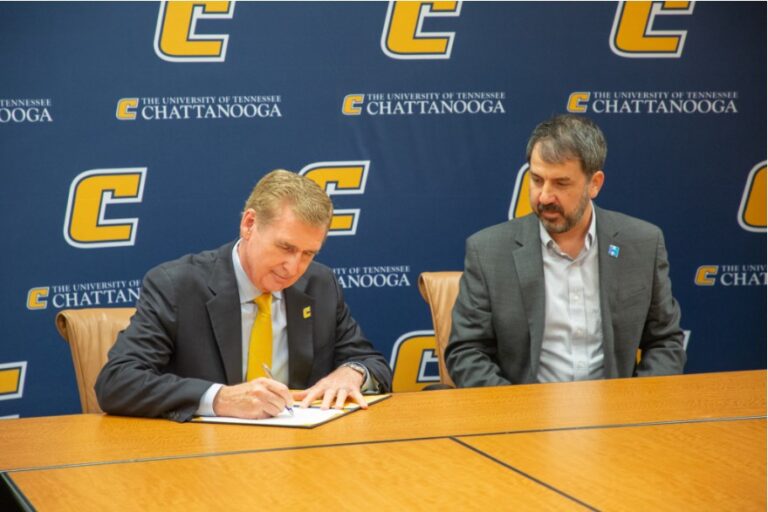
A college pipeline for high school students who might not have considered a four-year university education is the goal of a new partnership between Hamilton County Schools and the University of Tennessee at Chattanooga.
 
Debuting in fall 2023, University High is a Hamilton County Schools initiative headquartered on the UTC campus serving students and their families at no cost to them. An initial cohort of 50 high school juniors will enroll in college-level courses taught by UTC faculty and directly supported by high school courses taught by Hamilton County School teachers.
 
After two years in the program, University High students will earn 14 to 20 college credit hours. Courses will prepare students for future UTC classes while meeting high school graduation requirements.
 
The next class of high school juniors will arrive at UTC in fall 2024, with the campus supporting 100 students at that time.
 
Through shared collaborations between UTC and Hamilton County Schools, the program’s cost is supported financially through grants and pooled resources between both institutions.
 
Admission to University High is open to all Hamilton County Schools students. Applicants will be evaluated case-by-case to help recruit and support students seeking more in-depth learning. To be considered, students must have a minimum 3.0 GPA (on a 4.0 scale) and provide two letters of recommendation.
 
“We are delighted University High is being launched,” said Dr. Jerold Hale, UTC provost and senior vice chancellor for academic affairs. “This is an important partnership between Hamilton County Schools and UTC. It will help talented local students with college readiness as they complete high school while also reducing their time to college degree completion. I look forward to welcoming the students to campus and am confident they will flourish.”
 
University High students will have full access to all UTC student support services and engagement opportunities, including University Health Services, the UTC Library, the Center for Career and Leadership Development, the Aquatic and Recreation Center, and on-campus events.
 
At the same time, University High students will remain eligible to participate in extracurricular activities at their zoned high school.
 
University High program highlights will include:

  • A daily advisory structure called the ACES Lab, dedicated to advisory, college prep, experiential learning and support.
  • On-campus experiences via learning labs across UTC departments to build pathways toward continued higher education.
  • Place-based learning and internship opportunities within the community.

“University High will help us provide increased opportunities and access to students across Hamilton County, including those who have not always had a clear pathway to a four-year degree,” said Dr. Justin Robertson, superintendent of Hamilton County Schools. “With an emphasis on a personalized educational experience, University High will allow every student to help design their own personal pathway through high school classes, UTC courses, their personal projects, and internships. This allows each student to thrive in a way that can lead to their own future without limits.”
 
University High will be staffed by one principal, one counselor, four certified teachers and one administrative assistant—all employed by Hamilton County Schools and housed on the UTC campus.
 
Hamilton County Schools Director of Innovation and Fine Arts Grant Knowles and Dr. Shewanee Howard-Baptiste, UTC vice provost for academic outreach, have collaborated for over a year to coordinate this program.
 
“What is intentional about University High is supporting students who wouldn’t necessarily see themselves as heading towards a four-year university and attending UTC,” Knowles said. “We have a lot of prospects that will become first-generation college students or students that financially would never be able to attend a four-year institution. In some cases, there are students who have not really loved high school in the traditional sense; now, they are really excited about this opportunity.
 
“This is a new pipeline in attracting new students who wouldn’t have seen themselves in this role before.”
 
Howard-Baptiste said University High creates an opportunity to support equity in action.
 
“We will take into account the totality of the student: Where they come from; where they currently are; what their interests and passions are; how we can create a school program that will help them thrive,” Howard-Baptiste said. “Both organizations are committed to changing the lives of students and their families. We believe that University High has the capacity to recruit more diverse students and their families to this campus so that they feel that UTC is their first choice for higher education.
 
“These students will be UTC students. They will have a UTC ID and access to all the resources on our campus that help support our students. We want our University High students to feel like UTC students in every sense of the word.”
 
UTC leadership is finalizing office space and academic classrooms to support University High.