Thursday, October 15, 2026
Advertisement
Home Blog Page 86

Hamilton County Schools Hold Better Together Service Day

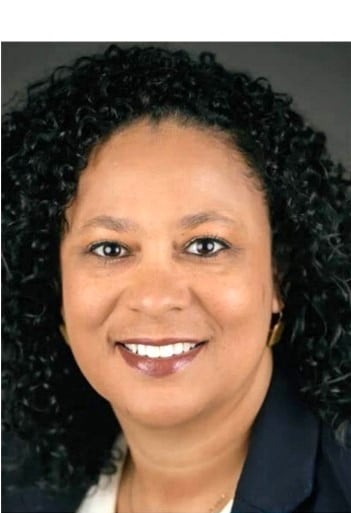
Dr. Sonia Stewart, HCS Deputy Superintendent

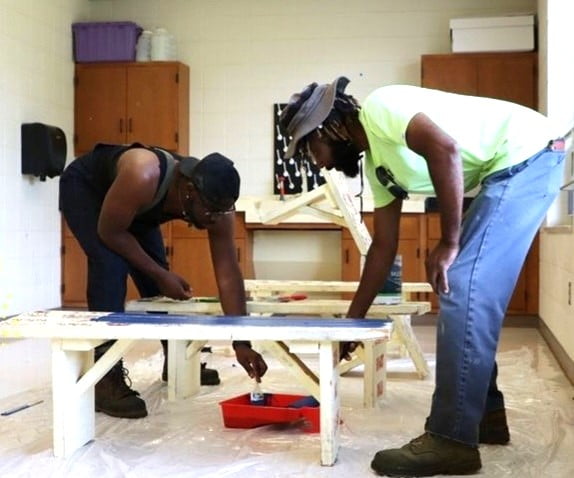
Hamilton County Schools (HCS) held its annual Better Together service day last Saturday, to help ensure students walked into facilities that were ready to welcome them on the first day of school.

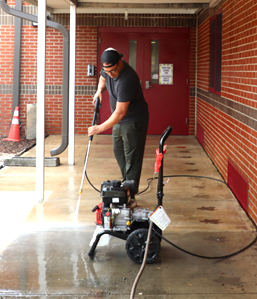
More than 30 schools across Hamilton County submitted projects and sought volunteers. Volunteers helped complete campus beautification projects such as landscaping, painting and pressure washing, as well as organizing classrooms.

“We know we are better when we connect with our students and families,” said HCS Deputy Superintendent Dr. Sonia Stewart. “Our community’s support of this initiative over the past few years has helped create a welcoming space for our students. I am grateful for a community that is dedicated to providing for our kids in all ways.”

“We want kids to walk in on the first day and be proud of their school and excited for the first day of learning,” said Kate Skonberg, family and community engagement coordinator for the district. “This annual event gives our community an opportunity to come together to support our schools and students. It is imperative to student learning to start the year right and provide a sense of connection for our students, families and community.”

Left, during Hamilton County Schools’ annual Better Together service day last Saturday, volunteers helped complete campus beautification projects such as landscaping, painting, and pressure washing, as well as organizing classrooms.

The Better Together service day is part of the district’s Opportunity 2030 commitment Every Community Served and First Day Ready initiative to make sure students, families, and schools are prepared for the first day of school. Students in Hamilton County Schools returned to the classroom on Aug. 9.

The next generation: MOC Academy celebrates its second year at UTC

By Sam Lennon

Donald Webb has spent his past two summers mentoring the next generation of students at the University of Tennessee at Chattanooga.

Webb is a junior at UTC majoring in elementary education with a minor in ESL (English as a Second Language) from Murfreesboro, Tennessee. In 2022, he was recruited to be a mentor for the first MOC Academy.

“MOC Academy stands for Men of Color Academy. It’s like a head start for us men of color,” said Webb.

MOC Academy starts with a jam-packed summer session. Incoming freshmen stayed on campus for the month of July and participated in all sorts of events. They visited the zoo, the Hunter Museum and many other Chattanooga staples.

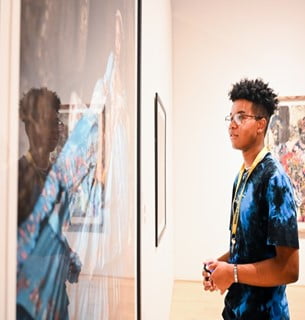
Incoming freshman J’Tory Matthews, a member of the second MOC Academy cohort, visited the Hunter Museum of American Art as part of his July introduction to life at the University of Tennessee at Chattanooga. Photo by Angela Foster.

Participation in MOC Academy is completely free, with housing, meals and events provided to the students at no cost.

The goal is to help them acclimate to UTC and Chattanooga by building connections through fun and educational activities

“In the first year of college, you don’t know who you’re going to meet. You’re scared, and you’re away from home. MOC Academy helps you get to meet new people before you come to college, so you already have some connections when you get there,” said Webb.

There is also a strong mentorship aspect to the program, where students of color who have been at UTC for at least a year help lead these new students.

“It’s a lot like a ‘Big Brother’ program because we are a bit older than them, and if they ever need us throughout the year, we are here,” said Webb.

For two students, the “Big Brother” aspect is quite literal.

Andy and Rudy Tomas are brothers who have been living in Chattanooga for the past eight years.

Rudy Tomas, the younger of the two, said they are “a year, one month and two days apart.”

Andy Tomas was part of the first cohort of MOC Academy students last year. He is a management major starting his second year at UTC. Now, he has helped to guide his younger brother through the same program that made him feel at home at UTC.

The brothers are originally from Guatemala. “We used to move basically every other year between the USA and Guatemala,” said Andy Tomas.

They moved back and forth from Guatemala, Kentucky, Missouri and Tennessee before settling in Chattanooga, but most of their extended family still lives in Guatemala. The brothers are both first-generation college students.

“My dad had two or three years of elementary education, and my mom only had one year. I’m a first-generation elementary, middle school, high school and college student,” said Andy Tomas.

Being the first college students in their family means that the support structure that MOC Academy provides is even more valuable. In addition to bonding activities and exploring what Chattanooga has to offer, MOC Academy enrolls the students in a course designed to teach them more about the college experience.

It is a one-credit-hour class about navigating academia, including topics like professionalism, the purpose of a college education and academic opportunities with an emphasis on educational and career planning.

MOC Academy is not limited to July. After the summer session is over, the 17 students in this year’s cohort will continue to receive support throughout the academic year and participate in events that encourage engagement on campus.

The network they become a part of at UTC can also lead to other opportunities. In addition to his job as a mentor, Andy Tomas will be working as one of the first Spanish-speaking tour guides at UTC. As he put it, “Those connections are coming in handy.”

The mentorship received is likely the most valuable among MOC Academy’s benefits. The mentors are passionate about the first-year students, especially during their busiest month of the summer.

“Maybe I’m tired at the end of the day, but I’m still going to make sure they’re good. I make sure I’m active enough to hang out with them, play games or just have a conversation with them at nighttime. No matter how long it takes,” said Webb.
Interested in becoming a peer mentor? Click here to apply.

Urban League Project Ready students place second in national competition

0

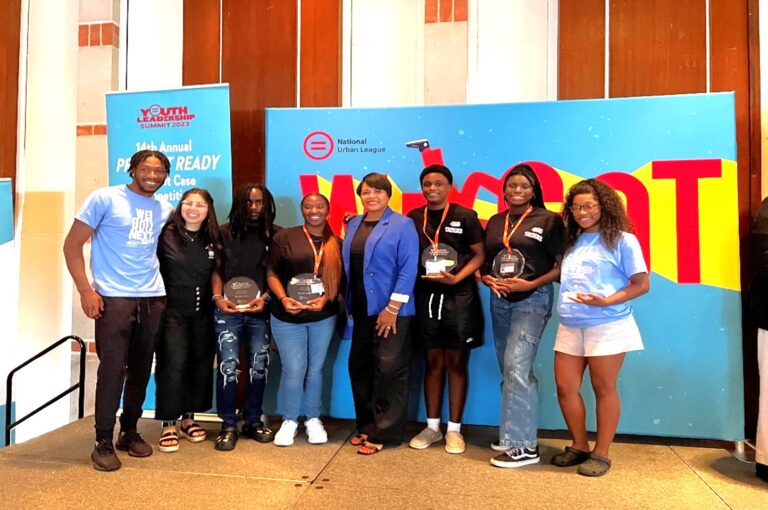
CHATTANOOGA, Tenn. (July 27, 2023) – Hamilton County students participating in the Urban League of Greater Chattanooga’s (ULGC) Project Ready program won second place during the case competition at the 33rd annual Youth Leadership Summit, hosted by the National Urban League (NUL).

The NUL case competition allows youth participating in Project Ready at local Urban League affiliates to present a program that addresses an issue that they see in their community. ULGC’s Project Ready students placed in the top four of 20 during the first round of the competition and competed again during the final round. Their program proposal, 423-T.K.T.T. (Think and Know the Tactics), focuses on reducing youth gun violence.

“Project Ready students engage with our education team program leaders and volunteers regularly throughout the year on various initiatives such as our college and career readiness curriculum, leadership, academic and civic development,” said Candy Johnson, president and CEO of ULGC. “I am beyond proud of these students and their tremendous efforts to prepare and advocate for issues they care about in our community during the competition. They represented Chattanooga with the level of excellence from which we strive to build our Project Ready program. This is our first time ever placing as an affiliate and that’s major!” 

During the annual Youth Leadership Summit students come together and engage in a transformative experience of learning, leadership and personal growth with the goal of ensuring that participants are prepared for the challenges of college, career and life. During this event, participants have the chance to interact with influential figures from the Urban League movement, as well as representatives from diverse local and global organizations.

Those representing ULGC’s Project Ready program at the leadership summit include:

  • Kennedy Garrett, recent high school graduate and incoming freshman at Middle Tennessee State University
  • Trinity Williams, rising Hamilton County senior
  • Timothy Rice III, rising Hamilton County junior
  • Te’Sean Murphy, rising Hamilton County junior

The Youth Summit runs simultaneously with the NUL Annual Conference and is the most important civil rights event of 2023 to advance the U.S.’s conversation and learning about justice, economic opportunity and the future of democracy.

For more information about Project Ready, visit www.ulchatt.net/national-achievers-society-nas.

Meet the youngest marcher to walk with Dr. Martin Luther King Jr. from Selma to Montgomery

55 years ago, in the spring of 1965, Lynda Blackmon Lowery was the youngest civil rights marcher to walk with Dr. Martin Luther King Jr. from Selma to Montgomery. She was jailed nine times before her 15th birthday. She was beaten by the police and needed 29 stitches in her head. Nevertheless, she marched on. 

On January 18, 2020, Lowery relived that experience. But this was no traumatic flashback. Instead, she watched her life story unfold on stage in the play “Turning 15 on the Road to Freedom,” based on the book of the same name that Lowery wrote about her experience. 

“I wanted people to know what happened,” Lowery says. “Those ugly things affected a lot of people’s lives.” 

The show is a musical dynamo filled with original gospel and freedom songs sung by a stellar cast of vibrant young performers. 

Queade Norah takes on the role of 15-year-old Lynda as she leaves home to march for voting rights, and after she’s attacked, “to show George Wallace what he did to me.” 

“It took me a minute to want to commit to playing Lynda,” Norah says. “I knew that to do it you have to have a certain type of strength to grasp the gravity of the story.” 

Lowery and Norah have formed a tight bond since performances began last year. The duo, representing the past and the future, both see a reflection of Lynda’s experience in our current struggles. 

“If you look at what’s happening today, it’s not that different than what was happening in ’65,” Lowery says. “Voter suppression, women’s health issues, gun laws. Our children, they are back on the battlefield, non-violently. Everybody has to get involved.”  “It’s heartbreaking that there still has to be a group of young people fighting for things that should have been resolved a long time ago,” Norah says. “I can take this stage to tell a story to inspire that it’s possible and that we do still have a fire inside us to make sure we’re continuing a legacy that started before us.”

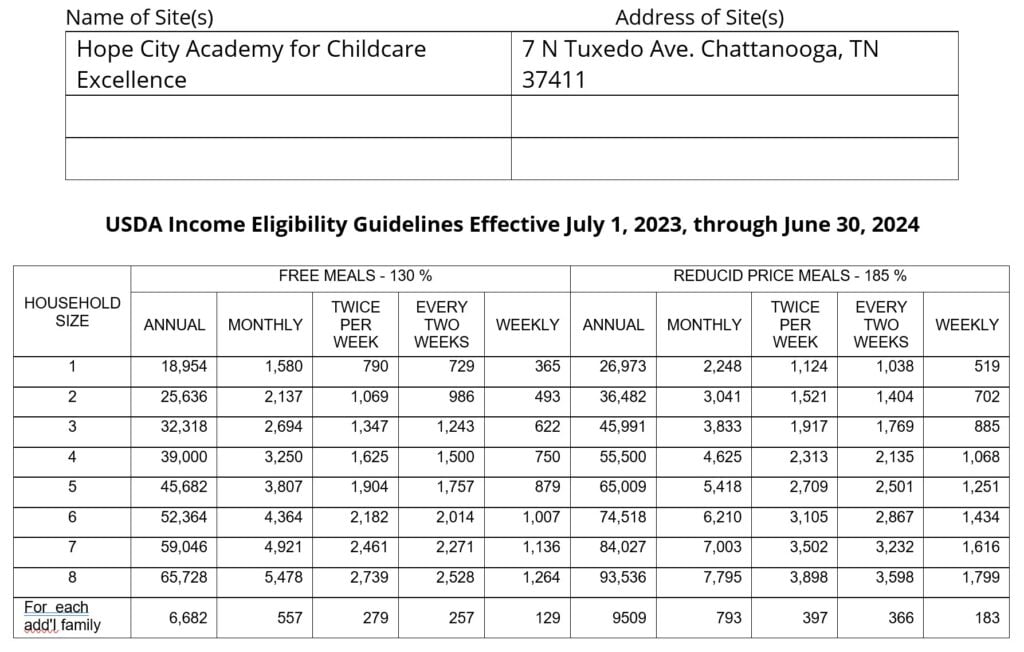
Hope City Academy for Childcare Excellence LLC announces participation in the Child and Adult Care Food Program

Sponsor Name: __Hope City Academy for Childcare Excellence LLC. announces participation in the Child and Adult Care Food Program. Meals will be provided at no separate charge to eligible children/adults without regard to race, color, national origin, sex, disability, age, or reprisal or retaliation for prior civil rights activity in any program or activity conducted or funded by USDA served at the following site(s):

In accordance with Federal civil rights law and U.S. Department of Agriculture (USDA) civil rights regulations and policies, the USDA, its Agencies, offices, and employees, and institutions participating in or administering USDA programs are prohibited from discriminating based on race, color, national origin, sex, disability, age, or reprisal or retaliation for prior civil rights activity in any program or activity conducted or funded by USDA.

Persons with disabilities who require alternative means of communication for program information (e.g. Braille, large print, audiotape, American Sign Language, etc.), should contact the Agency (State or local) where they applied for benefits. Individuals who are deaf, hard of hearing or have speech disabilities may contact USDA through the Federal Relay Service at (800) 877-8339. Additionally, program information may be made available in languages other than English.

To file a program complaint of discrimination, complete the USDA Program Discrimination Complaint Form, (AD-3027) found online at: http://www.ascr.usda.gov/complaint_filing_cust.html, and at any USDA office, or write a letter addressed to USDA and provide in the letter all of the information requested in the form. To request a copy of the complaint form, call (866) 632-9992. Submit your completed form or letter to USDA by:

(1) mail: U.S. Department of Agriculture, Office of the Assistant Secretary for Civil Rights, 1400 Independence Avenue, SW, Washington, D.C. 20250-9410;

(2) fax: (202) 690-7442; or

(3) email: program.intake@usda.gov.

This institution is an equal opportunity provider.

Getting ahead requires investing

By Kennedi Smith, 14

Start a business and invest money, said Jimmy Moncrief, a local bank executive.

“If you work hard for your money and spend the majority of it and that’s all you’re doing, it’s almost impossible to get ahead,” he said.

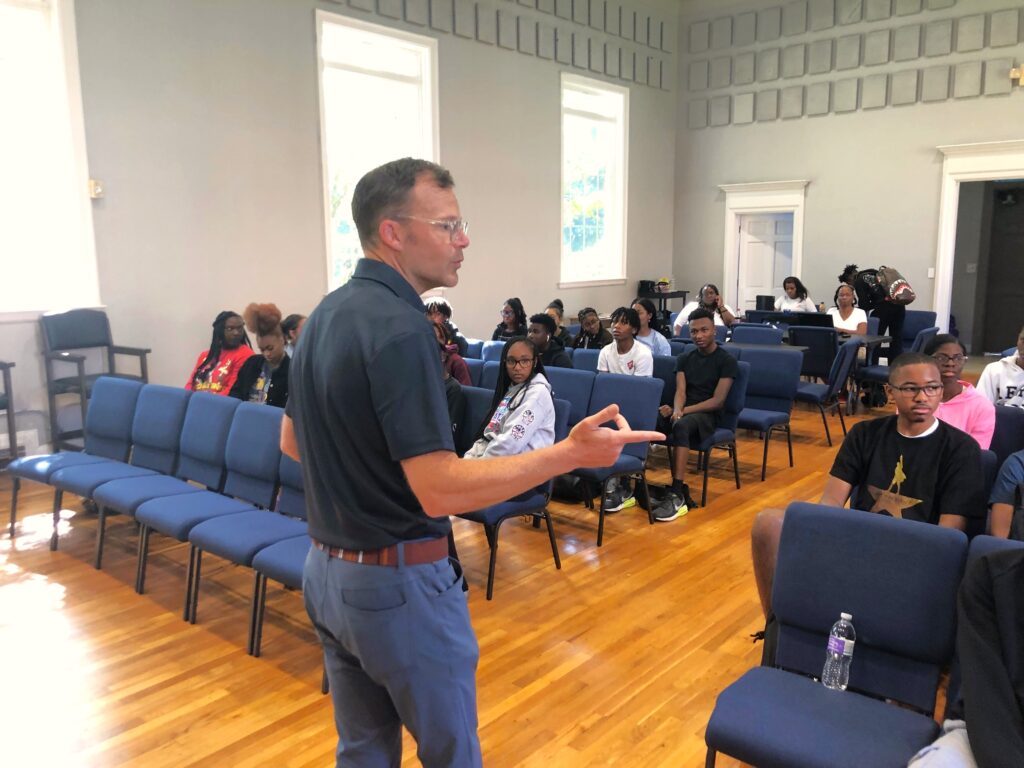
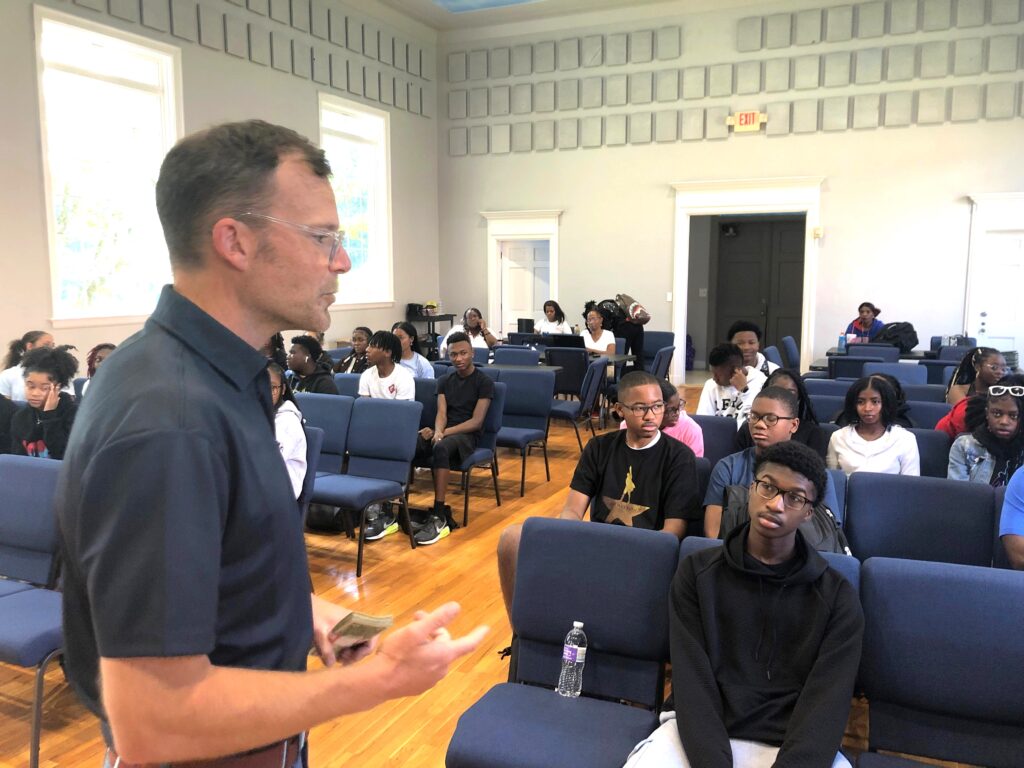
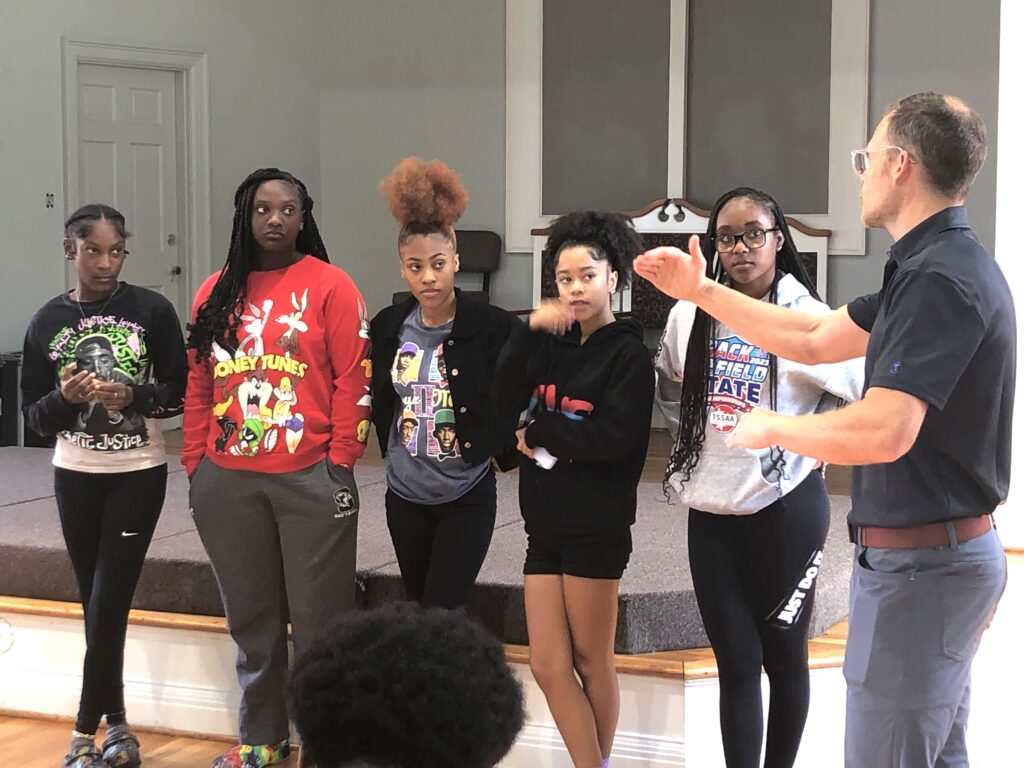
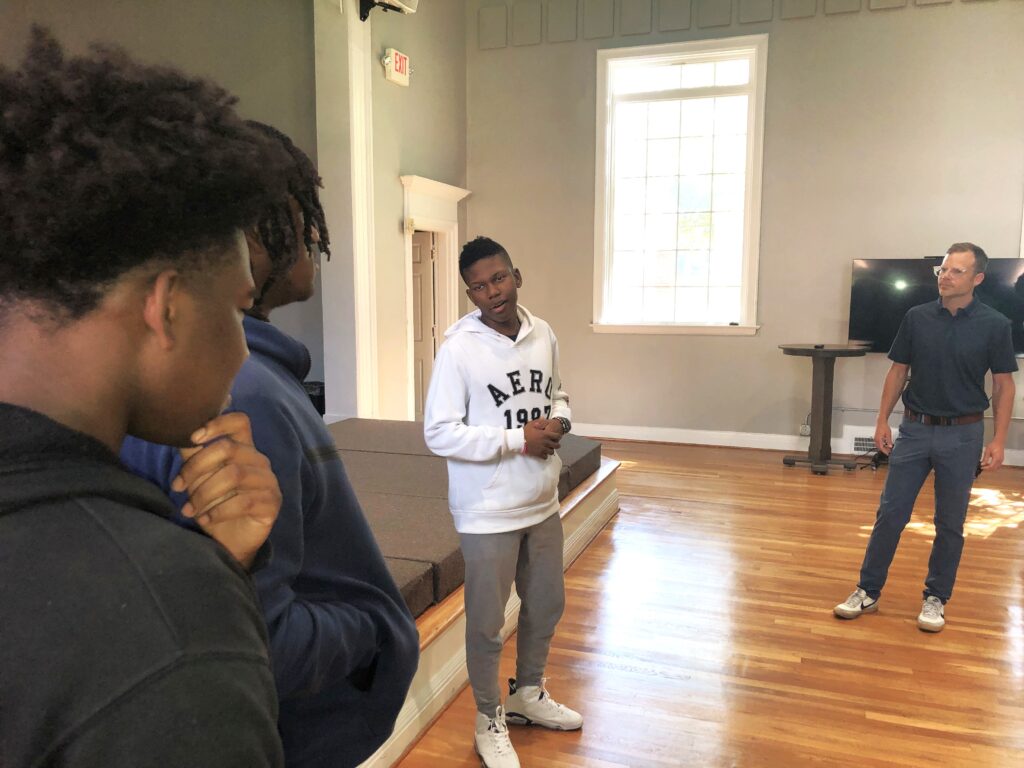
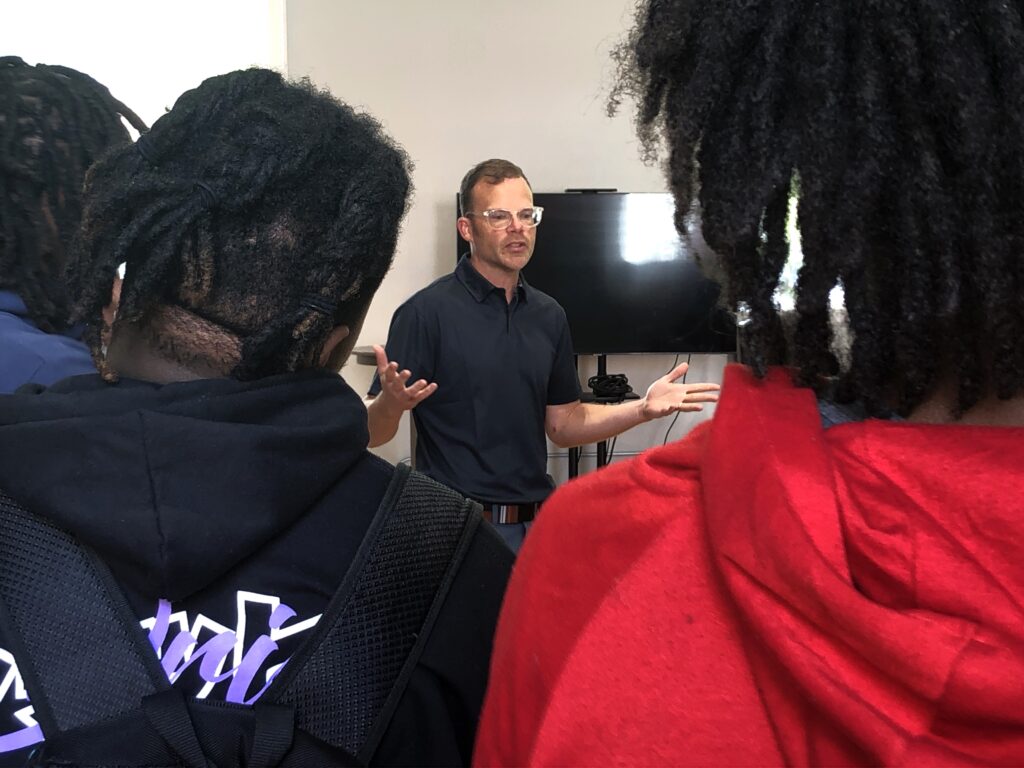
Moncrief, the senior vice president of Pinnacle Bank, shared his financial wisdom with nearly 50 students attending Camp REACH this summer. His main goal wasn’t recruiting customers, but educating young people on money management.

Senior Vice President of Pinnacle Bank, Jimmy Moncrief, shares his financial wisdom with Camp REACH students.

Several students said they increased their knowledge of financial affairs.

“He helped me learn about investments and think about what I wanted to do with my money,” said 15-year-old Tyson Lamont Armour.

All students attending the camp can earn up to $150 a week.

Moncrief brought $50 and offered suggestions about how students could spend it. It could buy a really nice dinner, but if a student put it in a savings account, it could draw interest. And if they bought a lawnmower to invest into their own lawn servicer, they could double their money every week, he said.

“Ever heard of Dr. Dre? How did he make money?” asked Moncrief. “Shaquille O’Neal has a fast food empire and Michael Angelo who painted the Sistine Chapel, made money in real estate, not painting.”

The common denominator is that they all invested in assets that made money, he explained.

Then Moncrief held a contest similar to Shark Tank where students presented their best ideas for starting a business. The student with the best idea got the $50.

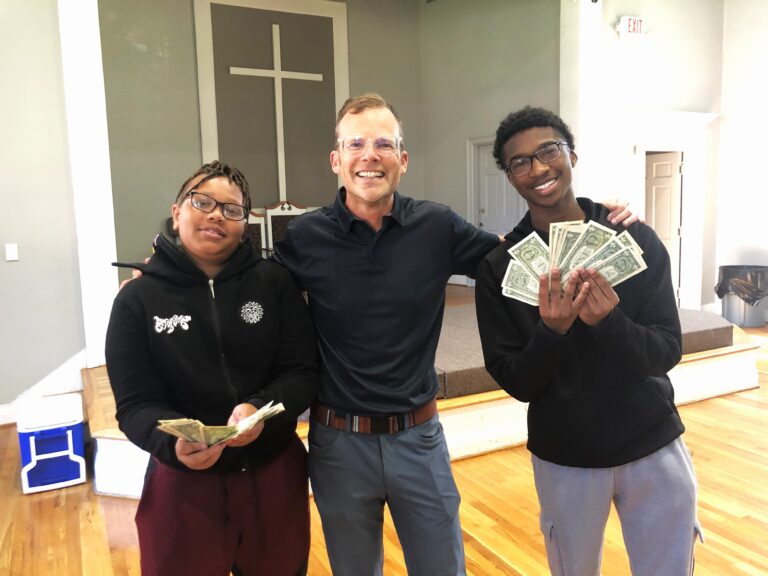
Shark Tank rendition winners Logan Daniel and Tyson Armour pitch their business idea to Pinnacle Bank Senior Vice President Jimmy Moncrief.

A shoe deodorant called Toe Tap, an acne cream and a shower head that sprays soap and water while playing music were among the innovative ideas suggested, but the winning idea came from Logan Carter Daniel, 13, and his partner Tyson Lamont Armour, 15 . Moncrief awarded Daniel the money because it was his idea.

The duo proposed a free online course that would provide information on trading stocks, investing, and managing money. And for $49.99 they offered one-on-one financial advice from a financial consultant.

Moncrief complimented the teens for having an idea in which they could immediately make money. He also liked that their business offered a free component that could attract a wide audience and they provided an option that enabled the business to make money while educating others on how to manage money.

Logan said he appreciated Moncrief’s information and the opportunity he provided.. “He was a helpful guy,” said Logan. “I liked how he spoke and I really liked that he gave us a challenge to win money.”

GET INVOLVED: To donate to Camp Reach call the Mary Walker Educational and Historical Foundation at (423) 267-2313 or go to marywalkerfoundation.org

Open Mouth, Insert Foot – courtesy of Tommy and Eli!

0

I was about to turn the page in the Chattanooga News Chronicle when I had one of my “whoa, I can do something with that,” moments. This time the source was the article, “America Could Learn from This Talk Show,” by Matthew Walther, editor, Catholic Literary Journal.

Suddenly out of nowhere, enter one Tommy Tuberville and a somebody by the name of Eli Crane, test cases in “I can’t believe he said that” incredibleness if ever there were ones. We’ll get to these guys’ nuttiness further down.

But first, about the newspaper article I mentioned at the outset.

You see, I extracted key lines from the article to construct the piece you’re now reading. In a nutshell, it is structured around two vocal sports commentators, Skip Bayless and ex NFL football player Shannon Sharp – Bayless white, Sharp African American – who often go toe to toe in disagreement when discussing both sports and thorny social issues with, said the author, “almost reckless lack of restraint, seemingly ignorant of the self-censorship that pervades so much of polite discourse.” A departing point from that article toward the end.

Now back to Tuberville and Crane and their recent bouts of OMIF (Open Mouth, Insert Foot), or “tasting leather,” as we used to say when I was growing up.

Well, Tuberville, the Alabama senator ignited a firestorm of controversy recently when he told CNN that white nationalists — a group defined as “militant white people who espouse white supremacy and advocate enforced racial segregation,” by Merriam-Webster — are not, get this, inherently racist.  You don’t have to take my word for it, look it up yourself. 

Clearly irritated for being called out, “that’s your opinion,” he huffed at the interviewer, adding that a white nationalist “is an American.” Whoa, of course they’re Americans Tommy. But to poo poo this aside as “someone else’s definition of a racist” is insulting and opens you up to well-deserved criticism.

 Well apparently it came as a shock to Tommy that many found his remark abhorrently racist because on Capitol Hill a day later, and severely tongue tied, he tried to clarify his views but ended up digging himself deeper into a racial quagmire with, fasten your seatbelts readers, “I’m not racist because I coached lots of minorities as a football coach” (his version of “some of my best friends are colored”).

One wonders what those “minorities” he coached at Auburn, Cincinnati and Texas Tech universities thought about his comments, let alone the collateral damage he did to the reputations of those institutions and to the state of Alabama.

Now not to be outdone, in the House of Representatives, Arizona Rep. Eli Crane created his own uproar when he referred to Black Americans as “colored people,” and claimed later that he simply “misspoke.” C’mon Eli, do you realize that uttering the word “colored” could bite you in the behind? Or did you miss the “Tuberville memo” from the previous week?

Lord, give me strength.

Okay, let’s go to a relevant piece on race in America penned in 2011 by Pulitzer Prize winner Leonard Pitts, Jr. Sayeth he, “I’m here to tell you that race is like a four-car pileup on the freeway; it simultaneously attracts and repels us. Because of this, we can’t not talk about it. Yet at the same time, we can’t talk about it, either. So we talk about race, but don’t. More often we yell about race or talk around race. Even when it shouldn’t be, even if don’t want it to be, even when you flee it like a back-alley mugger, it’s always there. Wherever you go, there it is – race in your face.”

So thanks to cultural troglodytes Tuberville and Crane, we again find ourselves caught in a four-car pileup on freeway America with rubbernecking passersby glaring from the safety of their autos while whispering “thank the Lord that it wasn’t me.”  Their recent bouts of OMIF are spectacularly at odds with present day nomenclature. You’d think that somehow – picking up a book, for heaven’s sake – they’d know better.

Let’s get back to Walther’s article.

“A stray remark, however churlish,” he writes, “need not mean a permanent asterisk next to a name, that forthright conversation begun from opposing premises can, in fact, lead to increased understanding, and that old-fashioned virtues such as forgiveness and liberality still have a place, alongside shouting and friendly wagers, in American life.”

A mouthful, yes? But how about putting asterisks aside momentarily and using that paragraph as a reference point for a debate about a contemporary hot issue – transgender, book banning, abortions, political candidates, gay marriage (yes, even OMIFs by Tommy and Eli), then see if you change your mind after hearing someone else’s reasoning. Yes, candor has its consequences.

Now if you decide to wade into a debate about a thorny issue where participants are brutally honest, understand that it all boils down to a litmus test of personal choices in response to what’s said. The question is do we excuse the problematic comment as an occasional slip of tongue, as all of us are sometimes guilty of, or was it something purposeful and sinister? 

In the end, if history is an accurate predictor, I suppose that we will anticipate the next Tuberville/Crane-like four-car racial pileup on freeway America and, in the words of Leonard Pitts, “…go about with fingers in ears singing “la, la, la” at the top of our lungs rather than hearing inconvenient truths…”

So fasten your seatbelts …. and make sure that you are fully insured with Allstate.Terry Howard is an award-winning trainer, writer, and storyteller. He is a contributing writer with the Chattanooga News Chronicle, The American Diversity Report, The Douglas County Sentinel, Blackmarket.com, co-founder of the “26 Tiny Paint Brushes” writers’ guild, recipient of the 2019 Dr. Martin Luther King, Jr. Leadership Award, and third place winner of the 2022 Georgia Press Award.

Tennessee Seniors Struggle as Poverty is on the Rise

0

Poverty among seniors is up.

That statement is not a surprising statement as everything—EVERYTHING–has increased in cost, packaging of food has been reduced in size, and the purchasing power of the average American is extremely diminished.

In the 2023 Senior Report published by the United Health Foundation, data from 22 different sources which analyzed 52 separate measures, examined the health and well-being of older adults in America. The report features state summaries for all 50 states in addition to a national overview of data.

Tennessee ranked 42 overall compared to neighboring states, Alabama at 45 and Georgia at 38. The report looked at metrics that include personal safety, food insecurity, the cost of housing, the access and quality of healthcare, and behavioral assessments–like nutrition, tobacco, alcohol and drug use, and physical activity.

Areas of poorer outcomes with Tennessee seniors involve the use of tobacco, inadequate dental health, mental health issues, the shortage of personal care and senior care workers–such as nursing home staff–and insufficient physical activity to promote wellness.

Looking specifically at economic factors; however, in comparison to our neighbors in Alabama and Georgia, Tennessee fared better, but still in the lower half of the states nationally.

Alabama was shown to have 15.3% of the senior population (65 years old+) designated as food insecure with limited access to foods. Georgia was assessed to have 14.3% of the Peach State’s seniors experiencing food insecurity, in contrast to 13.6% of Tennessee seniors. The national average, however, is 11.8%, meaning there’s still need for improvement. But as costs of groceries soar and packaging shrinks, or “shrinkflation” destroys our budgets, the hope doesn’t appear on the immediate horizon.

Some good news for Tennessee seniors–despite the number still ranking our state’s elderly at #33, is that 10.3% of those 65 years and older live at or below the federal poverty level. For 2023, that annual income is only $14,580. So, one tenth of Tennessee’s seniors have less than $1,215 monthly to pay all their expenses without government aid.

In Alabama, 11.4% of seniors live below the poverty level and an even 10% in Georgia, as the national average is 10.4%.

Lots of numbers. But appreciate that the inflation, which has really been a recession for several weeks that has not been recognized by the academic types, has disproportionately had a greater harm to seniors whose income is fixed, yet their expenses have risen astronomically like others.

In metro areas where development of downtown and urban living has driven up property values and the cost of renting, leasing, and owning a home, the greatest impact hits seniors.

Policies by members of the City Council, County Commission, and the state and federal governments will be challenged in years ahead as this population swells. By 2030, in less than 7 years, more than 25% of the entire Tennessee population will be 60 years or older, according to the TN Commission on Aging and Disability.  Seniors will also be voting for their best interests.

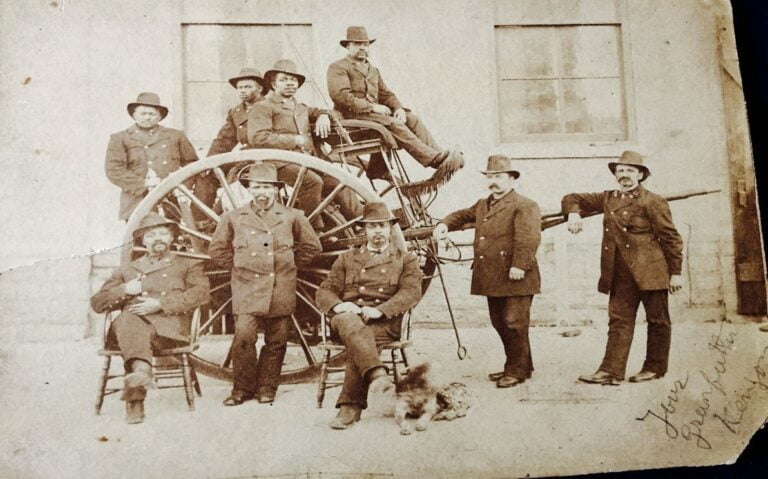
THE RICH HISTORY OF BLACK FIREFIGHTERS

The men and women who serve on the front lines as firefighters, rescuing citizens in harm’s way, should be saluted daily for their bravery. In one of the most dangerous and selfless occupations in the world, firefighters risk their lives for the safety of others at a moment’s notice. Even though history has not been kind to the memory of African American firemen, their contribution to firefighting is a significant one. Still, even with the most dedicated research, it is difficult to ascertain who were the first African Americans who took up the role of firefighters. 

Several sources, including historian Mike Legeros, all point to the summer of 1817 as being the earliest record that Black firemen existed in New Orleans, La. Although Black men stamping out blazes could have happened before then, there is no real evidence available in capturing this historic truth. According to Legeros, 1821 and 1833 also show evidence of freed men joining firemen ranks in New Orleans, but like before, the records were poorly kept, and the facts disjointed. 

In Philadelphia, a band of African-American men who had fireman aspirations joined as the African Fire Association in 1818. After a group of White firemen protested the move along with citizen discord, the group scrapped their plans of opening a Black firehouse in Savannah, Ga. In 1824, freed and hired slaves worked alongside the fire department but were largely relegated to assistant duties. White men, reluctant to share in the glory, kept potential Black firemen at bay. 

In Charleston, Sc., 10 firehouses manned by Black men were reportedly present but they worked without pay. In fact, how it worked was that the company who outed a fire first got paid and only other White-owned engines could assist before leaving the scraps behind for the Black firehouses. 

Patrick H. Raymond (pictured) of Cambridge, Mass., is universally regarded as the first African American fire chief. Born in 1831, the Civil War veteran joined the department sometime in the 1850s. He became the chief engineer of the Cambridge Fire Department in January 1871, holding his post for eight years. He passed away in the summer of 1894. 

Another historic first was volunteer firewoman Molly Williams of the Oceanus Volunteer Fire Company. In 1818, she would be the first female firefighter after working for the New York firehouse. 

Much later, after the strides of the Civil Rights Movement, Robert O. Lowery served as the first Black Fire Commissioner of a major city. Lowery helmed his New York post from 1966 to 1973. During Lowery’s tenure, the International Association of Black Firefighters was established in 1970. 

Black women have also made valuable contributions to firefighting. Toni McIntosh of Pittsburgh, Pa., became the first Black woman to become a career (full-time) firefighter in 1976.  According to the Department of Homeland Security, Cecelia Owens-Cox was the first woman to be assigned to a New York City truck company in 1984 as well. Chief Rosemary Cloud became the first African American woman chief for a career fire department in East Point, Ga., in 2002.  Even though the early records of Black firemen and women have been scattered over time, it is still noteworthy to mention that many of these achievements have not gone unspoken. Perhaps a dedicated educator or a team of researchers will continue to bore through the countless documents, images, and personal accounts to uncover more truth about the rich history of African American firefighters.