Wednesday, October 14, 2026
Advertisement
Home Blog Page 74

Urban League hosts 41st annual Equal Opportunity Day on December 7

CHATTANOOGA, Tenn– The Urban League of Greater Chattanooga (ULGC) will host its 41st annual Equal Opportunity Day (EOD) Breakfast presented by BlueCross BlueShield of Tennessee on Thursday, December 7. The event will be held from 8-9:45 a.m. at the Chattanooga Convention Center.

The ULGC’s primary fundraiser, EOD brings together hundreds of business and community leaders, as well as program beneficiaries, to celebrate and support the Urban League movement. Resources contributed during the event and through table sponsorship and ticket sales will support the work of ULGC’s three empowerment centers, assisting diverse community members in all stages of life.

For newcomers, this event provides a deeper perspective on the meaning of the Urban League movement. “We are fortunate to have so many supporters who have begun to understand what I mean when I say, “the Urban League movement”, said Candy Johnson, ULGC president and CEO. We are more than an advocacy focused organization. We provide direct services to individuals from various walks of life through the lens of equity and accessibility.

“My hope is that attendees will be inspired to get more involved and ‘be the movement’ as we work toward  empowering communities and changing lives,” she said.

During the event special recognitions will be awarded to those who embody the spirit of the Urban League movement. There will also be an opening performance, dialogue from program participants about the Urban League’s impact and special recognition of the Urban League’s recent Inclusion by Design cohort.

“We’re proud of the work of the ULGC and its commitment to help create a more inclusive Chattanooga,” said Dalya Qualls White, chief communications officer for BlueCross BlueShield of Tennessee and ULGC board chair. “Each year, EOD allows all of us the opportunity to celebrate our successes and continue the necessary work to empower communities and change lives.” Table sponsorships are available until November 16th and individual tickets can be purchased at https://shorturl.at/fi258. For more information about the event or how to support ULGC, visit www.ulchatt.net or email info@ulchatt.net.

Historians Say First Americans Were Black Indians of African Descent

Dr. David Imhotep, a respected historian and the first person in the world to hold a Ph.D in Ancient African Ancestry, argues that all humans originated from the continent of Africa and this includes Americans. Most books about American history begin with Cowboys and Indians, but that’s not the beginning of American history. An overwhelming amount of evidence supports the fact that there was indeed a presence and legacy of Africans in ancient America.

In his book They Came Before Columbus, historian Ivan Van Sertima examines navigation and shipbuilding; cultural analogies between Native Americans and Africans; the transportation of plants, animals, and textiles between the continents; and the diaries, journals, and oral accounts of the explorers themselves to support the claim of an African presence in the New World centuries before Christopher Columbus arrive.

Several other historical accounts support this claim. For example, the launching of the great ships of Mali in 1310 (two hundred master boats and two hundred supply boats), the sea expedition of the Mandingo king in 1311, and many others. The unmistakable face and handprint of black Africans in pre-Columbian America, and their overwhelming impact on the civilizations they encountered is undeniable.

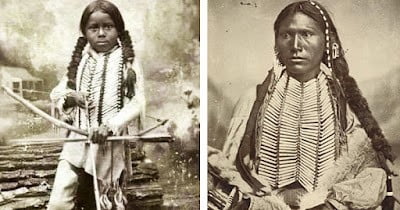
In The First Americans Were Africans, Dr. Imhotep also makes this same passionate and comprehensive case for a radical rewrite of orthodox history. He says that by examining the scientific and geological evidence, it can easily be determined that people of African descent were in America before the Vikings or Columbus. And this includes both North America and South America. In fact, there is a picture that can be seen today at the Natural Museum of London that was taken by the crew of The HMS Challenger Expedition, 1872-1876 A.D. at the most Southern region of South America at a place known today as Tierra del Fuego. In this picture is a colorful display of African explorers.

“Tragic Sensibilities” (for fixing the divided States of America!)

0

“Tragic Sensibilities” (for fixing the divided States of America!)

“We’re living in a brutalizing time: Scenes of mass savagery pervade the media. Americans have become vicious toward one another amid our disagreements. Everywhere I go, people are coping with an avalanche of negative emotions: shock, pain, contempt, anger, anxiety, fear.”

Okay, the words above are those of columnist David Brooks, not mine. Although Brooks and I are as different as, well, “Black and White,” literally, we’re joined at the hip with our assessment of where we are today vis-à-vis our relationship with others. It’s just that he cut through the chaise and articulated it way better than I could.

What further sets us apart is his (and my lack of) knowledge of the striking narratives of Greek tragedies and, until I stumbled across his recent column, how they could serve us well as foundational for addressing the “Divided States of America,” and the foreshadows of more to come with wars, AK-47 toting domestic terrorists, and a rancorous national election on the horizon.

He further writes….

“The first thing to say is that we in America are the lucky ones. We’re not crouching in a cellar waiting for the next bomb to drop. We’re not currently the targets of terrorists who massacre families in their homes. We should still start every day with gratitude for the blessings we enjoy. But we’re faced with a subtler set of challenges. How do you stay mentally healthy and spiritually whole in brutalizing times? How do you prevent yourself from becoming embittered, hate-filled, calloused over, suspicious and desensitized?”

The ancient Greeks, Brooks reminds us, knew about violent times. They lived with frequent wars, massacres and mass rape. In response, they adopted a “tragic sensibility” that begins with the awareness that the crust of civilization is thin, that breakdowns into barbarism are the historical norm. However, warns Brooks, “Don’t fool yourself into believing that you’re living in some modern age too enlightened for hatred to take over. Tragic sensibility prepares you for the rigors of life in concrete ways.”

Here’s how explains David Brooks.

“First, it teaches a sense of humility. Humility is not thinking lowly of yourself; it’s an accurate perception of yourself. It is the ability to cast aside illusions and vanities and see life as it really is.”

“Second, tragic sensibility nurtures a prudent approach to life. It encourages people to focus on the downsides of their actions and work to head them off. In this way, people are taught resilience and anti-fragility — to be prepared for the pain that will inevitably come.”

“Third, tragic mentality encourages caution. The price we pay for our errors is higher than the benefits we gain from our successes. Be incremental, patient and steady.”

“Fourth, tragic mentality teaches people to be suspicious of their own rage. “Rage” might feel luxurious because it makes you convinced of your own rightness, but ultimately it blinds you and turns you into a hate-filled monster. Rage hardens and corrodes the mind of its bearer.”

“Fifth, tragedies thrust the harsh realities of individual suffering in our faces, and in them we find our common humanity.” Drawing reference to Aeschylus’ “The Persians,” Brooks suggests that the play teaches us to be empathetic to all those who suffer, not just those on our own side, and that compassion is the noble flame that keeps humanity alive, even in times of war and barbarism. That compassion recognizes the infinite dignity of each human soul.

Brooks then turns us to a different mentality, one that emerged among the great Abrahamic faiths, and in their sacred city, Jerusalem.

“This mentality celebrates an audacious act: the act of leading with love in harsh times. The essence of dehumanization, Brooks explains, “is not to see someone and render him inconsequential and invisible. The core counterattack against this kind of dehumanization is to offer others the gift of being seen. What sunlight is to the vampire, recognition is to the dehumanizers. This is the kind of social repair that can happen in our daily encounters, in the way we show up for others.”

During a Zoom call, Brooks was asked this fair question: Isn’t it dangerous to be vulnerable toward others when there is so much bitterness, betrayal and pain all around?

His answer: “Yes, it is dangerous. But it is also dangerous to be hardened and calloused by hard times. The most practical thing you can do, even in hard times, is to lead with curiosity, lead with respect, work hard to understand the people you might be taught to detest.”

“That means seeing people with generous eyes, offering trust to others before they trust you. That means adopting a certain posture toward the world. If you look at others with the eyes of fear and judgment, you will find flaws and menace; but if you look out with a respectful attitude, you’ll often find imperfect people enmeshed in uncertainty, doing the best they can.”

Here’s a question, one that I posed to my good friend “Bernard” after we discussed Brooks column: Will casting this kind of attention as Brooks suggests change the people you are encountering?

“Maybe; maybe not,” answers Brooks. “But this is about who you are becoming in corrosive times. Are you becoming more humane or less? Are you a person who obsesses over how unfairly you are treated, or are you a person who is primarily concerned about how you see and treat others?”

We’ll leave you, readers, to go face to face with the person in the mirror to grapple with those questions.

Humm, “tragic sensitivities!”

That’s one to think about, huh? Terry Howard is an award-winning writer and storyteller. He is a contributing writer with the Chattanooga News Chronicle, The American Diversity Report, The Douglas County Sentinel, Blackmarket.com, co-founder of the “26 Tiny Paint Brushes” writers guild, recipient of the 2019 Dr. Martin Luther King, Jr. Leadership Award, and third place winner of the 2022 Georgia Press Award.


Tauheedah Brady Awarded Presidential Scholarship from Tennessee Tech University

0

Tauheedah Brady, a senior at the Chattanooga Girls Leadership Academy (CGLA), has been awarded a $20,000 Presidential Scholarship from Tennessee Tech University in Cookeville.

The scholarship recognizes her academic excellence and her deep commitment to STEM  (Science, Technology, Engineering and Mathematics).

This achievement was made possible through the guidance and support of ALTundergrad, a leading educational consulting firm dedicated to empowering Chattanooga’s youth through higher education. ALTundergrad has been instrumental in helping students like Brady navigate the challenging landscape of college admissions and secure valuable scholarships, ultimately alleviating the burden of student debt.

“Tauheedah is an inspiration to us all,” said Marie Mott, founder and CEO of ALTundergrad. “Her dedication to her studies and her passion for STEM exemplifies the brilliance we aim to foster in the young minds we work with at ALTundergrad. We are immensely proud of her accomplishments. Congratulations, Tauheedah!”

Black Americans Made History in Last Tuesday’s Elections

November 2023 – Black candidates celebrated historic victories in elections across the country last Tuesday, including a few firsts. In Philadelphia, Cherelle Parker became the first woman and first African American woman to win the mayoral election. Mayor-elect Parker, 50, easily defeated her Republican opponent, David Oh.  Parker touted her life experience as a Black woman in Philadelphia while campaigning. “That I would put to great use everything inside of me, my lived life experience, my professional experience, my academic preparation, that I would put all of it to great use, and I would make Philadelphia the safest, the greenest big city in the nation with economic opportunity for all,” said Parker.

In Rhode Island, Gabe Amo became the first Black person to represent the state in Congress. In New York City, Exonerated Five member Yusef Salaam went from being wrongfully convicted to a city council member.  “If I’m not mistaken, I’m the first person who was exonerated to be in city council,” he said. “That says something to a community of people who are looking for solutions to similar issues. Folks who have been run over by the spoke wheels of justice.”

Although he was running unopposed, Salaam’s victory brought hope to the fight for criminal justice reform.  “For Rhode Island, it’s been interesting to have an immigrant story that everyone can relate to,” Amo said to CBS News. “I’m going to be a voice for making sure we can restore confidence and trust despite the Republican Party that is rife with chaos.”

Recent American Heart Association Research Deserves Attention of Marijuana Users

0

Two studies were presented at the American Heart Association’s Scientific Sessions which need further study, but should also get the attention of a growing population using daily marijuana. Both pieces of research highlighted the relationship of heart failure, heart attacks, and strokes in marijuana use.

Convened annually, the American Heart Association (AHA) hosts the highly reputable Scientific Sessions where the latest research in cardiovascular science is presented to key thought leaders, practitioners, and researchers. The 2023 AHA Scientific Sessions were held November 11-13 in Philadelphia.

The first presentation was entitled, Daily marijuana use is associated with incident heart failure. The research was conducted by the National Institutes of Health in a large population study.

At baseline, participants were free from heart failure as documented through medical screenings. Over a four-year period, more than 150,000 participants were tracked with a record of the frequency of their marijuana use.

The study involved more than 150,000 adults in the U.S. who were free from heart failure when they enrolled in the research program. Participants were surveyed on the frequency of their marijuana use and were followed for nearly four years.

Almost 2% of participants, or 2,958 people, developed heart failure. Individuals who used marijuana daily had a 34% increased risk of developing heart failure compared to non-users, even after adjusting for various risk factors.

A secondary analysis of this data suggested that marijuana use may contribute to this significant increase in heart failure through the development of coronary artery disease.

The second major research presented at the AHA Scientific Sessions of 2023 was entitled, Increased risk of major adverse cardiac and cerebrovascular events in elderly non-smokers who use cannabis. The Agency for Healthcare Research and Quality, one of 12 agencies within the US Department of Health and Human Services, was the source data analyzed from the 2019 National Inpatient Sample. Specifically,  cannabis use in older adults was reviewed in relation to cardiovascular risk factors.

This study that will be presented at the conference shows that people older than 65, with any combination of type 2 diabetes, high blood pressure and high cholesterol who also use marijuana, but not tobacco, have a statistically significant risk for a major heart or brain event, compared to people who never used the drug.

The results demonstrated at least a 20% increased risk of heart attack, stroke, cardiac arrest, or arrhythmia for participants with the data being described as “significant” in the body of research emerging in cannabis use.

In a statement issued by Robert L. Page II, PharmD, MSPH, chair of the volunteer writing group for the 2020 American Heart Association Scientific Statement: Medical Marijuana, Recreational Cannabis, and Cardiovascular Health, the warning was unmistakable. “Together with the results of these two research studies, the cardiovascular risks of cannabis use are becoming clearer and should be carefully considered and monitored by health care professionals and the public,” cautioned Dr. Page.

Learning from service-learning at the East Lake Salvation Army

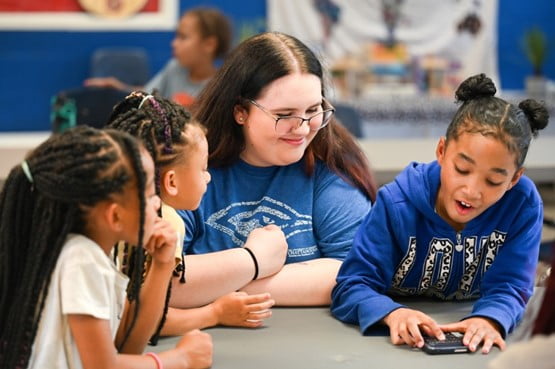
Lilly Tyler (third from left) reads with students at the East Lake Salvation Army as part of Lori Waite’s Sociology of Social Problems class.

By Sydney Brown

Students in University of Tennessee at Chattanooga Professor Lori Waite’s Social Problems class have the opportunity for service-learning work every year. This year, they have expanded that work to include the East Lake Salvation Army site.

The East Lake Salvation Army provides a warm and welcoming environment to children who can earn prizes and recreational time by reading and completing their homework with volunteers after school. The more books the children read, the more recreational time they are awarded.

Waite said, “This is a wonderful opportunity for UTC students to make valuable campus-community connections in a meaningful way. I love teaching service-learning classes because this type of experience helps students better understand the links between classroom concepts and real-world problems.”

The East Lake Salvation Army hosts a safe, fun, after-school space for children to socialize and be productive with other children their age. The site has plenty of books to read, a gym to play in, arcade games, a swimming pool outside when the weather is warm and the children get a hot meal before they go home.

“I have always wanted to work with children and it always makes me feel good,” said Anyssa Holloway, a junior nursing and sociology major. “Not just because I’m doing something that I love but also being a person that they see that probably looks just like them and see that there is someone who cares for them.

“It makes me feel like I have done something good and I’ve had an impact on the smallest person.”

Holloway also is a Brock Scholar in the Honors College.

“As a student myself, I was able to participate with the kids and read to one of them who was very patient and determined to read ‘Green Eggs and Ham’ by Dr. Seuss with me. I was inspired by how sweet the kids were and how playful they were with one another,” Holloway said. “I could definitely tell they felt safe and comfortable with the Salvation Army and the wonderful staff provided there.”

Lilly Tyler, another participating student, is a freshman psychology major.

“I’m a very quiet person, but I like it here,” Tyler said. “I feel more comfortable here than I do in classes. I love being here for the kids for whatever they need, hanging out with them, and being goofballs together.”

Captain Rebecca Sullivan is the East Lake Salvation Army’s site supervisor.

“Ever since I was a kid, myself, I have enjoyed ministering to youth of all ages. I was one of these youth when I was young. My mother was a single mom and she dropped me, my sister and brother at the Salvation Army every day,” Sullivan said. “I enjoy loving on all the youth that walk through our doors every day, just as someone loved on me. I am thankful for the Salvation Army and its mission.”

The East Lake Salvation Army serves children in downtown Chattanooga and welcomes any help from volunteers.

EPB Seeks Community Input and Submissions for Fourth and Final 10th Street Mural

EPB is seeking community input and submissions for the fourth and final installment of its 10th Street Mural Project. The project began in 2020, offering local artists an opportunity to share their talent on each side of EPB’s 10th Street substation wall.

Community members are encouraged to spread the word to local artists and encourage them to submit their work.

An outside group of community stakeholders will use an anonymous judging process to select artists who live or work in EPB’s service territory based on the submission’s artistic value, community reflection and thematic relevance.

A tentative timeline of the mural process is as follows:

January 2024: Call for artist submissions (must be at least 18, and live or work in EPB’s service territory. First time muralists are welcome to apply)

February 2024: Select artists

March 2024: Announce selected artists

April 2024: Begin work

May 2024: End work

Thursday, June 13, 2024: Mural celebration event

Murals showcased on the Foster and E. 10th Streets sides of EPB’s 10th Street substation wall over the last three years honor Dr. Martin Luther King Jr., Chattanooga history and well-known Chattanooga community members.

EPB is a locally owned and operated electric power and utility company serving Chattanooga and Hamilton County, Tennessee. The company provides electricity to over 160,000 customers. For further information on the 10th Street Mural Project, contact Vanessa Willis with EPB at willisvm@epb.net.

Hamilton County Kindergarteners Get Ready to Discover! Free Passes Are Yours!

0

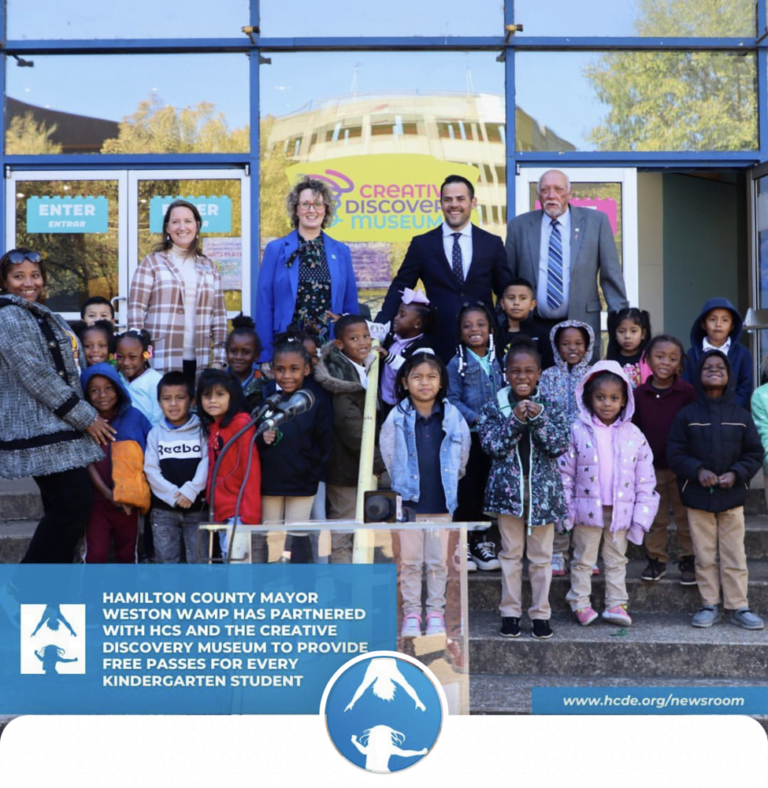
Hamilton County Mayor Weston Wamp announced that kindergarten students enrolled in the Hamilton County Public Schools will receive four unlimited passes per student to the Children’s Discovery Museum as part of the County’s commitment to a lifetime of learning.

The unique program will bring the funding from the County Mayor’s budget approved by the County Commission, distribution efforts within the Hamilton County Public Schools, and the open door of discovery and educational fun provided by the immersion experience of the Children’s Discovery Museum.

“The future of our county will be defined by how well we serve our youngest citizens today, and this partnership will give every kindergartener in our community an equal opportunity to experience our world-class Creative Discovery Museum,” Hamilton County Mayor Weston Wamp said. “My hope is that as families are adjusting to the first year of elementary school, they are able to use these passes to spend quality time playing and learning together.”

Almost 4,000 families of kindergarten students in the county will receive passes that will be honored during the 2023-2024 school year, through June 30 at the facility located at 321 Chestnut Street.

“More learning takes place in early childhood than any other time in a person’s life, and caregiver interaction multiplies the impact,” observed Claire Stockman, vice president of Education at the interactive museum. “We at Creative Discovery Museum are proud to create a space where learners of all ages can explore, innovate, create, and play together. This wonderful partnership with Hamilton County will give access to the museum to all HCS kindergarteners and their caregivers and we can’t wait to witness the learning, growing, and relationship-building that will build strong foundations and support classroom learning for the rest of these students’ school careers.”

Kindergarten students will be presented with the passes within the next few weeks. Families wanting to plan their visit should visit https://www.cdmfun.org/visit for times of operation, parking and information about free shuttles which run throughout downtown, other details relative to the visit. HCS Superintendent Justin Robertson noted, “Education is a shared responsibility, and the district’s commitment to collaboration with community partners continues to provide opportunities for students and families to explore learning interests and find resources. We look forward to our students enjoying this premier interactive learning experience.”

EDUCATION TASK FORCE HEARS MORE CONSEQUENCES OF REJECTING FEDERAL DOLLARS

0

NASHVILLE—A public policy research center today (Tuesday, Nov 7) warned state lawmakers that cutting programs or raising taxes are potential consequences of refusing more than a billion dollars in education funds from the federal government.  The Sycamore Institute today told a joint legislative committee that those are two possible options if they follow through on a Republican proposal to reject federal education dollars and state revenues continue to shrink.

The Joint Working Group on Federal Education Funding held its second day of meetings today.  House Speaker Cameron Sexton and Lieutenant Governor Randy McNally created the task force to examine replacing federal education dollars with state funds because federal dollars come with “strings” attached.

However, the Sycamore Institute told the panel that because no state has ever rejected federal K-12 funding much is unknown. But some of the possible ramifications could include budget cuts or tax increases during a shortfall or recession, extended court battles over federal requirements that may still exist for state schools even if funding is refused and Tennesseans having to pay federal income taxes on money now going to other states.

In the afternoon session, a cross-sexton of county school superintendents told the panel that even with the federal education dollars they still don’t have enough money to repair school roofs and they have to send children to learn in buildings that are more than 100 years old and falling apart. 

Following the meeting, State Representative Ronnie Glynn of Clarksville, who is one of only two Democrats serving on the Task Force, said that after today, he’s not sure why the committee is continuing to meet: “We are telling school superintendents that we can replace the billion dollars the federal government provides with state money when they have buildings crumbling around them. Instead of replacing federal dollars, we could take the matching billion that we say we have and use it to fix their buildings and hire more teachers. We are literally asking them how they could repurpose existing employees who have to fill out federal paperwork, when we could just give them the money to hire more teachers and retain the teachers they have.  It doesn’t make a lot of sense.” The committee meets again tomorrow at 9:00 AM in Senate Hearing Room one.  Officials with the U.S. Department of Education and the National Conference of State Legislatures are scheduled to make presentations.