
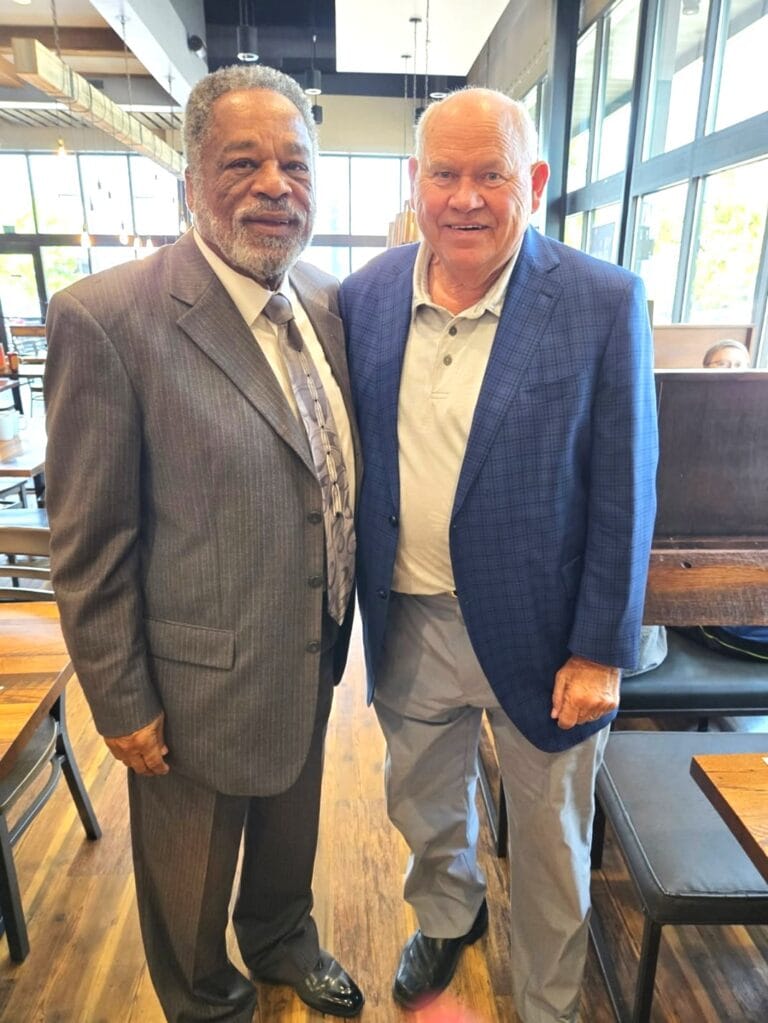
Last Thursday John L. Edwards, lll, publisher of Chattanooga’s longest operating African American Newspaper, the Chattanooga News Chronicle (37 years) had an unexpected visit with former University of Tennessee head football coach and Athletic Director, Phil Fulmer. Coach Fulmer was in Chattanooga on business and the two ran into each other at a local restaurant. Edward’s newspaper was one of only two black-owned newspapers covering Tennessee football in the press box and on the field during Fulmer’s tenure. Of course, the conversation included the late Reggie White who played at Howard High School and was one of the Volunteers most famous football players. Fulmer also mentioned up and coming player from Chattanooga Brainerd High School, Bo Carter who UT is expecting great things from. Coach Fulmer presently serves as advisor to UT president for community, athletics, and university relations.
Chattanooga-Hamilton County NAACP 36th Ruby Hurley Image Awards Scheduled for October 30th

7:00 P.M. Chattanooga Convention Center
Mr. Ruben Studdard, the second winner of American Idol will headline the Ruby Hurley Image Awards for 2025.
In the years following Idol, Ruben has released seven studio albums, including his platinum-selling debut, Soulful, and the top-selling gospel follow-up, I Need an Angel. He is most well-known for his recording career, which has produced hits including Flying Without Wings, Sorry, and Change Me. Ruben has also segued into television and stage work.
Notably, he toured with Robin Givens in the comedy-drama I Need a Hug and starred as Fats Waller in a national tour revival of Ain’t Misbehaving, which spawned a Grammy-nominated soundtrack. Ruben embarked on an eighty-two-show tour throughout North America with his close friend and fellow American Idol alumni Clay Aiken.
Mr. Studdard’s new album – The Way I Remember It – has charted the first two singles. Ruben will hit the road with “The 2025 Masterpiece Tour”. This show will have the new and old.
Reverend Ann Pierre, president of the local NAACP Branch said, “we are excited to welcome Mr. Ruben Studdard to highlight the presentation of awards to notable community workers.”
The 2023 Ruby Hurley Image Awards will highlight individuals who work to build a viable community and serve as ambassadors for the local community.
Tickets to the event may be purchased by contacting the event Chairperson, Patricia Shackleford Gray at 423-227-4883 or email naacpchatt@gmail.com.
HAMILTON COUNTY SCHOOLS Safety Protocol Updates

Athletic Events*
Entry Requirements
Student Admission: Students will only be permitted admission with a school-issued ticket OR if they are identified as a student of a school participating in the event through PowerSchool verification.
o Minors: Minors under the age of 18 and not affiliated with either school playing in the game must be accompanied by a parent or guardian.
Security Screening: To promote a secure environment, all attendees will be screened upon entry, including a hand-held or walk-through metal detector scan and bag check.
Apparel: All bags must be clear** or smaller than 4.5” x 6.5”, and face coverings of any kind are prohibited.
General Expectations
Assigned Areas: Spectators must remain in designated areas; fields and restricted spaces are off limits. No loitering in walkways, concourses, parking lots, or other areas in and around the school campus
o Student Assigned Areas: Students must remain in assigned areas during the game unless going to the concession stand or restroom.
Respect Others and Enjoy: Our goal is to create an enjoyable, safe, and respectful environment for our community to support and celebrate our athletes. Please show positive sportsmanship and refrain from using profanity, taunting, or disruptive behavior.
Follow Staff and Security Guidance: Effective security measures are fluid and adapt to situations as they arise. Please cooperate with all school staff and security to ensure appropriate safety.
All procedures will be strictly enforced. Any violators may be removed and restricted from future events.
*These athletic safety protocols are for Friday night football and basketball games, or other athletic events as necessary. **Diaper bags and medically necessary bags will be allowed.
Board Meetings
Room Capacity: The meeting room holds a maximum of 155 individuals. After accounting for personnel, seating for community members will be limited to 120 attendees on a first-come basis. HCS may reserve limited additional seating for individuals and guests scheduled for presentations or recognitions on the agenda.
Security Screening: To promote a secure environment, all attendees will be screened upon entry, including a hand-held or walk-through metal detector scan and bag check. Prohibited items include weapons, sharp objects, large signs, sticks/poles, or anything deemed unsafe by security staff.
Public Comment Procedures: Public comment continues to be an important part of the meeting, and we remain committed to ensuring voices are heard.
o Those who have signed up to speak but are not among the first 120 admitted will be allowed to enter the room at their scheduled time via a designated entrance.
o Speakers will be allowed to enter when called, offer their comments, and exit the room immediately after giving their comments.
o The public comment sign-up process will continue to be managed according to current Board Policy. Time limits and decorum expectations set by Board Policy will be enforced.
Conduct During Meetings: All attendees are expected to maintain respectful behavior and follow the rules of order. Disruptive conduct will result in removal from the meeting, consistent with Board Policy.
For any community members who wish to watch a Board meeting virtually, the livestream for the work session and the Board meeting can be found on the Hamilton County Schools YouTube Channel.
Community Police Academy Kicks Off with Largest Class in Decades

The Chattanooga Community Police Academy (CPA) recently began its latest session with the largest class it has seen in decades, according to police officials. The academy, which started in 1999, aims to foster positive relationships and open communication between the Chattanooga Police Department (CPD) and the community it serves.
The program is a nine-week Law Enforcement Education course that offers participants an in-depth look at police work and the criminal justice system. Students meet once a week from 6-8 p.m. at the Police Services Center on 3410 Amnicola Highway. During the course, community members learn from various CPD specialized units and engage in interactive activities and shared dialogue with officers.
While the academy provides extensive instruction and training on police-related subjects, it is important to note that graduates are not authorized or expected to perform any police services.
The CPA has a strong reputation within the community, with positive comments and referrals from alumni driving interest in the initiative. Upon completion, participants are honored with a graduation ceremony and receive a Community Police Academy certificate.
For those interested, the next opportunity to apply for the Community Police Academy will be available early next year. More information about the CPA can be found on the CPD’s website, chattanooga.gov/services/police/community-outreach/community-police-academy. Applications can be submitted by email to cpdcommunityoutreach@chattanooga.gov or mailed to the Chattanooga Police Department at 3410 Amnicola Highway, Chattanooga, TN 37406.
United Way of Greater Chattanooga announces Catalyst Fund to power local nonprofit innovation

United Way of Greater Chattanooga today announced its Catalyst Fund partners, committing a total investment of $686,000 to 21 local nonprofits that are bringing bold, new ideas to life for families and the broader community. Five of these organizations are receiving United Way funding for the first time, selected through an open and competitive grant process. This investment empowers partners to pilot breakthrough solutions and connect with a wider network of funded organizations to amplify their impact.
The Catalyst Fund is part of United Way’s broader commitment to supporting both immediate and future needs of ALICE households, defined as Asset Limited, Income Constrained, and Employed. These grants empower nonprofits to take risks and explore new models that could reshape how services are delivered across the region. Funding decisions were made through a rigorous process involving more than 60 trained volunteer reviewers and the United Way Board of Directors.
“In times of uncertainty, innovation is not a luxury; it’s a necessity,” said Abby Garrison, Vice President of Community Investments at United Way of Greater Chattanooga. “The Catalyst Fund is our way of saying: try it. Test it. Learn from it. We believe in our partners’ creativity and their deep understanding of community needs. This fund is designed to unlock that potential.”
The Catalyst Fund recipients include: Bethel Bible Village, BetterFi, Chattanooga Autism Center, Chattanooga Room at the Inn, Children’s Advocacy Center, Communities in Schools of Catoosa County Inc., Dynamo Studios, East Lake Expression Engine, Friends of the Zoo, Hope for the Inner City, KELCURT Foundation, LIFT Youth Center Inc., Lookout Mountain Judicial Circuit, Purpose Point Learning Academy, Rabbit Valley Farmers Market Inc., RISE Chattanooga, SPLASH Youth Arts Workshop, Tennessee Nonprofit Network, The AIM Center, The Pop-Up Project, Two Bikes Chattanooga.
To see the full list of funded partners across all community investments, visit unitedwaycha.org/fundedpartners.
City Staff Re-Organization Comes in Response to State’s Dismantling DEI Law



Earlier this year, Governor Bill Lee signed the ‘Dismantling DEI Departments Act’ and ‘Dismantling DEI in Employment Act’, respectively. The city asked legal counsel to research these new laws and were informed that they do not allow the city government to legally maintain ECE.
The city’s Department of Community Development will absorb staff from community health, engagement, safety and gun violence prevention under a new ordinance passed Tuesday by the City Council on first reading.
The city staff re-organization also includes dissolving the Department of Equity and Community Engagement (ECE) and moving staff over to the Office of Constituent Services.
“I remain committed to building a community where every Chattanoogan has access to opportunity,” said Mayor Tim Kelly. “This re-organization reflects my administration’s efforts to create community resource hubs across the city. It also allows us to keep talented, dedicated people on staff in service of the community.”
“This is a classic case of making lemonade out of lemons,” Councilman Clark said. “We can’t control what the state wants to outlaw, but we can continue Chattanooga’s commitment to this body of work so that all Chattanoogans can thrive and prosper.”
As part of the re-organization, Mayor Kelly announced Kelly Valcarce is serving as the new Director of Community Engagement. She previously led the Office of New Americans, where she enhanced language access to city services, launched Chattanooga 101, founded the Bridging Communities Coalition and organized major events including the Hispanic Heritage Festival and consular visits.
A board member of the JA Henry YMCA and a current member of Leadership Chattanooga and Leadership Hamilton County Schools, Ms. Valcarce earned her master’s degree in business administration from the University of Tennessee at Chattanooga and a bachelor’s degree in political science from Lee University.
Mayor Kelly also announced Miles Huff as director of the Office of New Chattanoogans where he is developing and implementing strategies to welcome, integrate and retain new residents, ensuring they thrive in Chattanooga and become civically involved, it was stated. He previously served as the Executive Coordinator for the Mayor’s Office. Mr. Huff is active in the community and serves on the board of directors for the Leadership Chattanooga Alumni Association and the executive committee of the board for the Children’s Advocacy Center. Mr. Huff was a part of the inaugural class of Leadership Hamilton County Schools and completed the Leadership Tennessee NEXT program. He earned his master’s degree in mental health counseling and bachelor’s degree in psychology from Lee University.
The Enduring Legacy of Love, Peace and Happiness

What began as a handful of college students harmonizing Temptations tunes after choir rehearsal in the 1970s has become one of Chattanooga’s most enduring musical legacies.
The R&B group Love, Peace and Happiness–founded by Valitus Edwards Sr., Kenneth Parks and the late Lutrell “Truck” Brown–was born on the campus of the University of Tennessee at Chattanooga, nurtured by friendships that stretched back to Riverside High School, and sharpened on the legendary East Ninth Street music scene.

East Ninth Street, known back then as the Big 9, was alive with music, drawing both local performers and national touring acts. Clubs and cafés spilled melodies into the street, creating the backdrop for the young men who dreamed of following in the footsteps of soul legends like The Temptations, Delfonics, and James Brown.
The name Love, Peace and Happiness itself carried a spirit of the times. Edwards explained that it came from an album by the Chambers Brothers, released during the era of flower children, anti-war marches, and cries for unity.
“It depicted the time of the flower children–stop the war and all those things,” Edwards said. “That’s what we wanted our music to reflect.”
Even before the group found its footing, family support played a surprising role in its formation.
“When I think of the beginning of the Love, Peace and Happiness Band, I have to think of the role my dad, Rev. J. Loyd Edwards Jr., played in its infancy,” Edwards recalled. “We were renting equipment to play gigs until my dad located a public address system and a bass amplifier that had belonged to the old El Continentals Band. Being a preacher’s son, I was surprised that he was being so supportive instead of rebelling against my pipe dream.”

The group’s rise was interrupted when two members were drafted into military service during the Vietnam War. In the aftermath, Edwards later married and stepped back to support his growing family, believing for a time that his days in the spotlight were behind him.
The opportunity for a revival came in 1994 when a film project sought to capture the history of East Ninth Street’s musical past. Edwards’s brother, John Edwards III, who was serving on the board of directors for the Mary Walker Historical and Education Foundation, successfully advocated for the documentary to include the 1970s era. That decision paved the way for Love, Peace and Happiness to reunite for Doing Fine on Big Nine: The Ninth Street Revival, a performance at Miller Plaza that reignited the group’s journey.
“Fans won’t let us retire,” Edwards laughed. “We thought it would just be a one-time thing, but the people kept calling.”
From that second chapter on, the band began performing steadily again, sharing stages with WAR, The Impressions, and even a young Usher Raymond. They quickly became a mainstay at community festivals, weddings, corporate functions, and regional events. What made them special was not only their skill but also the way they connected with audiences–mixing jazz standards, Motown favorites, and soul classics into a repertoire that spanned generations.
For Edwards, the journey has always been about more than music. He believes the group’s longevity is due to faith, humility and the support of his loved ones.

“My wife has been the key to my success,” he said. “She gave me the freedom to pursue music, even when it meant late nights and weekends away. And my brother John–he was the one who pushed me back into this when I was ready to walk away. Without them, there would be no Love, Peace and Happiness today.”
Though their performances brought joy to countless audiences, the members of Love, Peace and Happiness never defined themselves solely as entertainers. Edwards and Parks each earned master’s degrees and built respected careers in education.
Edwards spent years at EPB before moving into academia at UTC, while Parks devoted his career to teaching French and Spanish at Baylor School. Brown, meanwhile, remained deeply involved in church music until his passing. Their devotion to faith and family gave them balance and perspective as they navigated both careers and music.
Their commitment to education even found its way into their art. The band recorded a motivational song titled We Won’t Stop (Until We Get to the Top), a message of perseverance and achievement that embodied the same values they carried into classrooms and communities. The song, which encourages students to find their personal success within, was distributed as a CD to thousands of youth across Hamilton County’s underperforming schools.
“I believe the Lord worked it out this way,” Edwards shared. “If I had been a success when I was young, I might not have been able to handle it. Now we know where to put our priorities.”
The group’s lineup has shifted through the years, with talented new members such as Howard Brown, Cheryl Porter, Kris Phillips, and David Bledsoe stepping in to help carry the sound forward.
Other musicians have included McKinley Sims (sax); Edward Gore (drums); Ronald “Rat Juice” Johnson (bass); Allen Stubbs (piano), son of music legend Pop Stubbs; and Calvin Florence (trumpet), who was one of the first black football players at UTC.

LPH group lent their talents and inspiration to motivate students at Hardy Elementary School to aim high on the state standardized tests. They created a song (“We Won’t Stop (Until We Get to the Top)” that became such a hit that it had to be shared with the ten other underperforming schools in Hamilton County. Their efforts were recognized by Johns Hopkins University’s National Network of Partnership schools.
Edwards remains the band’s leader and the last original member, guiding Love, Peace and Happiness through roughly 30 shows each year. Audiences still request their signature Motown choreography, still sing along to their harmonies, and still prove that the name “Love, Peace and Happiness” connects with audiences as much today as it did half a century ago.
Asked what keeps him going, Edwards doesn’t hesitate. “The requests from the people. As long as they call, we’ll keep singing.”
As for the legacy of Love, Peace and Happiness, Edwards hopes it will be remembered not only for the music but also for the heart behind it.
“We were true to the game,” he said. “We were true to the music. And we played it like we thought it should be played.”
Looking to the future, Edwards noted, “As far as the future, I’m trying to say that we’re hanging on until natural attrition takes us out. We’re getting old. We’re going to age out. One time I thought about just stopping and say ‘I quit,’ but I’m not going to quit. When the people quit calling then I’ll know to stop.”
The group lent their talents and inspiration to motivate students at Hardy Elementary School to aim high on the state standardized tests. They created a song (“We Won’t Stop (Until We Get to the Top)” that became such a hit that it had to be shared with the ten other underperforming schools in Hamilton County. Their efforts were recognized by Johns Hopkins University’s National Network of Partnership schools.
HISTORIC VIRGINIA KEY BEACH


During a recent vacation excursion in Miami, Florida we experienced a unique opportunity to visit Historic Virginia Key Beach Park. Despite years and visits to Miami as well as visits to many of the city’s numerous well-known beaches, we were not familiar with Virginia Key Beach Park and its rich history.
Historic Virginia Key Beach Park was dedicated on August 1, 1945. It was known as the colored only beach during the era of racial segregation and was the only recreational facility legally open to the African-American community.
Closed for over 26 years, Historic Virginia Key Beach underwent a multi-million dollar renovation of its shoreline, wetlands, historical buildings and the planning stages for a future museum/cultural center before the property was officially re-dedicated for public use on February 22, 2008.
Historic Virginia Key Beach Park is owned by the City of Miami and is managed by the Virginia Key Beach Park Trust, whose missionis to restore and preserve this urban jewel for all people. The 82.5 acre beach park is designated a State of Florida Heritage Site and is listed on the National Register of Historic Places.
The Realities of Dark-Skinned Black Women

I begin this piece with a test on your ability to recognize the faces of five prominent Black women in the United States. Any luck? Okay, to save time I’ve listed their names and professions to keep you from guessing.
From left, Lisa Cook, Federal Reserve Board member; Latitia James Attorney General, New York; Ketanji Brown-Jackson, United States Supreme Court Judge; Stacey Abrams, former Georgia State Representative; and Jasmine Crockett, Texas State Representative.
What else do you notice about these Black women? Okay, I’ll point out the obvious; they’re all dark skinned! And add to that they all are outspoken and as a result have been subjected to caricatures and racist attacks because of their outspokenness. Now former Vice President Kamala Harris aside, I scratched my head – and recent memory – trying to recall when light skinned Black women were attacked that way. Well, maybe I missed the memo.
So let me start the rest of this narrative with a supposition, perhaps one that needs to be teased out later through research. My hunch, unsupported by facts of course, is that there’s a correlation between their dark skin and the vicious invectives leveled at these women. Said differently, the darker they are the nastier the insults. Let that sink in for a moment.
Arguably, Crockett and to a lesser extent James have shouldered the brunt of some of the recent heinous attacks. Hey, say what you want about Crockett, her willingness to duke it out with anyone to defend her position are TV and social media classics. And pertaining to James, the interested reader may want to check out The Nation magazine’s article, “New York’s Badass AG,” by Joan Walsh and the Latitia James she describes as an “attorney general who has emerged as a North Star in the chaos of Trump 2.0.”
Now the question that answers itself, or should, is whether it is fair that these Black women are constantly met with negativity when they worked hard to receive the opportunities they rightly deserve? One wouldn’t think so. But from online trolls to racial slurs, these and many other Black women have faced a barrage of hate for daring to break free from stereotypes. From “being from the hood,” “uneducated” – or the contemporary boogeyman, a “DEI hire” – and attacks on their physical characteristics (hair style, eyelashes, weight, dress, etc.), and despite having graduated from elite universities (Harvard, Yale, Berkeley, etc.), Black women have been the persistent target of insults.
So, to find answers to this treatment of dark-skinned Black women conundrum I decided to do some research to confirm my suspicion that their dark skin is a causative factor in their treatment. To begin, for years Black women were the brunt of the joke on social media. Light-skinned vs. dark-skinned jokes were frequent.
Well I’m probably going to have to apologize after this column gets published for sharing some “dirty laundry” about realities in Black history beginning with “moon tanning” and the “brown bag test” that led many of us – yep, me too – to laugh at the insulting jokes about us, succumb to self-loathing and demean ourselves with skin bleaching. So I’ll get that apology out of the way right now…. sorry folks, my bad.
First I’ll explain “moon tanning.”
You see, for yours truly this light skin, dark skin thing conjures of vivid memories of my growing up as a snotty nosed dark-skinned lad in Virginia. I was inundated with the subliminal message in jokes and lyrics, among them being, “if you’re Black stay back, if you’re brown stick around but if you’re white you’re right.”
Further were images of white folks suntanning during the day to get dark like me while many dark-skinned kids were “moon tanning” at night trying to get light like them. Problem is that their tanning worked (well, temporarily) where ours didn’t. Crazy stuff, huh?
Now not to be ignored was the treatment of many light- skinned Black folks who straddled the tightrope of zero or lukewarm acceptance from both Black and white communities because of their pigmentation. They dealt with “Redbones,” ‘white wannabes,” and other demeaning stigmas regularly. I should also mention that light, brown-skinned Black folks who occupied the middle of the dark versus light-skinned spectrum flew under the radar with “brown sugar,” “Sistah cinnamon,” and other creative terms of endearment.
My point being readers is this: every Black person in America has experiences, one way or the other, depending on where they are now or were on the color line spectrum. Ask those you know if you want to factcheck me.
Next, let me now tell you about the brown paper bag test, a test of colorism where individuals, particularly Black people, were denied entry into social groups or spaces if their skin was darker than a brown paper bag. This demeaning practice, prevalent in the 20th century, was used by historically Black fraternities, sororities and social clubs to maintain an elite status for lighter-skinned members, often manifesting the impact of a history of white supremacy and classism within Black communities.
Anyone whose skin was darker than the bag was denied entry or privileges afforded to those wo were lighter. The test was used to scrutinize individuals, effectively excluding those with darker complexions from certain Black social circles, churches, and institutions. The test was a manifestation of the internalization of white standards of beauty and ideals where lighter skin was associated with privilege and social standing.
Now arguably an epic game changer that help persuade the United States Supreme Court to strike down segregation in its Brown v. Board of Education decision occurred when Dr. Kenneth Clark conducted the “Doll test” in the late 1930s. In experiment after experiment, young Black girls overwhelmingly pointed to white dolls over dark skinned Black dolls when asked to pick one they liked the most. The chilling images of shock, anger and outrage went viral.
From there, one could argue quite convincingly that soul singer James Brown’s seminal “Say it loud, I’m Black and Proud” flipped the script on self-detestations with a song that challenged the myth of Black inferiority, a time when many beautiful dark-skinned women began showing up on the covers of popular fashion magazines, let alone becoming sought after date material from men who previously ignored them because they were too dark.
“Some of us piled Afros high on our heads and some of us clenched our fists and cried, “Black is beautiful” in a nation that always told us that you could be one or the other, but never both,” wrote a Pulitzer Prize- winning columnist about emergence of Black pride. For yours truly, my now dearly departed “Fro” was wide and tall enough to put ex-pro footballer Colin Kaepernick’s Afro to shame.
So here we are today, which takes me to a few more words to say on this issue before I go.
First, I wrote this column to introduce – or reintroduce – the reader to the issue of colorism and how it shapes attitudes, perceptions, self-esteem and ultimately decisions about who to include and exclude based on the immutable nature of skin color.
And second, I decided to call out the relative silence – or more accurately the lack of public outrage – to this country’s shameful indifference to the inexcusable levels of misogynoir, colorism and insults experienced by dark-skinned Black women nowadays.
I say no more because the preponderance of evidence is irrefutable. Terry Howard is an award-winning writer, a contributing writer with the Chattanooga News Chronicle, The American Diversity Report, The Douglas County Sentinel, Blackmarket.com, recipient of the Dr. Martin Luther King, Jr. Leadership Award, and third place winner of the Georgia Press Award.
New Tyner Middle-High Academy Opens with Celebration of Student Advocacy

Four years to the day after students walked out of their deteriorating school building in protest, Hamilton County officials celebrated the grand opening of the new $95 million Tyner Middle-High Academy with a ribbon cutting ceremony.
The timing was intentional. On August 18, 2021, Tyner Academy students staged a walkout to protest poor conditions in their school building. Exactly four years later, students, staff, and county leaders gathered in the school’s new gymnasium to mark the completion of Hamilton County’s first high school replacement in more than three decades.
Hamilton County Mayor Weston Wamp praised the project as a rare example of grassroots leadership driving meaningful change.
“Today we cut the ribbon on the new Tyner Academy, the first time Hamilton County has replaced an existing high school in my lifetime,” Wamp said during the ceremony. “It’s a bet on the students and faculty of Tyner, where academic improvement has recently won the state’s highest distinction and the school’s excellence on the athletic field has made championship history.”
The journey to the new school began with a facilities crisis. A 2019 report ranked Tyner Academy and Tyner Middle Academy as the second and third worst school buildings in the county. The situation reached a breaking point the day before the 2021-22 school year when water leaks from the roof forced the closure of the 400 building, which housed Tyner’s Freshman Academy.
That prompted the student walkout, with three seniors later addressing both the Hamilton County school board and County Commission. Within days, the school board voted to approve hiring an architect to design a new school.
When construction bids came in around $17 million over budget in December 2022, district and county leaders committed to seeing the project through anyway. The school board authorized a $95 million bid for construction.
The new facility combines and replaces the former middle and high school buildings, offering significantly expanded opportunities for students. Principal Rashaad Williams highlighted the additions, including a theater, two gymnasiums, and a new football field expected to be completed by early October.
The building also houses expanded career preparation programs called Future Ready Institutes, including new pathways for audio/visual production and social work careers. Students interested in early childhood education can gain experience at an on-campus micro-center that provides childcare for Hamilton County Schools staff.
“We have something for every student in that building,” Williams said.
Hamilton County Commissioner Greg Beck, who helped champion the project, addressed students directly during the ceremony.
“What a beautiful facility, and young people, this facility proves we care about you and care about our future in you,” he said.
Karitsa Mosley Jones, the School Board member representing the district where the school is located, said the dedication was an emotional moment for her.
“Today we get not to just cut a ribbon, but to open doors to opportunity, growth and a bright future for our students,” she said.
The school was designed by MBI Companies Inc. and constructed by The Christman Company. Some work remains to be completed, including grading for fields and amenities on the east side of the campus.
The old Tyner Middle Academy building is in preliminary stages of demolition, while the former high school portion of the campus was torn down earlier this summer.
Despite the modern facilities, the school honors its history with an old plaque in the entrance hall commemorating the original Tyner High School built in 1907, before that building was destroyed by fire in 1957.
Williams closed the ceremony by emphasizing that the true measure of success lies not in the building itself, but in its occupants. “These walls represent opportunity, these classrooms represent hope, and this school represents our promise to provide every student a place where they can learn, grow and lead,” he said. “Together we will make Tyner Middle High Academy a place of excellence, respect and opportunity for generations to come.”