Saturday, October 17, 2026
Advertisement
Home Blog Page 135

Howard High School Announced its 2022 Scholarship Winners

Last month, the National Alumni Association of Howard High School announced its 2022 Scholarship Winners.  Applicants had to submit an application, 500-word essay, college acceptance letter, faculty recommendation letter, and meet a specified ACT/GPA score.  

Each Winner received $1,000 in funding to attend a 4-year University or College. Winners are Javarous D. Mayes; Natajai M. Moore; Trinity H. Smith; Keonna A. Miller; and Jamaal H. Macon, Jr.

The academic achievements of these students reflect great credit upon themselves, family and friends, the faculty of The Howard School, and the Hamilton County School Board.

June 2022 Civics Article Rights Versus Responsibilities


UNITED STATES DISTRICT COURT
EASTERN DISTRICT OF TENNESSEE
Joel W. Solomon United States Courthouse
900 Georgia Avenue
Chattanooga, Tennessee 37402

RIGHTS VERSUS RESPONSIBILITIES

Americans often talk about “our rights” and are not hesitant to invoke “our rights.”  When we do so, we are talking about those rights protected under the United States Constitution, such as the right to freedom of speech, freedom of assembly, freedom of religion, and freedom from unreasonable searches and seizures.   As citizens, we all have these and other rights protected from infringement by the government, whether federal or state.  These rights are vitally important and play a large role in the kind of government we have and the society in which we live. 

What we do not talk about nearly as much, but which are equally important, are the responsibilities that go along with our rights. Under our democratic republican form of government, there are corresponding responsibilities that go with citizenship and membership in our larger society.  Without citizens recognizing and willingly shouldering these responsibilities, our government and our society would cease to function.  In a free society such as ours, it is imperative that citizens embrace these responsibilities.

General Civic Responsibilities.

General responsibilities of citizens include obeying the laws, paying taxes, keeping informed on pertinent public issues, voting, serving in the military, serving in public office, serving on juries, and, serving as witnesses when called upon to do so.  These last two civic responsibilities pertain specifically to citizens’ obligation to participate in the judicial branch of our government.  

Jury Service.

Jury service is one of the most important civic responsibilities we can fulfill.  Our Constitution assigns to the average citizen acting as part of a jury the responsibility to determine whether the “life, liberty, or property” of another citizen should be diminished.  

In criminal cases, that must happen twice.  First, before a person can even be subject to the loss of life or liberty, average citizens acting as part of a grand jury must give their consent by the return of an indictment if they find that the government has presented sufficient evidence to show there is probable cause to believe a crime has been committed and the person in question committed that crime.  After indictment, a person charged with a serious crime may not be deprived of life or liberty without another group of average citizens, acting as a petit or trial jury, determining unanimously that the government has produced proof beyond a reasonable doubt that the person is guilty. Only after the jury has made this determination may a judge impose a sentence.

In civil cases, one person is seeking money from another in a private dispute.  There is no risk of a loss of life or liberty, but there is a risk of loss of property when a defendant is ordered to pay money to the plaintiff.  As in criminal cases, before a defendant can be subjected to a loss of property, average citizens acting as a trial jury must determine by preponderance, or majority, of the evidence that the deprivation is justified. 

This shows how important it is for average citizens to serve on juries.  Without average citizens willingly serving as jurors, the judiciary would not be able to fulfil its fundamental function of resolving disputes.  Those accused of crimes could not have their day in court.  The government would not be able to fulfill its responsibility of enforcing the criminal laws. People seeking financial compensation in civil cases would not be able to get decisions.  So, when called upon to do so, it is critical to our judiciary and society at large that citizens respond to requests to serve as jurors.  

Serving as a Witness.

Our judiciary functions by giving both sides in a dispute the right to present evidence to support their positions in court.  The evidence most often involves the sworn testimony of witnesses who have knowledge about the dispute.  Without the testimony of witness, parties would be unable to present the proof they believe supports their positions.  Cases might then be decided incorrectly, and justice would not be served.  As in the case of average citizens being called to serve as jurors, it is critical to our judiciary and society at large that citizens respond positively to requests to testify as witnesses.  This is another of our crucial civic responsibilities 

Citizens Serving in the Judiciary.

There is another way to fulfill a civic responsibility to through the judiciary.  Judges are the public face of the judiciary.  They are the individuals we most often identify with the courts.  Although judges are indispensable, the judiciary could not function without a host of others working diligently behind the scenes.  Clerks, judicial law clerks, probation officers, U.S. Marshals, and others make the judiciary work.  The judiciary relies on ordinary citizens filling these important positions so it can fulfill its role as assigned by the Constitution.  These public servants fulfill an important civic responsibility through their work every day.

Rights and responsibilities – both are necessary and equally important in our democratic republican form of government.  The judiciary, like the two other branches, depends on average citizens being willing to accept the responsibilities that come with citizenship to ensure we remain a free society. 

Curtis L. Collier

United States District Judge

Chair, Eastern District of Tennessee Civics and Outreach Committee

Carrie Brown Stefaniak

Law Clerk to the Honorable Curtis L. Collier

Past President, Chattanooga Chapter of the Federal Bar Association

Kristen A. Dupard

Law Clerk to the Honorable Curtis L. Collier 

(BPRW) Tennessee Invests $25 Million in Low Income Fathers Through Families Matter and Maximus Partnership

The AFIRM (A Father’s Involvement Really Matters) Program Funded by the Tennessee  Department of Human Services is First-of-its-Kind Model Nationally 

(Black PR Wire) TYSONS, Va.–(BUSINESS WIRE)– Families Matter, a nonprofit organization serving families through a variety of community partners, and Maximus, a leading employer and provider of government services worldwide, announced that the AFIRM (A Father’s Involvement Really Matters)  program has been awarded a $25 million grant to help low-income fathers in Memphis, Tennessee. AFIRM is a new and unique model targeted exclusively to fathers and the first to be piloted by a state in  the U.S. The program is focused on achieving three key goals for low-income fathers: increase economic mobility and earning capacity; increase sustained child support payments; and develop potential for healthy parenting and co-parenting. 

Families Matter was one of seven groups awarded – out of more than 80 – by the Families First  Community Advisory Board to operate a pilot project as part of the Tennessee Opportunity Pilot  Initiative. Through this initiative, the state is investing in innovative safety net services that are evidence-based and demonstrate scalable and replicable service models. The Families Matter model is unique among the selected groups because it leverages the capacity and service expertise of companies like Maximus and is guided by national industry experts who have created some of the most prominent fatherhood service models in the country. Under the leadership and community credibility brought by  Families Matter, the project will impact Memphis area fathers’ ability to provide both emotional and financial support for their children – building capacity of fathers to reduce dependency of their children on public assistance benefits. 

“Our model respects that low-income men need – and access – services differently than traditional programs deliver,” said Carol Jackson, Executive Director, Families Matter. “Our vision is to permanently 

transform the way that low-income fathers are viewed and served by safety net and social programs.  The deep experience that the combined staffs of Families Matter and Maximus brings to this project sets  us up for long-term success, and we appreciate the state’s support of our program.” Families Matter is relying on the support of Maximus and its decades of experience reaching and  transforming under-resourced families and operational best practices for service delivery to help these types of programs. Maximus has been successful in Tennessee across many agencies, including its work supporting many of the state’s vulnerable populations through CoverKids and Families First programs  for nearly a decade. 

“We are excited to support Families Matter through the implementation of the AFIRM program, building on our continued commitment to help under-resourced families across Tennessee,” said Meshia  Henderson, Vice President, Workforce Services, Maximus. “Thanks to our experience, we have a toolbox  of repeatable processes and performance management protocols that are proven and successful. We  know the importance of these types of programs and how this program will allow us to work together to  transform the lives of more low-income fathers and their children.” 

About Families Matter – A Faith-Based Organization 

Families Matter is an organization serving families via schools, churches, hospitals, and a variety of community partners with whom we align to educate, enhance and encourage our clients to become their best selves. Experienced and transparent educators lead individuals into conversations based on principles that stand the test of time. These principles once received and eventually believed, are the beginning of true transformation, leading the individual and the family to a changed life and a restored legacy. 

About Maximus 

As a leading strategic partner to governments across the globe, Maximus helps improve the delivery of public services amid complex technology, health, economic, environmental, and social challenges. With a deep understanding of program service delivery, acute insights that achieve operational excellence,  and an extensive awareness of the needs of the people being served, our employees advance the critical missions of our partners. Maximus delivers innovative business process management, impactful consulting services, and technology solutions that provide improved outcomes for the public and higher levels of productivity and efficiency of government-sponsored programs. For more information,  visit maximus.com. 

Source: Maximus

Contact Information 

Media & Public Relations 

Eileen Cassidy Rivera, media@maximus.com

Education Department Releases Proposed Regulations to Expand and Improve Targeted Relief Programs

Proposed regulations limit student loan interest capitalization, and improve borrower defense, Public Service Loan Forgiveness and other debt relief programs 

Today, the U.S. Department of Education (Department) released proposed regulations that would expand and improve the major student loan discharge programs authorized by the Higher Education Act. The regulations propose to alleviate student loan debt burdens for borrowers whose schools closed or lied to them, who are totally and permanently disabled, and for public service workers who have met their commitments under the Public Service Loan Forgiveness (PSLF) program. The regulations also propose stopping many instances of interest capitalization, which occur when unpaid interest is added to a borrower’s principal balance, increasing the total amount they owe. Finally, the regulations propose to give borrowers their day in court if they have disputes with their colleges. Today’s proposals build upon the work the Biden-Harris Administration has already done to improve the student loan program, make college more affordable, and deliver tens of billions of dollars in relief to over one million student loan borrowers across the country. 

“We are committed to fixing a broken system. If a borrower qualifies for student loan relief, it shouldn’t take mountains of paperwork or a law degree to obtain it,” said U.S. Secretary of Education Miguel Cardona. “Student loan benefits also should not be so hard to get that borrowers never actually benefit from them. The Biden-Harris Administration is determined to build a more accessible, affordable, and accountable student loan system. These proposed regulations will protect borrowers and save them time, money, and frustration, and will hold their colleges responsible for wrongdoing.” 

This regulatory package is part of the Biden-Harris Administration’s continued commitment to making student loan programs work, including delivering targeted relief to eligible borrowers and ensuring they have an affordable and effective path out of debt. The Administration’s efforts to date have resulted in the approval of nearly $26 billion for more than 1.3 million federal student loan borrowers, more than any other Administration in history. When finalized, these proposed regulations would establish lasting improvements to federal student loan programs that address concerns the Department has heard from borrowers and experts throughout the regulatory process.  

“We’ve heard from borrowers who have faced roadblocks when attempting to pursue the loan relief they’ve earned or are entitled to,” said James Kvaal, Under Secretary of Education. “Whether it is for closed school discharges, borrower defense claims, PSLF, or relief after a total and permanent disability, borrowers have had to navigate narrow rules and a needlessly complicated system. What’s worse, borrowers whose schools lied to them can’t pursue litigation because restrictive and unfair arbitration requirements and class action bans were foisted on them by their colleges. Borrowers should not have to jump through hoops to get the relief they deserve. The regulations we’ve proposed today would remove many of those barriers and help create a federal student loan system that works better for borrowers.”  

The proposed regulations will be published in the coming days and the public is invited to comment on the proposed regulations for 30 days. The Department aims to finalize these rules by November 1 of this year, meaning they will take effect no later than July 1, 2023.  The rules propose needed and critical improvements to the student loan system including:

Borrower defense to repayment and arbitration

The proposed regulations would create a fair path for borrowers to receive a discharge if their colleges lied to or took advantage of them. This includes allowing for group claims, eliminating overly strict limits on when borrowers can file a claim, expanding the type of misconduct that can lead to an approved claim to include aggressive and deceptive recruitment practices, and ensuring borrowers receive timely decisions about their claims.

To curb predatory behavior by colleges, the Department proposes a strong process for recouping the costs of such discharges from the college, running for at least six years following the borrower’s last date of attendance at the school. The Department also proposes ensuring that borrowers whose schools take advantage of them be allowed their day in court, by prohibiting colleges from requiring borrowers to sign mandatory pre-dispute arbitration agreements or class-action waivers. Additional transparency into arbitration proceedings that do occur will help the Department investigate possible wrongdoing.

PSLF

The Department proposes to make it easier for borrowers working in public service to gain progress toward forgiveness. Specifically, the Department proposes allowing more payments to qualify for PSLF including partial, lump sum, and late payments, and allowing certain kinds of deferments and forbearances (such as those for Peace Corps and AmeriCorps service, National Guard duty, and military service) to count toward PSLF. The Department also proposes to ensure the rules work better for non-tenured instructors whose colleges need to calculate their full-time employment. It also seeks comments on how best to consider the eligibility for PSLF of doctors providing services at nonprofit hospitals in states that prohibit their direct employment by that hospital and employees of for-profit early education programs that are licensed and regulated. The Department also proposes to create a formal reconsideration process in the regulations for borrowers whose applications are denied.

These proposed regulatory changes would build on parts of the limited PSLF waiver that the Department announced in October 2021. That waiver allows borrowers to count all their payments toward PSLF, provides for an automatic reconsideration process for borrowers whose payments or applications were previously denied, and provides for some automatic application of credit towards forgiveness. However, not all of the limited PSLF waiver provisions are included in the proposed regulations due to statutory restrictions. Borrowers seeking to count their payments on Federal Family Education Loans toward forgiveness should apply for PSLF before October 31, 2022. 

Interest capitalization

The Department proposes to protect borrowers from seeing their balances balloon by removing instances of interest capitalization wherever it is not required by statute. Interest capitalization occurs when accrued interest is added to the principal balance of the loan, so that future interest accrues on a higher amount. The Department proposes to eliminate capitalization when a borrower enters repayment, exits forbearance, defaults on a student loan, and exits most of the income-driven repayment plans. These changes will help borrowers who struggle to repay their loans.

Total and permanent disability discharges

The proposed regulations would help more borrowers who are totally and permanently disabled receive and keep the discharge they are entitled to under the law. The proposed regulations would allow for a broader set of disability statuses recognized by the Social Security Administration (SSA) to qualify for discharge, eliminate the three-year income-monitoring period for borrowers who receive discharges based upon a determination by a physician or SSA, and widen the types of documentation and signatures borrowers may submit to demonstrate they are eligible for relief. The Department is particularly concerned that the income monitoring requirements have caused far too many borrowers to lose their discharges even though they still have low incomes.

Closed school discharges

In recent years, the Department has seen a significant number of college closures, and often these schools leave borrowers holding debt but no degree. Many of those borrowers default on their loans after the closure. The proposed regulations provide automatic discharges to any borrower who was enrolled within 180 days prior to the closure and who didn’t complete their education at the school or via an approved teach-out agreement at another school within one year after the closure of their original school.

False certification

The Department proposes to streamline the rules for when a college falsely certifies a borrower’s eligibility for student loans when, in fact, the student was ineligible. These proposed rules would provide these borrowers with an easier path to a discharge. These improvements include expanding allowable documentation and clarifying the applicable dates for a discharge. The Department also proposes to allow for group false certification claims, so that similarly affected borrowers don’t need to individually apply for relief when sufficient evidence exists.

An Equitable Agenda for an Education Beyond High School

The proposed regulations released today are the latest action in the Department’s ongoing agenda to support a stronger, more equitable student aid system. The Department launched negotiations on affordability and student loan issues with a series of public hearings in June 2021. The negotiating committee, which was formed to develop proposed language, reached consensus on three of the issues being announced today: interest capitalization, total and permanent disability discharges, and false certification discharges. The negotiating committee also reached agreement on regulations governing a statutory change to make incarcerated individuals eligible to receive Pell Grants. Those regulations and the income-driven repayment changes negotiated by the committee will be released in a separate notice this summer.

After negotiating on key issues to ensure a strong student loan safety net, the Department also formed a committee and negotiated critical issues related to ensuring accountability for colleges and programs that receive federal aid. Proposed regulations for two of those issues, the 90/10 rule and rules governing changes in ownership for colleges, will be released along with the rules surrounding Pell Grants for incarcerated individuals and income-driven repayment.

The remainder of those issues, including the Department’s landmark gainful employment regulations that would require career training programs to meet minimum standards for their outcomes to retain eligibility for federal aid, will be released in early 2023. 

The proposed regulations released today are part of the Administration’s ongoing efforts to address challenges in the student loan system with long-term improvements. The Biden-Harris Administration has already approved nearly $26 billion in targeted student loan relief for more than 1.3 million borrowers through executive action. This includes:

  • Approximately $8 billion through borrower defense; 
  • Nearly $9 billion to borrowers who are totally and permanently disabled;
  • More than $8 billion to public servants through the PSLF program; and
  • Over $1 billion in closed school discharges.

The Department also recently announced steps to remedy long-standing problems in the income-driven repayment plans that will help tens of thousands of borrowers receive forgiveness through that program and through PSLF.View unofficial copy of proposed regulations here and fact sheet with further information here.

EPA Awards Chattanooga $4.9 Million to Clean Up Polluted Sites

New funding includes $500,000 for brownfield assessments, $500,000 for cleanup, and $3.9 million in revolving loan funds to help renew and revitalize contaminated properties

Chattanooga, Tenn. (July 6, 2022) — The U.S. Environmental Protection Agency has awarded Chattanooga $4.9 million in funding to tackle brownfields in the city, helping turn contaminated sites into productive economic opportunities. 

The funds consist of two $500,000 grants — one for analysis, one for cleanup — and $3.9 million for Chattanooga’s Revolving Loan Fund, which offers low interest loans for cleanup of brownfield sites. 

The funding will help revitalize polluted properties throughout the city, many of which were once industrial sites that contributed to Chattanooga’s 1960s-era reputation as the “Dirtiest City in America,” and return them to productive use to create homes and jobs. 

“It’s expensive and time-consuming to correct the mistakes of the past that led to parts of our city becoming virtually unusable, but thanks to the tremendous support from the EPA, I’m confident that we’ll be able to work toward turning more of these eyesores into healthy properties that generate economic growth for our community,” said Chattanooga Mayor Tim Kelly. 

The $500,000 assessment grant will be used to develop an inventory of brownfield sites and conduct environmental assessments, which help determine remediation needs based on planned redevelopment. Priority sites for the funding include the R.L. Stowe Mercerizing Mill, the U.S. Pipe and Wheland Foundry site, and a former 9.7-acre quarry. 

The $500,000 cleanup grant will be used to clean up the abandoned rail corridor — the site of a future greenway — at 3225 Broad Street, and to support community engagement activities, such as community meetings, to get input on cleanup work plans. 

The $4.9 million is supported by President Biden’s Bipartisan Infrastructure Law, which provides a total of $1.5 billion to advance environmental justice, spur economic revitalization, and create jobs by cleaning up contaminated, polluted, or hazardous brownfield properties. 

Cempa Community Care and The City of Chattanooga, in Partnership with The Lighthouse Collective, Present: No Smoke Sunday’s

0

Lighting the Way for Tomorrow’s Leaders

Chattanooga, Tennessee (July 2022) – It started on Sunday, July 3, 2022, The Lighthouse Collective will host No Smoke Sunday’s events for middle and high school students, every Sunday in July, from 6:00 pm-8:00 pm, at Miller Park.

No Smoke Sunday’s will provide an alternative, safe gathering event, for youth to have activities during some of the peak times of gun violence in the city. There will be fun and engaging activities for middle and high school students.

The Lighthouse Collective is a licensed 501(c)3 founded by LaDarius Price, Montrell Besley, Troy Rogers, and Chris Sands. Their goal is to provide mentoring and life skills training for Chattanooga’s youth and young adults. “Together we can make a greater impact!”

To learn more about the Lighthouse Collective, go to www.lighthousecollectivecha.org

For more information, email us at TheLCH2021@gmail.com.

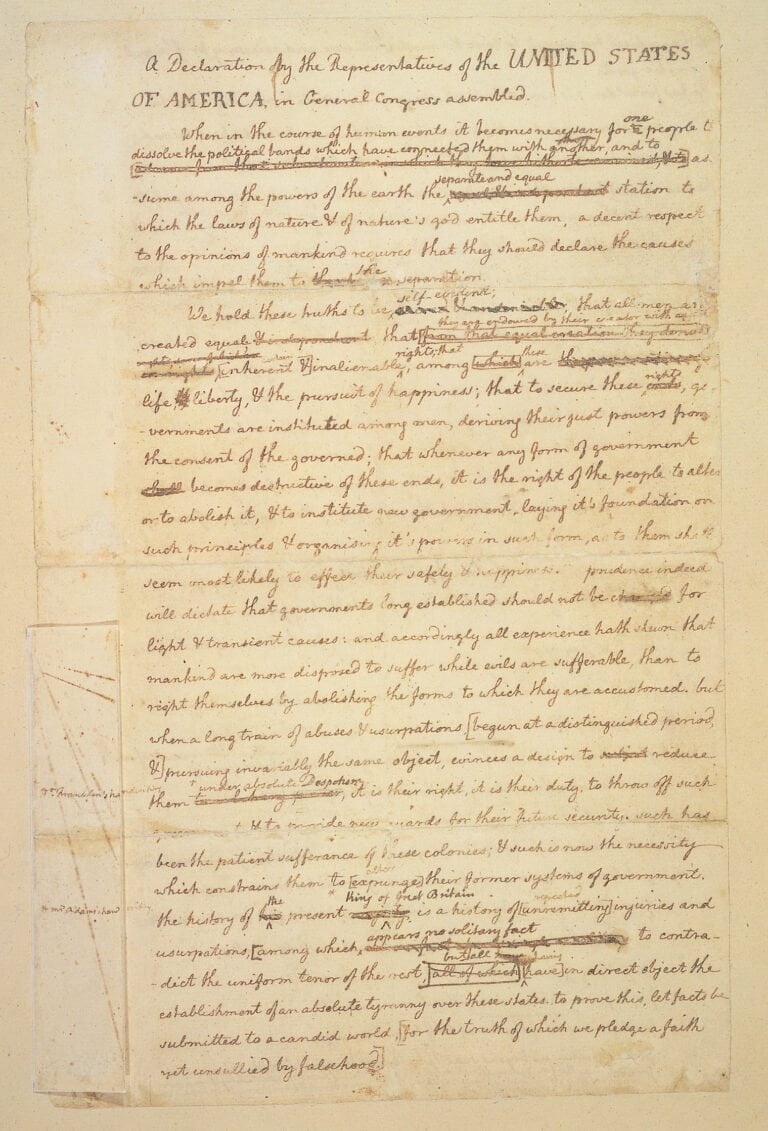
America’s Declaration of Independence: Edited for Cultural Expedience

By Robin Smith 

Monday, July 4 was the American holiday that serves as America’s birthday, filled with fireworks, barbeque, red-white-and-blue, time with family, friends and references to freedom.

Two hundred, forty-six years ago on America’s Independence Day, 56 men signed their names, and in effect, their own death warrant, to a document–the Declaration of Independence–announcing to the world that citizens of 13 colonies were uniting in the effort for independence. 

Colonists were fed up with the oppressive government which had made a mockery out of their worship by forcing universal support of the Church of England through taxes and were taking hard-earned money from colonists to redistribute to others through whims of King George III. 

The Declaration of Independence is still an amazing document to read. Drafted in June 1776 chiefly by Thomas Jefferson, a fiery writer whose powerful penmanship was the first, even before he was elected a Virginia delegate, to openly criticize the King of England, the original announcement was to first document that the actions against the Crown were necessary and then to justify, after failed attempts to be represented on issues and concerns in Britain, this independence. 

Jefferson cited 18 acts of tyranny, or oppression through government, committed by King George for these two goals. Four colleagues–John Adams, representing Massachusetts; Benjamin Franklin, representing Pennsylvania; Robert Livingston, representing New York and Roger Sherman, representing Connecticut–joined Jefferson as the appointed Committee of Five charged with the duty of crafting language which supported the historic act of creating a new nation and announcing the formation of a republic, deriving its “just powers from the consent of the governed.”

Yet, the first draft of Thomas Jefferson was edited, not by this committee, but by the Second Continental Congress, comprised of delegates representing the original 13 colonies. Dissecting the document, knowing they would be targets of the British, these delegates first eliminated a section assigning blame of the establishment of the slave trade in the colonies to the King.

While the global culture accepted the sin of slavery as part of gaining wealth for a nation, the Jefferson-led Committee of Five had seen King George’s efforts, “suppressing every legislative attempt to prohibit or restrain this execrable commerce.” The original Declaration of Independence draft declared the Crown not only protected disgusting acts for the purpose of commerce and profit, but “waged cruel war against human nature itself, violating the most sacred rights of life and liberty.”

The temptation to assign blame for a grave practice which benefitted the economies of nations exists. But allowing this to inform for our best days as a nation will reveal our wisdom. 

America is great because of her people…all of her people. But the expediencies for the purpose of popularity and profit predate King George, even ancient Bible times, and still live on. 

Americans will be blessed to learn and abide by Saint Augustine’s admonition, “Right is right even if no one is doing it; wrong is wrong even if everyone is doing it.”

Should Your Child and Our Future Leaders Be Taught What to Think or How? 

By Robin Smith 

Today, instruction material and course curriculum in our schools, public and private, amount to culturally driven content that falls into the category of teaching what to think: gender identity, safe sex and birth control options, role play to demonstrate racial and socio-economic divisions as well as injecting political topics and agendas. 

Rather than curriculum approved by “experts,” what exactly do our students need to survive in changing labor markets, tough economic times and to be ready for the next trends in workforce and opportunities in their futures?

In classic education, students are taught a common set of skills–reading, writing, arithmetic and foundational content that is built upon year after year that, metaphorically, is adding a rung upward in their ladder of success. These common skills apply to any discipline and transfer from one career to the next. This ladder to success is fortified by the idea of how to think for oneself rather than being told what to think.

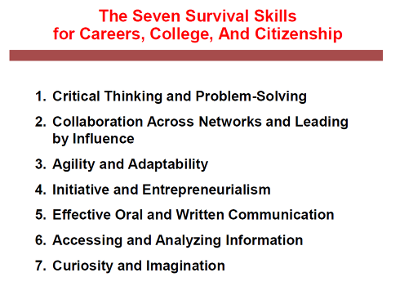
Tony Wagner, known for innovation in education as a senior fellow at the Learning Policy Institute and time in the classroom as a teacher and principal, has researched seven survival skills children need in the 21st Century that are infrequently being taught in schools today. 

Understand that in America, 54% of adults have a 6th grade literacy level. So, these survival skills mean little if schools continue to chase cultural topics rather than literacy. Nevertheless, here are the 7 Survival Skills as specified in almost 100 interviews of leaders “from Apple to Unilever to the US Army” for Wagner’s book, The Global Achievement Gap: Why Even our Best Schools Don’t Teach the New Survival Skills our Children Need:

1. Critical Thinking & Problem-solving: Able to ask questions that elicit and reveal the right answers.                                           

2. Collaboration Across Networks & Leading by Influence: Because most work is done in teams, being self-motivated while effective in teams is essential. Leaders emerge through effectiveness in building relationships in these teams.       

3. Agility & Adaptability: Due to ever-changing needs in the workplace and workforce, possessing critical thinking skills and problem-solving while being coachable to the common mission or goal is mandatory.

4. Initiative & Entrepreneurialism: Being a self-starter and pro-active are disciplines refined through practice and reward coupled with determination to find solutions, even when creativity must be applied.

5. Effective Oral & Written Communication: A foundation of literacy is the answer and only solution to these profoundly critical skills that transcend any job, career or vocation.

6. Accessing & Analyzing Information: Having information is useless if one can’t comprehend its meaning and application.

7. Curiosity & Imagination: Improvements come from innovations, which come from curiosities and imagination.

Lifelong learning is necessary for success, so read, read, read then encourage questions. Narrowing achievement gaps academically narrows opportunity gaps, which translates into success.

4 Warning Signs of Melanoma That Are Easy to Miss

0

The dangerous skin cancer can take on odd forms and pop up in unexpected places

Nearly 100,000 Americans are diagnosed with melanoma each year, making it one of the most common types of cancer in the U.S., especially among older adults who have endured decades of sun exposure and whose immune systems aren’t as robust as they once were. And while melanoma can be deadly, it is highly curable if caught early.

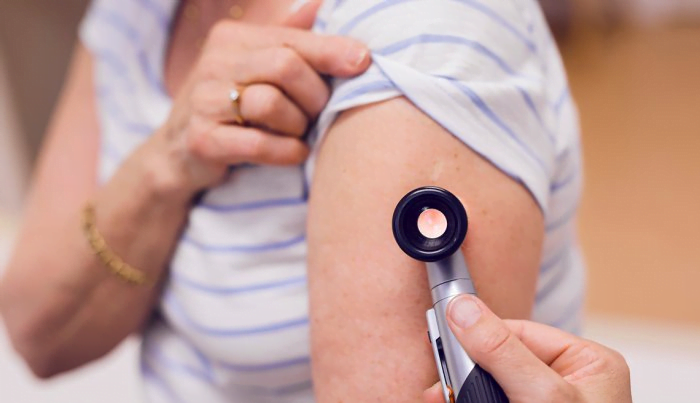
Do you know what to look for? The hallmarks of melanoma are asymmetrical or rough-looking moles that are not defined by a border. A spot on the skin that continues to grow in size or change is another indication, and a once-monthly body scan is an easy way to keep tabs on any of these concerning characteristics. But there are also some more unusual signs that could signal the presence of the skin cancer.

“Melanoma is such a rule breaker,” says Elizabeth Buchbinder, M.D., an oncologist at the Dana-Farber Cancer Institute in Boston and an assistant professor at Harvard Medical School. Little moles can cause big trouble, and new spots can grow and spread quickly, she adds. “And so knowing what to look out for, it’s super important.”

Here are four warning signs of melanoma you need to know about so that no spot goes unnoticed.

1. The ‘ugly duckling’

People who have lots of moles are at increased risk for melanoma. That said, there’s no need to start counting your spots or panicking over every mark on your body. Instead, pay attention to the moles that stand out — those that are darker than the rest, have changed recently or are more oddly shaped. Buchbinder calls these “ugly ducklings.”

“If you have a bunch of dark moles, but you have 50 of them, they’re not all melanomas,” she says. “But if you have one mole that really looks different than the others, and it’s kind of that ugly duckling, that’s the one that you really want to get looked at and checked.”

With women, melanomas most commonly appear on the arms and legs. Men need to pay special attention to their head, neck, back and trunk. Still, those aren’t the only places this type of skin cancer can pop up.

2. ‘Where the sun doesn’t shine’

The majority of melanomas are thought to be caused by ultraviolet (UV) light, but not all of them come from sun exposure. Melanoma can develop anywhere on the body, including “in places the sun doesn’t shine,” like the soles of the feet or the palms of the hand, says Elizabeth Quigley, M.D., a dermatologist and associate physician at Memorial Sloan Kettering Cancer Center in New York.

The cancer can also appear as a dark streak under a fingernail or toenail, which is what happened to musician Bob Marley, who initially mistook his melanoma for a bruise on the toe and eventually died from it. (A clue that you should see a doctor: a dark spot under the nail bed that doesn’t grow out with the nail over time, like a blood blister would, Buchbinder says.)

And while it’s rarer, melanoma can also develop on the eye, inside the mouth or on the scalp. Buchbinder has even seen patients experience changes in their hair color — “someone who had gray hair and developed a black streak” — because of a melanoma growing on the scalp. “So strange things can happen, but these aren’t common ones,” she adds.

That said, these “hidden” melanomas are more common in people with darker skin, points out Vishal Patel, M.D., assistant professor of dermatology at the George Washington School of Medicine & Health Sciences and director of the Cutaneous Oncology Program at the GW Cancer Center.

“So I tell Black and Indian and Asian patients that if you have nail changes, [any dark spots] on your palms and soles, as well as in the eye and mouth, these are ones that I worry about,” Patel adds. “Because while it is less common to have that, when it does happen, it is worse. So it’s important to know about that.”

Melanoma is more than 20 times more common in whites than in Blacks, according to the American Cancer Society. Hispanics are also less likely than whites to get the skin cancer. However, when melanoma develops in people of color, it’s often diagnosed at a later, more dangerous stage. A 2019 study from the Centers for Disease Control and Prevention (CDC) found that the five-year melanoma survival rate among non-Hispanic Black populations was 66.2 percent, compared with 90.1 percent for non-Hispanic white populations.

3. Red, white and blue hues

While melanomas are often depicted as dark-brown moles, they can actually present in a variety of colors. The cancer may have a blue tint to it, from deeper pigmentation, says Robert Brodell, M.D., a professor and chair of the Department of Dermatology at the University of Mississippi Medical Center. Or it can appear red, the result of an immune response. “The body is attacking it. It knows it’s abnormal and it’s trying to defend itself, and you get inflammation,” Brodell explains.

It’s also possible for a melanoma to “look like a rash,” says Quigley, and take on a pink hue. But when the spot doesn’t get better with creams and other treatments that normally nix a rash, “you need to check and make sure that that’s not a skin cancer,” she says.

Another sign of a melanoma can be lack of color. Some of these cancerous spots lose their pigmentation completely or partially, leaving a halo of white around a darker spot.

“And that’s something that gives us a little concern,” Buchbinder says. “Was the body recognizing something like a melanoma that was going wrong, and in its process of destroying the melanoma it destroyed some of the normal melanocytes [cells in the skin that produce pigment] in that area? It’s just one of those things that may kind of make you look a little closer at something.”

4. Spots on the skin that bleed or itch

If a mole on your body starts to itch or becomes more painful or tender, you need to get it checked out. The same goes if the surface of a mole changes. Maybe it starts to ooze or bleed or take on a scalier appearance and doesn’t heal on its own.

“We think that some of that irritation — the itching, the bleeding — is actually the body starting to recognize [the cancer] and starting to attack it a little, making it irritated. And so that’s why you’ll see some itching and bleeding and irritation near the actual mole,” Buchbinder says.

Skin cancer prevention

Wearing sun-protective clothing and UV-blocking sunglasses, and lathering up on sunscreen are some of the most effective ways to prevent melanoma. Another thing to keep in mind: People on certain blood pressure medications, including diuretics such as hydrochlorothiazide and calcium channel blockers such as nifedipine, for example, need to be extra cautious when spending time outside. “Many of those [blood pressure] medicines make us more sensitive to the sun and more likely to get a sunburn,” Quigley says, amplifying the risk of skin cancer.

Because not all skin cancers are caused by sun exposure, frequent skin checks are an important part of prevention, too. Catching a melanoma before it has time to grow in thickness and spread to other areas of the body greatly improves your chances of survival. (You can find tips on how to do a self-exam on the American Cancer Society’s website.) Keeping your immune system as strong as possible can also help prevent melanoma.

The bottom line: “People need to really be aware of their skin,” Quigley says. “And if there’s anything that seems abnormal, it’s not the time to wait — it needs to be evaluated. … Particularly with COVID, patients have been delaying their skin checkups and their skin evaluations, and we are seeing that that is detrimental.”

Risk Factors For Skin Cancer

A 2021 survey from the American Academy of Dermatology found that only one-third of adults are concerned about skin cancer, despite it being the most common form of cancer in the U.S.

Other findings from the survey:

  • 49 percent said they are more worried about avoiding sunburn than preventing skin cancer
  • 32 percent said they are more worried about avoiding wrinkles than preventing skin cancer
  • 25 percent said they got a sunburn in 2020

Robert Brodell, M.D., a professor and chair of the Department of Dermatology at the University of Mississippi Medical Center, says it’s important to know your risks for skin cancer. According to the CDC, the most common risk factors, include:

  • A lighter natural skin color
  • Skin that burns, freckles, reddens easily or becomes painful in the sun
  • Blue or green eyes
  • Blond or red hair
  • More than 50 moles
  • A family history of skin cancer
  • A personal history of skin cancer

(Source: American Academy of Dermatology/ by Rachel Nania, AARP, Updated June 22, 2022)

Chattanooga Drug Dealer and East Tennessee Woman Who Used Money for Plastic Surgery Accused in Covid Loan Schemes

0

By Camm Ashford 

The long arm of the law finally caught up with two East Tennessee residents accused of participating in what prosecutors are calling the “largest fraud in U.S. history.”

Arrests of Antonio Dewayne Menifee of Chattanooga and Leslie Danielle Bethea of Surgionsville are the result of what the Justice Department is regarding as an “epic swindle” of Paycheck Protection Program (PPP) funds.

In the wake of the economic and social disruption caused by the coronavirus, Congress on April 3, 2020 initially set aside $349 billion to be administered by the Small Business Administration (SBA)–in the form of the PPP–to help small business owners continue paying their employees during the pandemic. 

The program authorized banks and other financial institutions to make government-backed loans to businesses, loans that were to be forgiven if the companies spent the money on business expenses. 

Perhaps the largest and most significant federal emergency aid bill in U.S. history, an NBC News investigation last year reported that as much as $80 billion of the total $800 billion eventually authorized under the PPP was doled out to fraudsters in the U.S. and abroad and used to pay for luxury cars, mansions, pricey vacations, drugs and plastic surgery.

Federal officials acknowledge that the PPP program in 2020 sacrificed security for speed. And experts say millions of borrowers inflated their numbers of employees or just created companies out of thin air.

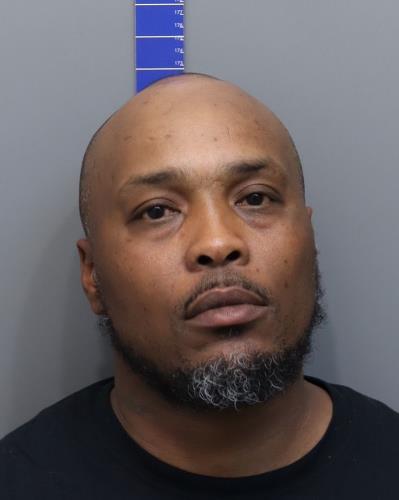
Menifee, a 45-year-old convicted drug dealer, is accused of submitting fake forms in April 2021 to defraud the SBA into granting him a PPP loan for a nonexistent construction firm. 

Bethea, 40, is accused of conning the SBA into awarding her a PPP loan for a fake business and using the money to get plastic surgery in Florida and spending a week recovering at the Trump International Beach Resort. She was already on probation in a federal fraud case.

Leslie Danielle Bethea of Surgionsville, 40, is accused of duping the Small Business Administration into awarding her a Paycheck Protection Program loan for a fake business and using the money to get plastic surgery in Florida.

Federal and state law enforcement officers in September 2021 sought to execute a search at 8209 Blue Spruce Dr., the residence of Menifee and his girlfriend, as part of an investigation into the $11,485 PPP loan Menifee received. They discovered and seized cocaine, a Glock 9mm later identified as stolen, ammunition, plastic baggies used to package drugs, digital scales used to weigh drugs and $15,000 in drug money, FBI Agent Coley Vincent Warner wrote in a criminal complaint.

Menifee was convicted in 2002 in U.S. District Court in Chattanooga of conspiracy to sell cocaine and guns. He served roughly a decade behind bars before he was released but later wound up repeatedly violating the terms of his probation by using drugs, lying to authorities and threatening violence against his wife, records show.

Menifee was ordered back to prison in 2017 as a result of those violations and served another 27 months. It’s not clear from the court record whether he was still on federal probation when he sought and won the PPP loan in 2021.

According to the U.S. District Court indictment, Bethea filed fake tax documents with the SBA in March 2021 to secure a PPP loan for $20,805. She has been charged with wire fraud and money laundering.

“On the electronic application … Leslie Bethea fraudulently stated that she was a sole proprietor of a marketing consulting services business that grossed $99,865 a year when, in truth and fact as she well knew, Leslie Bethea had no business that grossed that sum,” U.S. Secret Service Senior Special Agent Thomas Whitehead wrote in a criminal complaint.

Bethea was on federal probation for identity theft and for creating fake credit cards when she conned the SBA. Whitehead said in the complaint that Bethea was awarded the PPP loan without question and deposited the loan proceeds into her Knoxville bank account. She then used that money to travel to Aventura, Fla., in April 2021.

While in Aventura, Bethea “received elective cosmetic surgery services totaling $5,500” from Dolls Plastic Surgery over a three-day period, Whitehead’s complaint stated. The agent did not disclose details of that surgery in the complaint.

Bethea spent five days at the Trump International Beach Resort, a luxury hotel in Sunny Isles, Fla., while recovering from the surgery, using the Covid relief plan loan to pay the $2,834 tab, the agent wrote.

Both Bethea and Menifee are now behind bars awaiting further court action in their respective cases.