Saturday, October 17, 2026
Advertisement
Home Blog Page 131

Hamilton County Mayoral Candidates Debate Top Issues Organized by Non-Profit Coalition

0

WHO: Hamilton County Mayoral candidates 

                  Weston Wamp (R) and Matt Adams (D);  
              Ray Bassett, Scenic Roots host on WUTC 88.1 FM, moderates 

WHAT: General election forum 

WHEN: Thurs., July 21 at 8 p.m. EST 

WHERE: WTCI – PBS and WUTC 88.1  

Partnering organizations include the Chattanooga Area Chamber of Commerce, Chattanooga 2.0, Community Foundation of Greater Chattanooga, The University of Tennessee at Chattanooga, United Way of Greater Chattanooga, and The League of Women Voters of Chattanooga. Presented by WTCI-PBS and WUTC. 

Viewers and listeners will hear candid discussions about the candidates’ experiences, priorities and opportunities for Hamilton County’s future. The focus will remain on substantial issues. 

Early voting continues until July 30. The primary election is August 4. 

Chattanooga at ‘high risk’ for COVID, as infections rise across the state

Chattanooga at ‘high risk’ for COVID, CDC recommends remaining up-to-date on vaccines

If it seems like more people in your orbit have been coming down with COVID recently, it’s not your imagination.

COVID is spreading again, not yet at the same high levels of last spring, but the disease is experiencing a noticeable spike in Tennessee and across the country.

One in four Tennessee counties is now at high risk for COVID-19, part of a growing nationwide surge in the virus that nevertheless remains an undercount as a result of widespread and unreported in-home testing, according to July 14 data released Monday by the Centers for Disease Control and Prevention.

Chattanooga, Clarksville, Nashville, portions of northeast Tennessee and rural western parts of the state are in the 24 counties experiencing the highest rates of COVID.

Tennessee now ranks 13th in the nation for its rate of coronavirus. Hospitalizations have increased by 21% over the prior week, but inpatient levels remain far below previous surges that taxed nurses and doctors and swallowed available bed space in some of the state’s healthcare facilities.

CDC recommendations for people living in high-risk areas include wearing masks in indoor public places and remaining up-to-date on COVID vaccines. Tennessee is the 5th-least vaccinated state in the nation, based on its percentage of fully vaccinated individuals.

The CDC also advises people with symptoms to get tested and isolate from others to reduce the risk of transmitting disease.

Tennessee averaged more than 2,400 cases and seven deaths per day, according to Tennessee Department of Health data. The state’s current fatality rate from COVID hovers at about twice above the national average, according to the CDC. As of last week, the state reported that 26,772 Tennesseans have died since the beginning of the pandemic in 2020 after contracting COVID. (Source: Anita Wadhwani, Tennessee Lookout) 

On “Turbulence,” “Accents” and “Ifs”!

0

I’m amused by life in today’s “whining America,” the land of the “woe is me.” I mean after hearing account after account of the devastation of lives in war-torn Ukraine, poverty-stricken Haiti and the pain and suffering by families who lost loved ones to COVID-19, and mass shootings in gun crazy America, one would think that we’d not sweat the everyday annoyances and small stuff. Obviously not. 

Which brings me to a flight, a big city mayor and a novelist. First the flight.

During our recent five-hour flight from Georgia to California, the first three hours were as smooth as ever. It was about then that we encountered 45 seconds of bumpy turbulence. So, does 45 seconds of turbulence during a five-hour 18,000 second flight across country make that a bad flight? Deliberate on that thought for now. 

Which brings me to that big city mayor.

“If you place the accent on the wrong letter, you’re going to mispronounce the word,” advised New York City mayor Eric Adams in an interview with columnist Maureen Dowd. “If you place the accent on the wrong moment in your life, you’re going to mispronounce your life. Place it on how many times you got on the train, and nothing happened to you. Nothing eventful. That’s where the accent should go, not ‘Hey, this is my 900th ride and you know what, I saw a homeless person today. Oh my God, things are out of control. They’re not!” 

Just curious gentle reader; if I apply Adam’s logic and place the accent on that 45 second of turbulence, do I “mispronounce” the 18,000 seconds of smoothness during the entire flight? Hold that thought as I pose than answer my own questions.

If I sometimes err with an improper use of a past participle or irregular verb (or a comma splice in this piece you’re now reading) does that make me bad writer? I sure hope not.

If I unleash an occasional “OMIF” (Open Mouth, Insert Foot) comment and offend someone, as I’m sometimes prone to do, does that make me a bone-headed troglodyte? Please, please don’t say yes.

If I showed up as a brick throwing fool during last year’s insurrection at the nation’s Capitol, does that make me an idiot? (Oops, strike that. Next question please). 

If I had a one-time bad experience in a restaurant I’ve eaten in for years, say my French Fries were cold or the service was slow because of a staff shortage, does that warrant my avoiding that restaurant in the future and nailing it with a bad rating in social media? It shouldn’t.

Which brings us to the turbulent times of today; violence and turbulence in our communities, our nation, our world and in our political and economic systems, a world with too many short fuses, too much flying off the handle at the slightest inconvenience, where cutting someone some slack is the exception and not the norm. 

Which brings us to the journalist.

Rudyard Kipling was an English journalist, poet, and novelist. He wrote the following poem, “If,” in 1895 as advice to his son encouraging him to move through life with composure, self-control, integrity, and humility. Please think about the turbulent times we live in today and your life as you read each lyric: 

IF, by Rudyard Kipling

If you can keep your head when all about you
   Are losing theirs and blaming it on you;
If you can trust yourself when all men doubt you,
   But make allowance for their doubting too;
If you can wait and not be tired by waiting,
   Or, being lied about, don’t deal in lies,
Or, being hated, don’t give way to hating,
   And yet don’t look too good, nor talk too wise;

If you can dream—and not make dreams your master;
   If you can think—and not make thoughts your aim;
If you can meet with triumph and disaster
   And treat those two impostors just the same;
If you can bear to hear the truth you’ve spoken
   Twisted by knaves to make a trap for fools,
Or watch the things you gave your life to broken,
   And stoop and build ’em up with wornout tools;

If you can make one heap of all your winnings
   And risk it on one turn of pitch-and-toss,
And lose, and start again at your beginnings
   And never breathe a word about your loss;
If you can force your heart and nerve and sinew
   To serve your turn long after they are gone,
And so hold on when there is nothing in you
   Except the Will which says to them: “Hold on”;

If you can talk with crowds and keep your virtue,
   Or walk with kings—nor lose the common touch;
If neither foes nor loving friends can hurt you;
   If all men count with you, but none too much;
If you can fill the unforgiving minute
With sixty seconds’ worth of distance run—
   Yours is the Earth and everything that’s in it,
And—which is more—you’ll be a Man, my son

In closing, I remember my late dad telling me one lazy summer afternoon while we sat on our back porch, “son, the biggest word in the English language is the word “if.” 

Humm, let that sink in for a moment!

© TerryHoward is an award-winning writer and storyteller. He is also a contributing writer with the Chattanooga News Chronicle, The American Diversity Report, The Douglas County Sentinel, Blackmarket.com, co-founder of the “26 Tiny Paint Brushes” writers’ guild, recipient of the 2019 Dr. Martin Luther King, Jr. Leadership Award and 3rd place winner of the 2022 Georgia Press Award. He can be reached at wwhoward3@gmail.com

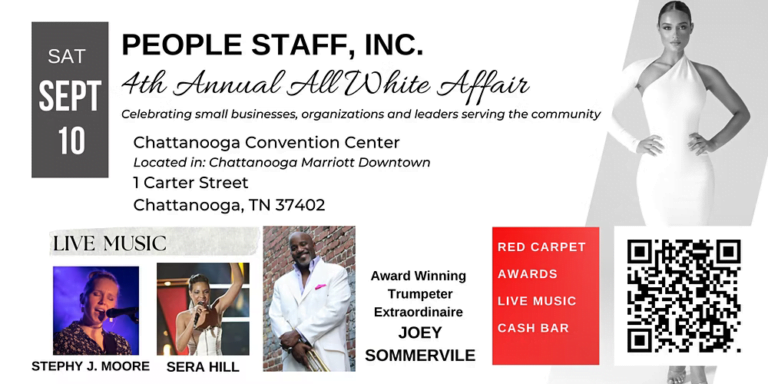
People Staff, Inc.’s 4th Annual All White Affair

People Staff, Inc.’s 4th Annual All White Affair, September 10, 2022 at the Chattanooga Convention Center is a celebration of small businesses, organizations and leaders serving the community. 

This years’ event will start at 8:00pm. Red carpet, mix and mingle and cover music provided by Stephy J. Moore will begin at 7pm. Stephy will sing songs recorded by artist such as, Corrine Bailey Rae and Norah Jones. The event also includes leadership awards, light finger foods, cash bar and live music.

This year’s awards will be given to two community leaders; Denita Strickland, Serenity Childcare I and II and Chattanooga’s own and Rock and Roll Hall of Famer, Willie Kitchens, Jr.. Both of these individuals have generously given of their time and resources to prepare our youth to compete, help others in the community to meet their goals and lend a helping hand to those in need.  

Joey Sommerville, featuring Sera Hill is our headliner for the evening. SeraHill, season 2 of the NBC show “The Voice”, will perform cover music recorded by artist such as, Beyonce and Mary J. Blige. Joey Sommerville, who has recorded the hit songs, “School Boy Crush” and “Like You Mean It”, will play contemporary jazz, blues and R&B. It is sure to be a great celebration.

Whole and Half tables can be purchased online at www.peoplestaffannualallwhite.com. (The QR code below will also take you to the website where you can purchase your whole or half table.) 

You can buy tables, half tables and individual tickets to general tables at Uncle Larry’s on MLK, Brainerd Road and Highway 58; Sunset BBQ on Dodson Avenue; C&W Café on East 23rd Street; and Herman’s Soul Food on Brainerd Road beginning July 15, 2022. 

Put on your “all white outfits” and join us as we celebrate Denita Strickland and Willie Kitchens, Jr. This event will be video recorded.  

Whole tables (8 seats): $500 Half tables (4 seats): $250 Individual Tickets (1 seat): $62.50
All tables and half table tickets ordered online can be picked up at the event receptionist table the day of the event.

UTC Affordable Course Materials Program Saves Students $1 Million Since 2017

CHATTANOOGA—In just five years, more than $1 million has been kept in the pockets of students at the University of Tennessee at Chattanooga by its Affordable Course Materials Initiative.
 
The initiative was barely more than a good idea when Rachel Fleming joined UTC as scholarly communications librarian in 2017 and was charged with taking it forward.
 
“What drew me to UTC was that affordability was part of the position, and I was looking for something where I knew the work that I do would make an impact for the good of students and this is very fulfilling to me,” Fleming said of the Affordable Course Materials initiative.
 
“One of the things librarians like to do is talk to all of the faculty and help them design what they need for their courses, and I love hearing from them about how we can do that.”
 
Developing more affordable course materials for UTC students is the result of collaboration between Fleming and faculty who come for help designing and preparing materials that can replace textbooks in achieving course learning outcomes. In most cases, course materials costs are completely eliminated in revised courses.
 
“It’s really the faculty who are doing the work of adjusting their courses,” Fleming said. “We’ve worked on courses at all levels—introductory to upper-division to graduate-level—and I’ve worked with faculty from all colleges.”
 
To learn more about what’s happening on campus, visit UTC Newsroom.

How to Qualify for a Small Business Loan in 5 Steps

While most loans require a good credit score, beyond that, qualification criteria can vary. That’s true both when comparing two loan types and two loans of the same type from different lenders. But you still have a shot: There are a few universal steps you can take to improve your chances no matter the loan type.

1. Build your credit report

Your personal and business credit scores are essential to a lender’s decision. These scores show lenders how responsible you are with their finances and how likely you are to repay the loan. Your personal score, typically the FICO score, can range from 300 to 850. Your business score, the FICO SBSS score, can range from 0 to 300. The higher your scores, the better you look to lenders.

While you can generally find financing unless your credit score is extremely low, pushing your score opens doors to bank loans and SBA loans. These funding routes are typically the borrower-friendliest. You can improve your credit scores by regularly repaying your debts – credit cards, student loans, and more. If your score is already good, you can open one or two more credit accounts, keep low balances on them, and repay them quickly. Over time, your credit score will likely rise.

You should also go over your credit reports and dispute any errors to make sure your rating isn’t getting needlessly dragged down. Roughly one in every three people finds errors in their reports. These errors can be make-or-break when applying for small business funding.

2. Research what the lender expects from you

Typically, lenders require potential borrowers to meet minimum criteria in several areas – not just credit score – to qualify for financing. You may need to be in business for a certain number of years or be a U.S. citizen. You might also need to put up collateral.

Before applying, you should look into what lenders might expect of you. This way, you only apply to loans that work best for your financial situation and business goals. The minimum requirements you’ll need to reach will differ depending on the type of loan you pursue.

Highly desirable financing options such as SBA loans will typically require minimum personal and business credit scores of around 680. They’ll also require at least two years of prior business experience.  In some cases, $100,000 in annual revenue may be required. And in other cases, if you don’t meet certain criteria, you can remain eligible if you excel in some others.

Loans catering to bad credit ratings (generally 630 and below) tend to have less restrictive minimum requirements. As a result, their vetting process and payouts are often faster than with traditional lenders. However, loans for bad credit are usually lower-quality.

For example, two-to-five-year loan terms are possible, meaning you’ll have to make larger monthly repayments. Loan amounts might cap at $50,000, less than you can get elsewhere. Bad-credit APRs can be orders of magnitude larger than high-credit loans. If that’s all that you can get based on lender qualifications, then it’s better than nothing. But if you can meet higher lender expectations, go for it.

  • Common lender requirements to qualify for a loan include a certain number of years in business, a minimum annual revenue, and U.S. citizenship.
  • Loans with borrower-friendlier repayment terms, loan amounts, and interest rates typically have stricter requirements.
  • If you can’t meet these requirements, other loans are available. However, they’ll likely cost you more.

3. Gather necessary documentation

Since traditional lenders have stringent vetting procedures, they often require a large amount of paperwork to approve your application. If you want an answer as quickly as possible, it’s essential to gather all the correct documents ahead of time. Typically, qualifying for a loan requires:

  • Bank statements and credit reports. Bank statements allow a lender to look at how your business managed its finances within a recent period. Similarly, lenders will typically ask for a credit report to see how well you and your business have managed your bills and debts.
  • Income statement. An income statement is one of the three main documents that help lenders understand your business’s financial performance. It reports your revenues and expenses over a certain period. It also indicates your net profit or loss during that period.
  • Balance sheet. The second of the three key documents for analyzing business finances, your balance sheet is a snapshot of a point in time. It summarizes all your assets, liabilities, and shareholder equity alongside your business’s net worth.
  • Cash flow statement. Your cash flow statement is the last of the three key documents. It tracks how cash and cash equivalents flow through the business. Lenders can use it to see how well you earn revenue to repay your debts.

4. Write a great business plan

Lenders will want to know how you plan to use their financial backing before signing off on your loan. This way, they can be sure that their extra capital will earn you profits you can use to repay the loan. A great way to give lenders everything they need on this front is with a business plan.

There are roughly a dozen parts to a business plan. Below are roughly half of them.

  • An executive summary. Start your business plan with a brief overview of various aspects of your business, including its main focus, products, and ownership structure.
  • Company description. Provide a detailed summary of several essential pieces of information about your business, including key personnel, the problems you solve, and your company history.
  • Business goals. Give a clear synopsis of what you’d like your business to accomplish in the short and long term. Here, you’ll detail why your business needs funding and show how you’ll use this funding to accomplish your goals.
  • Operational structure. Here, you’ll list all business owners and partners. You should also include each owner or partner’s percentage of ownership and detail their involvement in typical company operations. After that, you should outline your entire organizational structure from top to bottom.
  • Products and services. Get into the details of your products and services. For the best possible overview, explain:
    • How your product or service works and the need that it fulfills
    • Why your product or service fills that need better than your competitors
    • Your pricing model
    • The target demographic for your product
    • Your business’s sales, marketing, and distribution strategies
    • The equipment you’ll need
    • The potential for competitor patents or legal issues
  • Marketing strategy. Here, you’ll go into depth about your marketing strategy. You should name all the ways you’ll get customers to purchase your product over competitors’ offerings. Be sure to specify the strengths that set your business apart from competing brands. Doing so helps build confidence in the lender that you can reliably repay their debts.

Other sections discuss your competitor analysis, break-even analysis, target audience, and more.

Note that banks in the SmartBiz network do not require a business plan to apply for an SBA loan, a bank term loan or other financing.

5. Put up collateral

Many lenders will require you to put up collateral. This way, they can seize and sell your property to recoup their money if you can’t repay it. Your collateral can be any piece of equipment, inventory, or real estate with value equal to or greater than your loan amount.

Some lenders avoid collateral in favor of a personal guarantee. This clause in your loan contract allows the lender to seize any of your personal assets, whereas collateral limits the lender to certain assets. Other lenders don’t require collateral at all – the typical credentials are all they need to determine your eligibility.

Consider whether you want to risk losing your assets before you agree to put anything up for potential seizure. If you’re confident you can repay your loan, the risk may be worth it to get yourself access to the highest-quality loans available.

Find out whether you pre-qualify for a small business loan

Small business owners and aspiring entrepreneurs may find themselves bouncing from lender to lender to find one that will approve them for a loan. While prior research and good preparation can help, the journey might still be a guessing game – unless you quickly check whether you pre-qualify.

With SmartBiz®, you can see whether you pre-qualify in just minutes. If you do, SmartBiz will match you with the lender best for your needs. You’ll have an actual person, not just an online tool, available for help throughout the process. Check whether you pre-qualify now* – and, if not, take all the above steps and try again. You might get there sooner than later. (Source: SmartBiz)

Too Hot to Handle: Climate Considerations for Youth Sport During the Hottest Years on Earth

0

By Jessica R. Murfree, Texas A&M University; Natasha Brison, Texas A&M University

At least 50 high school football players in the U.S. have died from heat stroke after falling ill on the field in the past 25 years. And high school athletes in other sports are not immune from the risks – female cross-country athletes are twice as likely to suffer from heat-related illnesses as athletes in any other high school sport.

The numbers are especially shocking when you consider that heat-related illnesses and deaths are entirely preventable.

While sports equipment has improved over time to protect against concussions, young players and college athletes are facing increasing risks from rising heat.

We study sport ecology and legal aspects of sport. With summer temperatures rising, we believe many youth sports leagues and school districts will need to aggressively update their practice rules and heat policies to keep their players safe. We suggest particular attention be paid to low-income, minority neighborhoods and regions that can get excessively hot.

Heat risks in youth sports

Each year, summer marks the return of discussions of just how severe the sweltering heat is. Nine of the 10 hottest years on record globally have been since 2012, and this year’s late-spring and early-summer heat waves were previews for what forecasters warned would be a brutal summer of 2022.

Yet many interscholastic and preparatory sport summer camps have kids running hard through the summer months, sometimes on days that reach triple-digit temperatures.

In a period of rapid climate change, ensuring heat risks remain preventable is critical.

Heat is the most frequent climate-related killer in the United States, with more deaths associated with it than tornadoes, floods and cold temperatures. And days of extreme heat and humidity are now surpassing concerning levels for human health. Overall, the Centers for Disease Control and Prevention reported an average of more than 700 heat-related U.S. deaths each year between 2004 and 2018. Some of the hottest years ever recorded have happened since then, and preliminary data detailing heat deaths in the U.S. indicates the rate increased 56% from 2018 to 2021.

Extreme heat due to climate change is making sport participation progressively challenging.

For high school athletes, the prevalence of extreme heat is leading to escalating heat-related illness, injuries, hospitalizations and deaths. In fact, heat stroke is a leading cause of death in sports.

Unsurprisingly, the greatest concentration of heat illness in young athletes occurs in August: the back-to-school and back-to-sports season.

When heat risks trigger lawsuits

Recognizing the warning signs can be especially challenging for children and teens. Young people are still learning how to communicate their feelings and experiences, and that can be more difficult in sport environments that promote toughness and perseverance. Ultimately, young athletes must trust adults to protect them.

Evidence suggests the prevalence of exertional heat stroke among high school athletes is largely due to young athletes’ not acclimatizing, or physically adjusting to the heat, particularly in the first few weeks of practice. Although heat policies related to temperature and hydration exist at the high school level, they aren’t always enforced. And they may need to be improved to reflect the warming climate given the rate of heat illness.

Signs of heat illness and what to do. Elenabs via Getty Images

As a result, parents and guardians are faced with how best to advocate for their children.

In some cases, families have sued after heat injuries, both to recover money for their child’s suffering and to drive change in the hope that no other child will have to endure what others have. However, the heat injuries continue to rise.

Adults’ responsibility to keep children safe in sport settings becomes blurry as the growth in legal challenges related to heat illness demonstrates a disconnect between adults’ duty of care and athletes’ well-being. Negligence is a common claim associated with these lawsuits. Allegations of child endangerment or wrongful death can lead to civil or criminal legal disputes. But can reactive legal action prevent these heat injuries in the long run?

The fact that heat injuries are preventable is often why legal cases alleging negligence and wrongful death are successful. Still, heat stress, heat exhaustion, heatstroke and sunstroke are not uncommon in sports. Medical researchers have described heat illness among athletes as one of the most prominent pieces of evidence of climate change’s hazards and effect on sport.

Climate injustice for young athletes

Extreme heat can also enhance existing injustices and inequities.

For example, non-Hispanic Black Americans suffer heat-related deaths at a rate higher than the U.S. average. That doubles for Indigenous and Native Americans, who report the highest death rate from heat.

For athletes, the consequences of extreme heat can further complicate environmental and climate injustice. For instance, racial minorities and those in lower socioeconomic brackets have greater chances of living in the warmest areas, including urban heat islands, where heat trapped by pavement and buildings can make temperatures several degrees hotter than the city average.

The heat index is a combination of heat and humidity. Heat-related hospitalizations begin rising at lower heat index values in normally cooler parts of the country. Climate Central, CC BY-ND

At the same time, efforts are underway to diversify the sport landscape and provide equitable access to sport and recreation for all people. A vicious cycle spins between social justice – efforts to diversify sports – and environmental and climate justice, in which the most vulnerable communities face the greatest climate harm and health risks but are underresourced and ill-equipped to adapt to the changing climate.

Moving forward

Sports leagues and athletes have taken a stand on many social issues, but they are often reactive when implementing and advocating for change.

For instance, leagues implemented regulatory policies regarding brain safety only after countless tragedies. People began to focus on traumatic brain injury and chronic traumatic encephalopathy after the deaths of numerous NFL players and a blockbuster film.

The heat-related deaths of collegiate and NFL football players, notably Minnesota Vikings player Korey Stringer, have drawn some attention to the risks. Tokyo 2020 Olympians and FIFA World Cup organizers have cited the need for regulatory changes because of the effects of extreme heat on athlete health. But it’s often only after a tragedy that improvements are made to protect young athletes from heat illness.

The sport sector can make immediate practical and policy-related adaptations to extreme heat to protect children. These include modifying practice schedules, increasing the number of water breaks, revising athletic heat policies to reflect climate change, and implementing procedures to ensure compliance by coaches and athletic administrators.Texas A&M students Ariana Taylor and Ashwin Mathew in the DeBakey Executive Research Leadership Program contributed to this article. (The CONVERSATION)

6 Ways to Keep Kids’ School Skills Sharp Over the Summer

0

Suzanne McLeod

Assistant Professor of Educational Leadership, Binghamton University, State University of New York

Worried your kids will forget what they learned in school over the summer? Scholars have been studying the problem for over a century.

When William White, a New York state mathematics professor, set out in the early 1900s to study how much math students remembered over summer vacation, he checked to see how well they would do at the start of school on a test like the one they had taken at the end of the previous school year.

Whereas second graders on average got nine out of 70 questions wrong in June, after the summer break on average they got 25 out of 70 wrong on the same test. But after two weeks of drills, the number of answers the students got wrong dropped to 15.

White’s study – titled “Reviews Before and After Vacation” and published in 1906 – concluded that “that which is least vital is first to be lost.”

White’s study is also one of the first to identify what educators today refer to as “summer learning loss” – which is the negative effect that a long summer break has on students’ ability to remember facts and skills they had learned the previous school year.

Effects on student achievement

Studies of summer loss increased in the 1990s as Congress began to place a bigger emphasis on holding schools accountable for the achievement of all students.

Over the summer, students typically lose the equivalent of about a month’s worth of learning, mostly in the areas of math facts and spelling. Research has also found that summer learning loss is more severe among students with disabilities, English language learners and students living in poverty.

But researchers’ understanding of summer loss is continually evolving. For instance, one study found that the students who experienced the biggest losses were the ones who had shown the biggest gains just before the test at the end of the school year. This raises questions about whether their gains were true gains or just the result of special preparation for the test.

A longer school year?

Some people have argued that summer loss wouldn’t occur if the U.S. had a longer school year or year-round school. For instance, they point to countries like China, where the school year is 245 days, as opposed to the traditional 180-day school year in the U.S. China is ranked first in the top 20 nations in terms of student scores in math, science and reading. The U.S. is ranked No. 25 out of 77 countries and is several points behind Australia, Switzerland, Norway and the Czech Republic, which are ranked 21 to 24, respectively.

But shorter school years don’t always result in lower test scores. For instance, students in Ireland outscore American students on math, science and reading by an average of 10 points, according to the Program for International Student Assessment, better known as PISA, yet attend school for only 167 days, or 13 days fewer than in the U.S.

How parents and caregivers can limit summer loss

Some parents take advantage of school-based programs that can help students keep up their academic skills during the summer. But there are still ways that parents and other caregivers can stave off summer loss that do not involve school. Here are six:

1. Model what you want to see: First and foremost, never forget that you are a role model. Children will do what they see the adults around them do. Summer is the perfect time for you to reduce screen time and increase time reading, writing, taking walks, playing games or having conversations.

2. Visit the library: Children love independence. One of the best ways to allow children to demonstrate independence is to have them browse the shelves of the local library and select books that they can read independently or for you to read aloud to them. Participate in story hours if your local library offers the activity. Establish a habit of visiting the library on a weekly basis or at least several times a month. These library visits will strengthen a child’s reading skills.

3. Play games during trips: When traveling by car, bus or train, there are games – both word and number – that you can engage in with your children. For instance, you can play “I Spy with My Little Eye,” estimate the number of fast-food restaurants you’ll pass or even look for all the words that begin with a certain letter. These activities not only keep children engaged but also incrementally sharpen their skills in a wide range of academic areas such as literacy, numeracy and communication.

4. Encourage your children to keep a summer journal: To get them started, suggest one journal entry of “10 Things I Want to Do Before Summer is Over.” The list can include activities like watching the sunrise, going an entire day without wearing shoes or seeing how far they can spit a watermelon seed. To make the journal more interesting, encourage children to fill it with both writing and drawing.

5. Visit landmarks: Plan visits to acquaint you and your children with local landmarks. Document the visit with a journal entry, drawings or photographs and some research on the history of the site. The excursions can become even more meaningful if you have children do a little research into the landmarks you visit.

6. Plan weekly family picnics: Vary the meals to include breakfast, lunch, dinner or even dessert. Let your children plan the menu and cook with you, as well as select the site for the picnics. Research has found that involving children in the preparation of meals by doing things such as making grocery lists can help improve their reading, writing and math skills. (The CONVERSATION)

COVID-19 Cases in TN & COVID-19 Testing in Hamilton County, TN

0

The Tennessee Department of Health reports the number of test results for the entire state on their website at 2PM Central (3PM Eastern). In the case of a discrepancy between the two websites, our local data should be considered the more up-to-date for Hamilton County. 

Hamilton County Coronavirus (COVID-19) Current Case Information
New Cases for July 20, 2022 208
Total Number of Cases108,111
Deaths / Muertes1,185

*Case Count includes confirmed and probable COVID-19 cases.

Tennessee Department of Health Coronavirus (COVID-19) Current Case Information

Hamilton County Coronavirus (COVID-19) Current Case Information

****************************************************************

COVID-19 Testing in Hamilton County, TN

Call the COVID-19 hotline at 423-209-8383 to find testing options near you.  

The Health Department is currently distributing rapid-antigen COVID-19 test kits at the following health clinics, while supplies last. Please call in advance for test kit availability:

East 3rd Street Clinic
921 East 3rd Street Chattanooga, TN 37403
Hours: Monday-Friday, 8:00 a.m. – 4:00 p.m.
Phone: 423-209-8383

Birchwood Health Clinic
5625 TN-60 Birchwood, TN 37308
Hours: Tuesday, Wednesday, Friday, 8:00 a.m.- 4:00 p.m.
Phone: 423-209-5540

Sequoyah Health Clinic
9527 W Ridge Trail Rd Soddy Daisy, TN 37379
Hours: Monday-Friday, 8:00 a.m. – 4:00 p.m.
Phone: 423-209-5490

Ooltewah Health Clinic
5520 High Street Ooltewah, TN 37363
Hours: Wednesday-Friday, 8:00 a.m. – 4:00 p.m.
Phone: 423-209-5440

*Please do not line up prior to the clinic opening. Test kits will be available during normal operating hours.

New Analysis: State Abortion Bans Will Impact 36 Million Women

Women of color, women with disabilities, and women veterans will be harmed  

Click here to find out how many women in your state will be impacted:

https://www.nationalpartnership.org/our-work/economic-justice/reports/state-abortion-bans-harm-woc.html

Washington, DC — A new analysis from the National Partnership for Women & Families finds that millions of women living in the 26 states where abortion is banned or likely to be banned will be impacted because of the recent Supreme Court decision on Dobbs v. Jackson Women’s Health Organization that reversed Roe v. Wade.

36 million women of reproductive age live in these states, but the nearly 15 million Black and Native American women there are most likely to be impacted by the bans. Women with disabilities, women veterans, and women who are economically insecure are also disproportionately likely to live in these states. Here is a breakdown of the data:

  •  2.8 million are women with disabilities;
  • 12.6 million are women who are economically insecure;
  • 15.8 million are mothers with children at home; 
  • 389,600 are veterans; and
  • 14.8 million are women of color including:
  1. 5.8 million Black women;
  2. 6.5 million Latinas;
  3. 1.3 million Asian women;
  4. 34,300 Pacific Islander women;
  5. 285,500 Native American women; and
  6. 908,200 multiracial women.

The research reveals that the Dobbs decision will dramatically impact the lives, plans, and economic security of the women in these states, especially for women of color.

This brief is one of several resources available from the National Partnership on next steps people can take following the decision. Find more in “Dobbs v. Jackson WHO—What Now?”