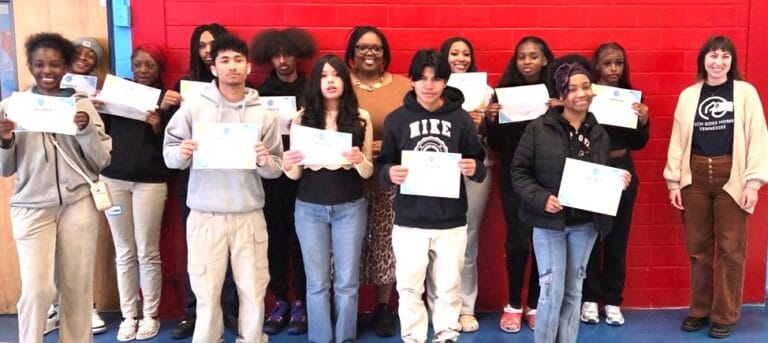
Brainerd High School students work on laptops during the Tech Goes Home digital literacy program.
Students at Brainerd High School recently celebrated the completion of a digital literacy program designed to equip them with the skills and technology needed to succeed in an increasingly connected world.
The Tech Goes Home program was implemented at the school in January 2026 and concluded with a graduation ceremony and device distribution on March 12. A total of 64 students participated in the program, most of them juniors, along with several seniors and one ninth-grade student.
The initiative is part of Tech Goes Home Chattanooga (TGH CHA), the digital inclusion program of The Enterprise Center. The local program is modeled after the national Tech Goes Home initiative, which was founded in Boston in 1999 and has helped participants gain access to technology, internet connectivity and digital education.
Dr. Squoia Holmes, a Computer Science Foundations teacher at Brainerd High School who served as the program’s trainer, said the partnership strengthened the learning already taking place in the classroom.
“Integrating the Tech Goes Home program into our Computer Science classroom was a powerful extension of the learning already taking place at Brainerd High School,” Holmes said. “This program enriched learning by giving students an incentive to continue growing as responsible digital citizens.”
Through the program, students completed 15 hours of digital skills training designed to help them understand how technology and the internet can support their daily lives, education and career goals. Upon completing the course, participants received a new Chromebook and information about accessing low-cost home internet services.
The program’s curriculum focuses on practical technology skills such as navigating the internet safely, using online tools for schoolwork, managing digital communication and exploring resources for education and employment.
Tech Goes Home Chattanooga partners with schools, public libraries, churches and nonprofit organizations throughout Hamilton County to provide free courses that promote smart technology use and digital citizenship. Programs are available for residents of all ages, including adults, school-aged children and preschoolers.
Organizers say the goal is to help bridge the digital divide by ensuring that residents have the devices, skills and connectivity needed to access 21st-century opportunities.
Located at 1020 N. Moore Road in Chattanooga, Brainerd High School is part of Hamilton County Schools and serves a diverse student population. The school offers a range of academic and career programs, including Advanced Placement and dual-enrollment courses, as well as career and technical education pathways in fields such as aviation and health sciences. School leaders say initiatives like the Tech Goes Home program help ensure students are prepared not only for college and careers, but also for navigating a technology-driven world.
For decades, there has been an ongoing controversial discussion about the origins of the famous Kentucky Fried Chicken original recipe. The controversy is whether or not the recipe that made KFC founder Colonel Harland David Sanders a wealthy billionaire was stolen from a Black woman named Miss Childress. Unfortunately, this debate exposes past and current problems when it comes to cultural misappropriation, intellectual property, and inequality.
According to some sources including the African Diaspora Facebook page, the claims are true. Miss Childress was, in fact, the woman behind the orignial KFC recipe. Not only did Colonel Sanders steal her recipe, he later tried to pay her $1,200 for it and then the company went on to become a multi-billion global empire. Another unverified source says that Miss Childress died in poverty, which doesn’t sound very far-fetched.
No solid evidence really exists – The problem, however, is that there is no real solid evidence that proves any of this. But there is a pattern in history that reflects a similar narrative. In fact, there are quite a few accusations of white entrepreneurs and chefs taking recipes from African Americans without giving them the due credit. For example, it’s been proven that the inventor of the Jack Daniel’s recipe was a former slave.
Sadly, it’s often very hard to prove because many Blacks during those times were denied the right to learn to read and write. Because of this, they were not able to properly document their culinary practices and recipes nor understand legal documents pertaining to intellectual property.
The truth is obvious – But for many, the success of KFC is obviously attributed to Miss Childress’ recipe, which was a blend of herbs and spices used to season the chicken itself. During those times in the 40-50s, America’s best-tasting fried chicken, cornbread, greens, and other popular dishes were traditionally prepared and cooked by Black women – usually maids or family housekeepers. White people were typically clueless in mastering these types of cuisines.
However, according to a book entitled Colonel Sanders and the American Dream by Joshua Ozersky, Colonel Sanders “tried to create an alternative reality in which the white planter not only ate the chicken, but implicity made it.” But again, this narrative is very inconsistent with the era when KFC was created.
In his book, Ozersky further reveals that Colonel Sanders tried to attribute the use of the pressure cooker to the success of KFC. When Colonel Sanders patented his pressure cooker process in 1966, he reportedly said that the method he had come up with allowed cooks in his restaurants to create “accurately controlled conditions of temperature, pressure, time, sizes of serving pieces, and the amount and composition of breading used” to create chicken that had a superior taste with great texture.
But obviously attributing the success of KFC to a pressure cooker instead of to the Black woman who actually created the recipe is both an insult to her… and to the company itself. Editor’s Note: According to various websites, the original recipe of Kentucky Fried Chicken (KFC) is one of the most famous trade secrets in the food industry. It is NOT PATENTED, allowing it to remain a secret indefinitely….which unlike patents EXPIRE.
Civil Rights activist, beaten and arrested 27 times!
I was in the middle of switching TV channels back and forth between watching the memorial services for the late Rev. Jesse Jackson and the conflict in Iran when I answered a call from my buddy Bill.
“Hey man, are you watching the service for Jesse? President Obama’s speech was phenomenal,” he asked.
“I am,” I replied. “And did you hear that Bernard Lafayette just passed away?’
“Humm, don’t recognize the name. Was he once the mayor of East Orange, New Jersey or played fullback in the NFL?”
With a sigh heard only to myself I told him that, no, Bernard Lafayette played a huge role in the Civil Rights movement and was a chief architect of the “Bloody Sunday’ march to Selma. But unlike Reverend Jackson and others, he was rarely in the spotlight and seemed to prefer it that way
Well, just who is Bernard Lafayette and what role did he play in the Civil Rights movement? Glad you asked or wanted to ask.
To be honest, after years of plowing through volumes of books on the Civil Rights movement I recognized but paid scant attention to the name Bernard Lafayette even though his name was frequently mentioned along with Dr. King, Diane Nash, James Bevel, John Lewis, Fannie Lou Hamer, Medgar Evers, Hosea Williams and other icons of the movement.
Now I’m not sure what that may suggest about me or how our history has been written, but my hunch is that Mr. Lafayette figured that he could be a lot more effective as a behind-the-scenes strategist like many other hidden figures in the movement.
Bernard Lafayette, Jr. (July 29, 1940 – March 5, 2026) was an American civil rights activist, organizer and Baptist minister, who was a leader in the Civil Rights Movement. He played a leading role in early organizing of the Selma Voting Rights Movement; was a member of the Nashville Student Movement; and worked closely throughout the 1960s movements with groups such as the Student Nonviolent Coordinating Committee, the Southern Christian Leadership Conference, and the American Friends Service Committee.
Born and raised in Tampa, Florida his family grew up poor, so he worked doing odd jobs at the age of 11. When reminiscing on his childhood, Bernard said: “I had to grow up rapidly. In other words, I didn’t have a childhood.”
Despite being Black in the south, Lafayette said he initially attended an integrated elementary school, and eventually began to go to schools that were still segregated. While he was at the integrated school he said that “even though it wasn’t segregated, I could still see the contrast between the two worlds.”
Lafayette had clear recollections of the racism that he experienced at a young age. When he was seven years old, he was heading downtown with his grandmother when they decided to catch a cable car. One of the segregation laws regarding cable cars was that Black people would pay at the front door and then enter through the back door. When his grandmother paid the cable car driver, the driver drove off before either of them could board, pocketed their money and left them stranded. This was one of the first instances where he realized that he wanted to do something about how African Americans were being treated.
At the age of twenty, Lafayette moved to Nashville, Tennessee, and enrolled in the American Baptist Theological Seminary, where one of his roommates was the future civil rights activist and congressman John Lewis. During the course of his freshman year, he took classes in nonviolence at the Highlander Folk School run by Myles Horton, and attended many meetings promoting nonviolence. He learned more about the philosophy of nonviolence as lived by Mohandas Gandhi, while taking seminars from activist James Lawson, a well-known nonviolent representative of the Fellowship of Reconciliation.
Lafayette began to use nonviolent techniques as he became more exposed to the strong racial injustice of the South. In 1959, he, along with his friends Diane Nash, James Bevel, and John Lewis, all members of the Nashville Student Movement, led sit-ins, such as the 1960 lunch counter sit-ins at restaurants and businesses that practiced segregation. As an advocate of nonviolence, in 1960 Lafayette assisted in the formation of the Student Nonviolent Coordinating Committee .
In 1961, the Congress of Racial Equality initiated a movement to enforce federal integration laws on interstate bus routes. This movement, known as the Freedom Rides, had African American and white volunteers ride together on bus routes through the segregated South. Lafayette wanted to participate, but his parents forbade him. After the Freedom Riders were violently attacked in the city of Anniston, Alabama, the Nashville Student Movement, of which Lafayette was a member, vowed to take over the journey.
At the time, some civil rights leaders worried that the Freedom Rides were too provocative and would damage the movement. Despite many doubts, these Nashville students were determined to finish the job. In May 1961, in the city of Montgomery, Alabama, Lafayette and the other riders were greeted at the bus terminal by an angry white mob, members of the Ku Klux Klan and were viciously attacked. Their attackers carried every makeshift weapon imaginable: baseball bats, wooden boards, bricks, chains, tire irons, pipes, and even garden tools.
During the Montgomery attack, Lafayette stood firm; his fellow riders William Barbee and John Lewis were beaten until they fell unconscious. Lafayette, Fred Leonard and Allen Cason narrowly escaped being killed by jumping over a wall and running to the post office. He and other Riders were arrested in Jackson, Mississippi, and jailed at Parchman State Prison Farm during June 1961. During Lafayette’s participation in civil rights activities, he was beaten and arrested 27 times.
In the summer of 1962, Lafayette accepted a position with the Student Nonviolent Coordinating Committee to do organizing work in Selma, Alabama. Upon arriving in the city in February 1963, he began leading meetings at which he spoke about the condition of African Americans in the South and encouraged local African Americans to share their experiences.
On the night of June 12, 1963 (the same night that Medgar Evers was murdered in Mississippi), Lafayette was severely beaten by a white assailant, but was rescued by an armed neighbor who confronted the attacker. While badly injured, he was not deterred from continuing his work.
Following Selma, Lafayette went on to write several books about his experiences in the civil rights movement and books covering his views and thoughts on nonviolence. These books include The Leaders Manual: A Structured Guide and Introduction to Kingian Nonviolence, The Briefing Booklet: An Orientation to the Kingian Nonviolence Conflict Reconciliation Program, and In Peace and Freedom: My Journey in Selma. His oral history is included in the 2006 book Generation on Fire: Voices of Protest from the 1960s.
I’ll close with two reasons why the late Bernard Lafayette’s coffin didn’t lie in the nation’s Capitol; first because of its devious attempt to erase history not to its liking, the current administration wouldn’t support it and, second, that’s something Lafayette probably wouldn’t have wanted in the first darn place.
RIP Mr. Lafayette. You’re gone but never will be forgotten, Terry Howard is an award-winning writer, a contributing writer with the Chattanooga News Chronicle, The American Diversity Report, The Douglas County Sentinel, Blackmarket.com, recipient of the Dr. Martin Luther King, Jr. Leadership Award, and third place winner of the Georgia Press Award.
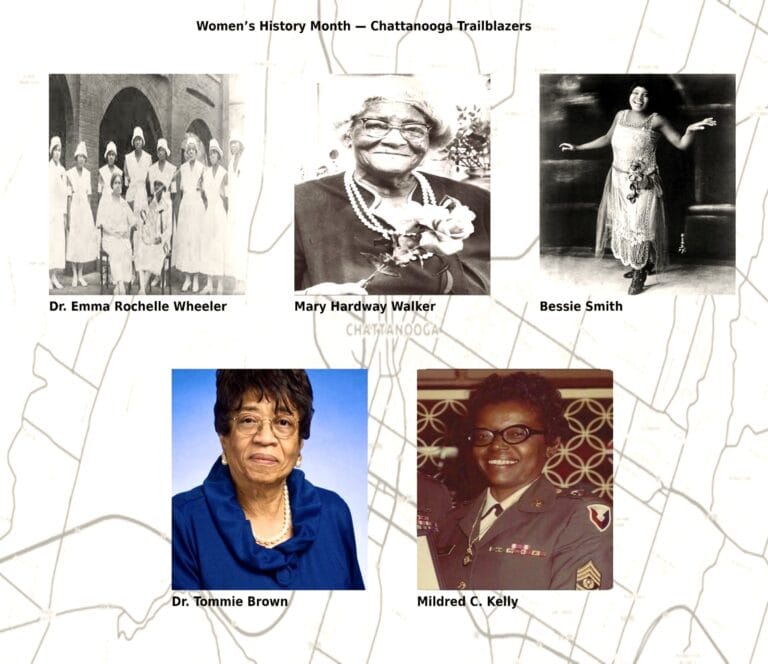
Women’s History Month provides an opportunity to value the courage to achieve, overcome, and work for accomplishment. Black women in Chattanooga have broken barriers in medicine, politics, military service, education, and the arts. Their achievements have been part of shaping the Scenic City, advancing the heritage of the African American community for generations, and creating many of today’s advancements.
One of the earliest pioneers was Dr. Emma Rochelle Wheeler, a physician who became Chattanooga’s first African American female doctor in the early twentieth century. After graduating from Meharry Medical College in 1905, Wheeler and her husband opened Walden Hospital (at 8th and Douglas Streets) in 1915 to provide care for Black patients who were often excluded from white hospitals. The hospital included surgery wards, maternity facilities, and a nursing school, becoming a critical center for healthcare and professional training within the African American community. Dr. Wheeler improved access to medical care, helped cultivate a new generation of Black nurses and physicians, and established prominence in Chattanooga.
Mary Walker moved to Chattanooga in 1917 and is a powerful symbol of perseverance and the value of education as a lifelong learner. Born into slavery in 1848, Walker spent most of her life working and raising her family without the opportunity to attend school. Ms. Walker enrolled in literacy classes at the age of 116 to achieve her lifelong goal–to read the Bible for herself. Walker’s accomplishment inspired many, gaining national recognition as the oldest student by the US Department of Education. Her story models the idea that the pursuit of knowledge is never limited by age and that we should never quit.
In the world of music and culture, Bessie Smith stands as one of Chattanooga’s most famous daughters. The Empress of the Blues was born in the city’s Blue Goose Hollow neighborhood. During the 1920s Ms. Smith became one of the highest-paid Black entertainers in the world, recording songs such as “Backwater Blues” and influencing generations of musicians. Today, the Bessie Smith Cultural Center preserves her legacy but also serves as a unifying hub that serves all, including the African American community.
Dr. Tommie Brown–a social worker, educator, and civic leader who later became the first Black woman elected to represent Chattanooga’s 28th District in the Tennessee House of Representatives–worked behind the scenes to support the 1960 student sit-ins led by Howard High School students protesting segregated lunch counters. Dr. Brown assisted students needing legal and social support during these peaceful protests, demonstrating both courage and strategic leadership during the civil rights era.
Military trailblazer Mildred C. Kelly was born in Chattanooga in 1928. Kelly rose through a distinguished 26-year military career. She became the first African American woman in the United States Army to achieve the rank of sergeant major and command sergeant major, breaking barriers in a traditionally male-dominated institution.
Many more have achieved……. AND CONTINUE TO ACHIEVE! Many more deserve their names spoken and honored. Find ways to honor them by living a life they have inspired.
(Editor’s Note: Seeking Community Input: Help the Chattanooga News Chronicle to recognize and celebrate Black women throughout 2026! We want to highlight more women for their contributions, sacrifice, and service to others. Send information of your honoree that includes a photograph and description, 300 words or less, of their service or achievement to newschronicleinc@gmail.com. Also include your contact information, telephone number and email address. Please contact me at 423/308-9969 for any questions or suggestions.)
The principal who helped guide The Howard School from one of Tennessee’s lowest-performing schools to one that outpaced others in academic growth has retired after 31 years in education.
Dr. LeAndrea Ware officially retired March 13 after serving the past eight years as Howard’s principal. Her tenure included significant academic gains, including a graduation rate that rose from 63 percent to 96.5 percent, along with rising enrollment and campus improvements at the historic high school.
Henry Billen, Jerri Allen, Dr. LeAndrea Ware, LaToya Oliver, Carlos Shackelford, Dr. Ware’s dedicated team from East Lake.
Hundreds of educators and community leaders gathered this month on the Redemption to the Nations Church campus for a retirement celebration in her honor.
“She is a force. She is a beast. She has served, served, served people,” said Assistant Principal Christy Drake as she called Ware to the stage and the crowd erupted in applause.
Assistant Principal Maya Farr described Ware as someone who sees gifts in others. Former Assistant Principal Dr. Elizabeth Renneisen said she would do anything for Ware because she had seen her do everything for others.
Howard Interim Principal Francisco Carrillo became emotional as he recalled how Ware called him to become an administrator and modeled for him how to love and lead children.
“Queen,” shouted someone from the audience as Ware bowed.
Many Howard educators spoke through tears while describing the impact she has had on their lives. Assistant Principal Dr. Charles Mitchell said he also appreciated Ware and called himself her protector.
Though retiring from the school system, Ware is continuing her leadership work in the community. On March 16, she began a new role as chief executive officer of the Boys & Girls Clubs of Chattanooga.
A Howard alumna, Ware returned to the school as interim principal during the 2017–2018 school year before later being named the school’s permanent leader.
During her tenure, the school experienced significant academic growth and enrollment gains. Howard earned its first-ever Level 5 designation for academic growth during the 2022–2023 school year. The rating, based on the Tennessee Value-Added Assessment System, represents the state’s highest level of academic growth and indicates students made significantly more progress than expected compared with peers across Tennessee.
Enrollment also grew significantly during her leadership, increasing from about 800 students in the 2017–2018 school year to a peak of roughly 1,600 students.
Major investments in campus facilities also occurred during her tenure. In 2024, the new Reggie White Field and football turf were installed as part of a $10 million investment in the school’s infrastructure. Billionaire and Microsoft Co-Founder Bill Gates visited Howard school in 2019 and blogged on GatesNotes about the school’s improvements under Ware.
In 2019–2020, Ware was named Tennessee’s Principal of the Year in recognition of her work to improve student outcomes and strengthen the school’s culture.
“Howard is more than a school,” Ware said. “Howard is a legacy, a family and a community that continues to rise despite all odds.”
Assistant Principal Dr. Marthel Young said Ware’s leadership left a lasting impact on the school community.
“Your leadership journey has been interwoven with humor, unwavering dedication and an intense commitment to excellence,” Young said.
Howard’s assistant principals presented Ware with a crystal plaque and 31 red roses in recognition of her tenure.
Just days before her retirement, Ware offered a final message of encouragement to students during the school’s Mr. and Miss Howard coronation ceremony. “Never stop striving,” she said, “to become the very best version of who you were meant to be.”
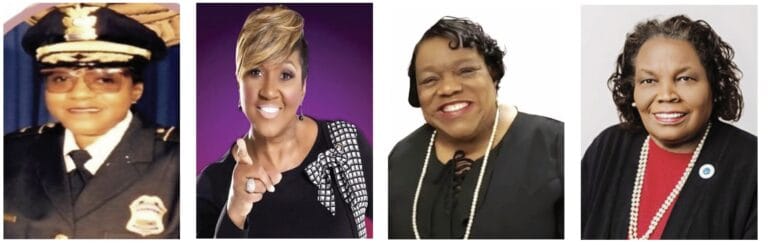
From left, Lt. Diana O. Williams; Jonnetta Patton; Patricia Shackelford-Gray; Dr. Edna Varner
Every March, by presidential proclamation, the United States pauses to honor the often-overlooked contributions of women to the American story. What began in 1978 as a localized “Women’s History Week” in Santa Rosa, California, has grown into a month-long national celebration.
This year, the Bessie Smith Cultural Center, 200 East Martin Luther King Blvd., is bringing that national legacy home to the Scenic City. On Saturday, March 28, the Center will host a special afternoon dedicated to the women who lead, serve, and inspire the Chattanooga community.
The afternoon’s centerpiece is a tribute to a woman who redefined what was possible in local law enforcement. Retired Chattanooga Police Lieutenant Diana O’Neal Williams, who passed away on December 1, 2025, will be recognized with a special exhibit opening at 3 p.m.
Williams was a true trailblazer, cementing her place in history as the first Black female to achieve the rank of Lieutenant within the Chattanooga Police Department.
A 1969 graduate of Central High School and a daughter of Washington Hills, Williams rose through the ranks to manage the Neighborhood Policing Bureau and serve as a member of the department’s elite Special Response Team (SWAT).
Known by colleagues as a compassionate yet fair leader, Lt. Williams was a dedicated mentor who famously rejected the pressure of legacy with a signature piece of advice: “There’s no such thing as ‘big shoes to fill.’”
Her exhibit will serve as a tribute to a life spent in service to public safety and equity.
Following a reception at 3:30 p.m., the program will shift to a powerful panel discussion titled “Women of Impact: Celebrating Leadership, Service, and Entrepreneurship in Our Community.”
The panel features three of Chattanooga’s most influential voices:
Jonnetta Patton, Patricia Shackelford-Gray and Dr. Edna Varner. They will share personal insights on navigating leadership roles and the importance of creating a lasting community impact.
The conversation aims to bridge the gap between the historical milestones of the past and the entrepreneurial spirit driving Chattanooga’s future.
The event is free and open to the public, offering a space for reflection, celebration, and networking among those shaping the city today.
As Women’s History Month continues to highlight the “foundational data” of the American experience–much like the movement successfully lobbied for by the National Women’s History Alliance in 1980–Chattanooga’s celebration ensures that the names of local pioneers like Lt. Williams remain a permanent part of that record.
For further information, visit www.bessiesmithcc.org, or call (423) 266-8658.
Charles Spurgeon Johnson (July 24, 1893 – October 27, 1956) was an American sociologist and college administrator, the first black president of historically black Fisk University, and a lifelong advocate for racial equality and the advancement of civil rights for African Americans and all ethnic minorities.
He preferred to work collaboratively with liberal white groups in the South, quietly as a “sideline activist,” to get practical results.
His position is often contrasted with that of W. E. B. Du Bois, who was a powerful and militant advocate for blacks and described Johnson as “too conservative.” During Johnson’s academic studies and leadership of Fisk University during the 1930s and 1940s, the South had legal racial segregation and Jim Crow discriminatory laws and practices, including having disfranchised most black voters in constitutions passed at the turn of the century. Johnson was unwavering in personal terms in his opposition to this oppressive system, yet he worked hard to change race relations in terms of short-term practical gains.
Johnson was born in 1893 in Bristol, Virginia, to well-educated parents. His father was a respected Baptist minister, and his mother was educated in public school. His father was born into slavery but emancipated.
He attended a boarding school in Richmond, Virginia, then earned a B.A. in sociology from Virginia Union University. Afterward, he began graduate study of sociology at the University of Chicago, though his study was interrupted by service in France during World War I as a non-commissioned officer with the U.S. Army. After returning to the US, he resumed graduate work at the University of Chicago, where he earned his Ph.D. in sociology and formed a friendship with Robert E. Park, who had a strong influence on his work. When he was appointed director of research and investigation of the National Urban League, Johnson and his wife moved to New York City.
After the race riot of 1919, when blacks fought back against white attacks as part of the urban violence in numerous cities during Red Summer, Johnson worked as a researcher for the National Urban League and in 1921, he became the League’s research director. During his time with the National Urban League, he also founded the magazine Opportunity as an outlet for black expression in the arts. He was a principal researcher and author for the Chicago Commission on Race Relations for its report on the riot. Newspapers of the period had reported that the instigators were largely ethnic Irish trying to maintain economic and social dominance over blacks in South Chicago; Johnson noted that African Americans had rebelled against the denial of economic and social opportunity. His work was fundamental to the commission’s report, The Negro in Chicago: A Study of Race Relations and a Race Riot (1922), published by the University of Chicago Press. It was considered a classic model for comprehensive commission reports.
In the 1920s Johnson moved to New York City, where he became research director for the National Urban League. He was an “entrepreneur of the Harlem Renaissance,” the creative movement by African-American writers and artists of that time. He edited two journals that published many writers of the period, and established prizes at the National Urban League to recognize young writers. In Harlem, he argued for black artists saying that they must use their own experiences as the basis for their creativity, rejecting European standards. His goal was to improve Negro self-image and character, and he felt that by writing they could achieve this.
Johnson yearned to return to the South, not only to study race relations but to change them. In 1926 he moved to Nashville, taking a position as chair of the Department of Sociology at Fisk University, a historically black college. There he wrote or directed numerous studies of how combined legal, economic and social factors produced an oppressive racial structure. Two of his works have become classics: Shadow of the Plantation (1934), and Growing up in the Black Belt (1940).
In 1929 an American missionary in Liberia reported that Liberian officials were using soldiers to gather tribal people who were shipped to the island of Fernando Po as forced laborers. The Liberian government denied the charges and invited a League of Nations commission of inquiry. Cuthbert Christy of Britain headed the commission. Johnson was the United States representative. The former President of Liberia Arthur Barclay represented his country. The commission began work on April 8, 1930. The result of the inquiries was an outspoken report submitted in September 1930. It found that the laborers had been recruited “under condition of criminal compulsion scarcely distinguishable from slave raiding and slave trading.” As a result of the Christy report, President Charles D. B. King and Vice-president Allen N. Yancy both resigned.
In 1930 Johnson was awarded the Harmon Prize for Science, for his work The Negro in American Civilization. During World War II, Johnson examined urban race relations at a moment when whites fought to preserve their power and privilege, especially in education, employment, and housing. One of his more important works in this period was a 98-page study of San Francisco’s African American community that highlighted the institutional racism throughout the city and how African Americans, often recent migrants from the south, build their communities in places like Hunters Point and the Fillmore District.
In 1946 Johnson was appointed as the first black president of Fisk University. He attracted outstanding faculty, including the author Arna Bontemps, Aaron Douglas and others. In 1946, Johnson was one of 20 American educators selected to advise on educational reform in occupied Japan. He was also a consultant for several White House conferences related to youth in American society, and a member of the first Board of Foreign Scholarships for the Fulbright Program.
Johnson lived to celebrate the landmark Supreme Court decision Brown v. Board of Education (1954), which ruled that racial segregation in the public schools was unconstitutional. He played a key role in the effort to implement the decision in the face of “massive resistance” in the South. His work and that of his peers also contributed to passage of federal civil rights legislation of the mid-1960s.
He was a member of Alpha Phi Alpha fraternity. He was also a charter member of the Zeta Rho chapter of Phi Mu Alpha Sinfonia music fraternity, chartered at Fisk in 1953.
On November 6, 1920, Johnson married Marie Antoinette Burgette. They had three sons and one daughter.
Johnson died unexpectedly in 1956. He was traveling by train from Nashville to New York when he had a heart attack on the platform at a stop in Louisville, Kentucky. He was 63 years old.
NEWSFLASH! Since we’ve run out of days to recognize important icons in African American History, I hereby grant myself an “extension” through the end of March (or beyond) for more stories. The other reasons are that the mid-term elections are just a few months away, that elections have consequences and, last, a reminder that scores of others have paid the ultimate price for our right to vote. With this “chapter” we’re pleased to spotlight just one more of many, one Unita Blackwell.
******************************
So, with that said and out of the way, I sure wish that Unita Blackwell was alive and with us today. More than ever, we need her out on the battlefield leading protests and knocking on doors extolling the urgency of exercising our right to vote. Lord knows we need her.
Well, the truth is that during African American History Month when we recognize well-known voter rights advocates from the past, chief among them Dr. King, Fannie Lou Hamer, Viola Liuzzo, and many others who risked their lives and shed their blood for our right to vote, often too many lazily shrug off with flimsy excuses for not voting. Hey, as the saying goes, “if the shoe fits, wear it” (including the ones you should be wearing to the nearest voting booth).
Well sorry history erasing proponents and “my one vote won’t make a difference,” excuse makers, but there’s no way I was going to sit quietly on the sidelines while February slips by while still another story disappears into the annals of oblivion or on some dopey banned books list. Uh, uh, nah, sorry, no way.
Turning now to someone you may or may not know……Unita Zelma Blackwell.
Unita Zelma Blackwell (1933 – 2019) was an American civil rights activist who was the first African-American woman to be elected mayor in the state of Mississippi. She was a project director for the Student Nonviolent Coordinating Committee (SNCC) and helped organize voter drives for African Americans across Mississippi.
Now if her plate wasn’t already full, she also served as an advisor to six US presidents: Lyndon Johnson, Richard Nixon, Gerald Ford, Jimmy Carter, Ronald Reagan and Bill Clinton. Her autobiography, Barefootin’: Life Lessons from the Road to Freedom, (2006) covers her life and the sharecropper work she and her parents experienced, all of which drove her actions in the Civil Rights Movement.
Indicative of the brutality of life for African Americans in parts of the South back then, when she was three years old, Blackwell’s father left the plantation on which he worked and fled to Memphis, Tennessee, fearing for his life after he confronted his boss about speaking inappropriately to his wife. Prior to that her grandfather was murdered by a white landowner. Blackwell and her mother left the plantation to live with her father soon afterwards. After her parents separated, Blackwell and her mother went to West Helena, Arkansas so that she could have access to a better education.
Blackwell spent a majority of her early years chopping cotton for $3 a day in Mississippi, Arkansas and Tennessee and peeling tomatoes in Florida. She was 14 when she finished the eighth grade, the final year of school at Westside, a school in West Helena for Black children. She was 25 when she met Jeremiah Blackwell and a few years later they married.
Later Blackwell got involved in the Civil Rights Movement when activists from SNCC came to town and held meetings concerning the rights of African Americans to vote. The following week she and seven others went to the courthouse to take a voter registration test to vote. While outside the courthouse waiting to take the test, a group of white farmers from the area heard what was happening and tried to scare them off. Her group stayed there all day, but only two were able to take the test.
The racism that they experienced, Blackwell wrote in her autobiography,, made that day “the turning point” of her life. Jeremiah and Unita lost their jobs the next day after their employer found out that they had been part of the group seeking to register to vote.
Blackwell attempted to pass the voter registration test three times over the next few months. In early fall she took the test successfully and became a registered voter. When the United States Commission on Civil Rights came to Mississippi in January 1965, Blackwell testified in front of them about her experiences with voter discrimination. As a result of Blackwell’s involvement with voter registration campaigns, she and other activists endured constant harassment.
After meeting Fannie Lou Hamer in the summer of 1964 and hearing about her experiences in the Civil Rights Movement, Blackwell decided to join the SNCC. As a project director for SNCC, she organized voter registration drives across Mississippi. Later that year, she became a member on the executive committee of the Mississippi Freedom Democratic Party (MFDP) which provided a party for voters that SNCC had been registering to vote.
In late August Blackwell and 67 other elected MFDP delegates traveled to the 1964 Democratic National Convention intending to get the MFDP seated as “the only democratically constituted delegation from Mississippi”. They were eventually offered two at-large seats but refused that compromise. The event, particularly Fannie Lou Hamer’s nationally televised famous “sick and tired of being sick and tired” testimony brought the party and the Mississippi Civil Rights movement into the public eye. During her time participating in the Civil Rights Movement, Unita Blackwell was jailed more than 70 times because of her role in civil rights protests.
Starting in 1973, Blackwell participated in 16 diplomatic trips to China, including a trip with actress Shirley MacLaine in 1973 to film The Other Half of the Sky. As part of her commitment to better relations between the United States and China, Blackwell served for six years as president of the US–China Peoples Friendship Association, an association dedicated to promoting cultural exchange between the United States and China.
She was elected mayor of Mayersville, Mississippi in 1976 making her the first female African-American mayor in Mississippi. As mayor, she oversaw the construction of several sets of public housing, the first time that federal housing had been built in Issaquena County. Blackwell obtained federal grant money that provided Mayersville with police and fire protection, a public water system, paved streets, housing accommodations for the elderly and disabled and other infrastructure. She gained national attention by traveling across the country to promote the construction of low-income housing.
Contuining her activism, Unita helped found Mississippi Action for Community Education, a community-development organization in Greenville, Mississippi. From 1990 to 1992, she was president of the National Conference of Black Mayors and in 1991, she co-founded the Black Women Mayors’ Conference as a corollary to the National Conference of Black Mayors and served as its first president.
Blackwell was awarded a $350,000 MacArthur Fellowship genius grant in 1992 for her part in creating the Deer River housing development among other creative solutions to housing and infrastructure problems in her state.
Unita Blackwell died in Ocean Springs, Mississippi on May 13, 2019.
In closing, like the advice I ended my last column with, insert Blackwell’s story into your three-ring binder so that by this time next year you will have a collection of relatively unknown stories of icons from African American history and, oh yes, save space for more stories to come.
Terry Howard is an award-winning writer, a contributing writer with the Chattanooga News Chronicle, The American Diversity Report, The Douglas County Sentinel, Blackmarket.com, recipient of the Dr. Martin Luther King, Jr. Leadership Award, and third place winner of the Georgia Press Award.
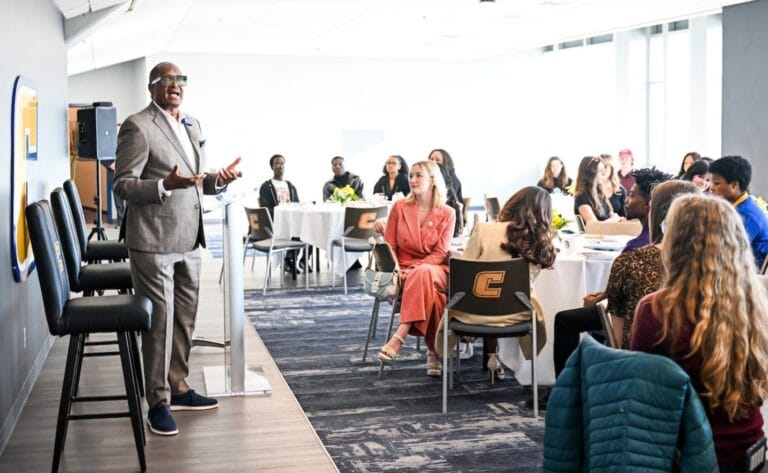
Attendees at the Health and Wellness Luncheon listen intently as Dr. Mathew Knowles speaks at the Wolford Family Athletic Center. The luncheon was part of a full day of events celebrating Knowles’ legacy as a former Mocs basketball player and his global success as the founder of Music World Entertainment.
Blue campaign ticket for Tommie F. Brown’s 1992 election bid, listing policy priorities such as job creation, public education, health care funding, and equal opportunity enforcement.
Just days before Dr. Tommie F. Brown passed away at the age of 91 on Jan. 20, 2026, archivists at the University of Tennessee at Chattanooga crossed a significant finish line: the completion of a federally funded project to process and open Brown’s personal and professional papers for public research.
The 18-month project, supported by a $144,049 grant from the National Historical Publications and Records Commission, resulted in the full processing of the Tommie F. Brown papers–a 172-box collection documenting the life and work of a woman whose influence shaped UTC, Chattanooga and the state of Tennessee.
Brown’s papers were donated to UTC Special Collections in 2023, filling more than 125 linear feet of space with original research, legislative records, correspondence, legal documents, photographs and personal papers spanning decades of academic, political and civic work. The grant-funded project made those materials fully accessible to researchers for the first time.
“What finishing this project means is access,” said Carolyn Runyon, director of Special Collections at UTC. “These papers are now open and available for anyone to come in and use–students, scholars, journalists and members of the community. That access is the reason this work matters.”
Brown joined the UTC faculty in 1971 and later became the founding head of the University’s social work program, serving as a faculty member until 1998. In 1980, she became the first person of color to lead an academic department at UTC.
Beyond campus, she built a parallel legacy in public service, representing Tennessee’s 28th District in the state House of Representatives from 1992 to 2012 and playing a central role in landmark civil rights efforts in Chattanooga.
The papers document Brown’s work as the lead plaintiff in Brown v. Board of Commissioners of Chattanooga, the federal lawsuit that ended the city’s at-large voting system and led to the creation of a mayor-council form of government with single-member districts. They also chronicle her two decades in the Tennessee General Assembly, including meticulously researched legislation focused on education, children’s welfare, voting rights and public accountability.
The project employed a full-time professional archivist, Sara Kaparos, for 18 months and a student assistant, Boden Wilson. Together, they organized, described and rehoused every part of the collection, ensuring sensitive information was protected while preserving the integrity of the historical record.
Runyon said the timing of the project’s completion remains striking. Kaparos’ final day on the project coincided with Brown’s funeral, during which the archivist spent the morning honoring the woman whose papers she had processed for more than a year.
“I’ve never experienced anything like it professionally,” Runyon said. “The grant project ended as my colleagues and I attended Dr. Brown’s celebration of life. The experience imparted me with a profound sense of responsibility steward her legacy as preserved in her papers.”
Runyon said that Brown was intentional about preserving her story. During interviews conducted as part of the grant process, she often spoke about growing up in Chattanooga’s Bushtown neighborhood and her belief that access to education, civic engagement and political power should never feel out of reach.
The collection is also notable for what it represents in the archival record. Based on Runyon’s research, Brown’s papers are the only known fully processed and publicly accessible archival collection documenting the career of a Black woman who served in the Tennessee legislature.
“Without collections like this, entire chapters of history remain incomplete,” Runyon said. “Dr. Brown understood that, and she made a deliberate decision to ensure her work could be studied and understood in full.”
Now that the project is complete, Runyon said UTC Special Collections staff encourage use of the collection in coursework, research and creative projects, with plans to explore future digitization and public programming.
“It’s emotional to think about the finality of finishing something this large,” she said. “But the most important thing is that Dr. Brown’s papers are now part of the public dialogue. “People can come here, open these boxes and learn directly from her life’s work. That’s the legacy she wanted.”