“On Friday, September 9, the United States of America achieved its 1 millionth organ transplant. This historic milestone and world record was confirmed by United Network for Organ Sharing (UNOS), the nonprofit powering the U.S. organ donation and transplantation system. Many of these transplants have been orchestrated by Tennessee Donor Services, the engine behind the Tennessee organ donation and transplant system. Tennessee Donor Services has single handedly facilitated thousands of organ transplants, significantly contributing to this major milestone.
Members of record of the Chattanooga Branch of the NAACP will begin receiving notices of the coming election process. The nomination committee will be elected at the September 19, 2022 members meeting, and the election supervisory committee will be elected at the October 17, 2022 members meeting.
The election of officers and committee members will occur on Thursday, November 17, 2022 using Election Buddy operated by the national office of the NAACP. This year each voting member will use a computer or smart phone to cast their vote. Those members who have not received a notice to the September meeting by email should contact the Chattanooga Branch at naacpchatt@gmail.com. Ann Jones Pierre, President 423-364-6952 (Text or voice)
ABINGDON, VA (Monday, September 12, 2022) – Company officials recently announced that area Food City Pharmacy locations will once again be providing the flu vaccine this immunization season.
“Food City’s immunizing pharmacists are certified to administer vaccinations in accordance with the standards set forth by the American Pharmacists Association and the corresponding state pharmacy associations. Food City Pharmacy offers the added convenience of a number of affordable preventative health care options, including the COVID-19 vaccine”, says Mickey Blazer, Food City executive vice president of pharmacy operations.
Seasonal flu vaccine provides protection against the most common strains of influenza. Vaccinations are available on a walk-up basis at Food City immunizing pharmacies and will continue throughout flu season, based upon vaccine availability. Visit foodcity.com for a complete list of immunizing locations.
Food City Pharmacy will be following the Centers for Disease Control and Prevention (CDC) Guidelines, including guidance to minimize the risk of exposure to SARS-CoV-2 and reduce the risk for patients during the COVID- pandemic. While all individuals are encouraged to receive a flu shot, the CDC strongly recommends vaccination for individuals considered high risk. High risk individuals include persons 65 or older, residents of long-term care facilities, persons 2-64 years of age with comorbid (more than one) conditions, and pregnant women. The CDC also recommends the flu shot for healthcare personnel who provide direct patient care and household contacts or caregivers of children under 6 months of age. Food City Pharmacists can immunize individuals 12 years and older.
Flu vaccines are available in Quadravalent or High Dose. Insurance, including Medicare Part B will be accepted, many with a zero copay. Other vaccines, including COVID, pneumonia and shingles shots, will be available as well. Please consult your local Food City Pharmacy or visit foodcity.com for details.
Flu viruses are most common during the fall and winter months. Influenza activity often begins to increase in October and November. Most of the time, flu activity peaks between December and February and can last as late as May.
“Food City takes pride in serving our community and we’re proud to once again offer our loyal customers the added convenience of flu vaccinations,” said Steven C. Smith, Food City president and chief executive officer.
Those names might not be familiar to all Americans, but their recent accomplishments amount to a potential sea change in labor rights.
As union organizers or advocates for better work conditions at some of the biggest and most powerful companies in the world – Starbucks, Google and Amazon, respectively – these three young people have highlighted just how far out of whack the balance between workers and organizations has grown.
It begins with a deceptively simple premise: investigating whether and how workers can live on what they earn from low-wage jobs. Operating essentially undercover by taking on retail jobs, cleaning houses and waiting tables, Ehrenreich chronicled her experiences and observations as she roved from Florida to Maine to Minnesota. She showed readers that it was virtually impossible to make a living with this work.
Once hired, Ehrenreich refused to rely on her savings or assets, instead paying for rent, food and utilities out of her hourly wages. She quickly found out that doing so left her uninsured, in poor health, sometimes hungry, often tired and always struggling.
“Nickel and Dimed” is an unforgettable best-selling expose that highlights what many low-wage workers already know: It’s impossible to get ahead when you can’t even break even.
A model for sociologists
I first read “Nickel and Dimed,” one of 21 books she published in her lifetime, in 2002 when I was finishing my coursework for a doctorate in sociology. Ehrenreich’s work resonated with me because of her focus on the grind of low-paying jobs.
She earned her own doctorate in cell biology and had no formal training as a sociologist. But she adopted what I like to think are the strengths of my discipline.
That is, she asked questions to help understand various groups’ experiences, as well as the relationships between institutions and individuals. She also forcefully recommended policy changes that could potentially improve the lives of people who are suffering due to powerful forces, such as corporations, the government and school systems.
In my view, Ehrenreich’s ability to document in clear, accessible prose exactly how low-wage work forced people into an unavoidable grind is the best kind of sociological research.
Opening a path
Her work also set an example for many other sociologists studying workers, labor markets and the economy. Ehrenreich laid a clear path for sociologists who have examined the inner lives of employees, the obstacles they face and the strategies they use to survive.
Howard Manly, Race + Equity Editor, The Conversation US; Matt Williams, Senior Breaking News and International Editor; Interviewed: Edie Goldenberg-Professor of Public Policy; Professor of Political Science, University of Michigan; Lisa García Bedolla-Vice Provost for Graduate Studies and Dean of the Graduate Division, Professor of Education, University of California, Berkeley; Terri Bimes-Associate Teaching Professor of Political Science, University of California, Berkeley
As political campaigning for the midterm elections is ramping up, millions of voters are considering how they should cast their ballots on Nov. 8, 2022. In addition to the traditional way of voting at their local precinct on Election Day, many have the option to vote earlier by mail.
With the exception of Alabama, Connecticut, Mississippi and New Hampshire, early voting is allowed in 46 states and is offered in different forms such as drop boxes, mail or early voting in person.
It’s important to check with your state’s election office, because different states have different deadlines and options available.
In Montana, for instance, early voting is allowed for about four weeks between Oct. 11 and Nov. 7. But in Texas, the early-voting period is only the 10 weekdays between Oct. 24 and Nov. 4.
The Conversation U.S. has published several articles looking at not only the integrity of early voting but also the larger question of turning out the vote.
1. The long, long history of early voting
Early voting periods are as old as presidential elections in the U.S.
It wasn’t until 1845 that Congress adopted the Tuesday after the first Monday in November as the national Election Day.
Given the long history, Terri Bimes, an associate teaching professor of political science at the University of California, Berkeley, raises an interesting point on the impact of early voting on turnout.
“While some scholars contend that early in-person voting periods potentially can decrease voter turnout,” Bimes writes, “studies that focus on vote-by-mail, a form of early voting, generally show an increase in voter turnout.”
Regardless of overall turnout, more and more voters are choosing nontraditional ways of casting their ballots. In the 2020 election, for instance, 69% of voters nationwide voted by mail or through another means earlier than Election Day. That number was 40% in 2016.
The conservative Heritage Foundation conducted a survey in 2020 and found 1,200 “proven instances of voter fraud” since 2000, with 1,100 criminal convictions over those two decades.
Edie Goldenberg is a University of Michigan political scientist who belongs to a National Academy of Public Administration working group that offered recommendations to ensure voter participation and public confidence during the onset of the COVID-19 pandemic in 2020.
Goldenberg writes: “The evidence we reviewed finds that voting by mail is rarely subject to fraud, does not give an advantage to one political party over another and can in fact inspire public confidence in the voting process, if done properly.”
3. Voting turnout is key to democracy
More people voted in the 2020 presidential election than in any election in the past 120 years, even as nearly one-third of eligible voters sat it out. That means nearly 80 million Americans did not vote.
Among the reasons nonvoters gave were not being registered, not being interested or not believing their vote made a difference. Despite such apathy, about 155 million voters – that’s 67% of Americans over 18 – did vote in 2020.
Part of the problem of reducing the percentage of nonvoters at the street level can be getting people to answer their doors to strangers or answering a telephone call placed by a campaign volunteer from an unrecognized number. Before the pandemic, an effective door-to-door campaign could increase turnout by almost 10%; a well-run phone campaign could add an additional 5%.
When University of California, Berkeley’s Vice Provost for Graduate Studies Lisa García Bedolla began studying voter mobilization in 2005, it was common for door-to-door campaigns to reach half of the people they tried to contact. By 2018, that number had dropped to about 18%.
To close the gap, campaigns moved toward asking people to contact people they knew and help turn out those supporters and social networks. Text messages, especially reminder texts, became the virtual door knock.
“These friend-to-friend approaches are seen as a way to cut through the noise,” Bedolla writes.
These personal approaches can also create a sense of accountability.
Knowing that someone is paying attention to your vote, however it is cast, might make a difference in a local, state, or federal election. (The CONVERSATION)
CHATTANOOGA, Tenn. – The Chattanooga Area Food Bank (Food Bank) recently hired Dominique Brandt as chief development officer and Jeannine Carpenter as director of advocacy. This is part of the Food Bank’s five-year strategic plan to invest in people to move forward the mission, increase awareness, ignite public passion, and mobilize the community in the fight to end hunger.
“We’re fortunate to have access to a wealth of talent in our own backyard, with Dominique’s corporate and nonprofit experience and from the advocacy community with Jeannine,” said Food Bank President & CEO Melissa Blevins. “Both bring years of experience from their fields to strengthen our mission and vision, while furthering our resources and our ability to serve our communities, while building pathways to long-term stability in southeast Tennessee and northwest Georgia.”
Brandt has 25 years of fundraising, organizational visioning, event & volunteer management, and community engagement experience, thirteen of which have been spent in nonprofit organizations. Beginning at Habitat for Humanity of Greater Miami, Brandt moved to Chattanooga in 2013 to serve as development director at Habitat for Humanity of Greater Chattanooga, where she grew faith-based giving, established the endowment fund and launched the Women Build Breakfast. Prior experience includes the United Way of Greater Chattanooga and work in the legal field. Dominique and her husband, Jack, have three adult sons. Dominique enjoys traveling, reading, and hanging with friends and neighbors on her front porch.
“I’m excited to join this dynamic team in the fight to end hunger. Increasing equity in distribution and lowering barriers to access to healthy foods, including fresh produce and milk are key initiatives of our strategic plan. Our communities are ready for this work and the Food Bank is positioned to lead it,” said Dominique.
Before joining the Chattanooga Area Food Bank, Jeannine worked as the Director of Research and Policy at the Women’s Fund of Greater Chattanooga. While at the Women’s Fund, Jeannine wrote legislation, advocated on behalf of women’s issues and led advocacy education programming. Jeannine received a PhD in Sociolinguistics from Duke University, a Master’s Degree in English language studies and a Bachelor of Arts from North Carolina State University. She is the proud mother of a two-year old boy and an eight-year-old Doberman. (Continued on Pg. 2)
” I’m so grateful for the opportunity to begin this meaningful work of creating systemic change- to advocate for policy changes that benefit the families and individuals and community we serve, to build partnerships that amplify a collective voice, and increase access to nutritious food to those in need,” Jeannine says.
By Jasmina Burek | Assistant Professor of Engineering, UMass Lowell
Energy efficiency can save homeowners and renters hundreds of dollars a year, and the new Inflation Reduction Act includes a wealth of home improvement rebates and tax incentives to help Americans secure those saving.
It extends tax credits for installing energy-efficient windows, doors, insulation, water heaters, furnaces, air conditioners or heat pumps, as well as for home energy audits. It also offers rebates for low- and moderate-income households’ efficiency improvements, up to US$14,000 per home.
Together, these incentives aim to cut energy costs for consumers who use them by $500 to $1,000 per year and reduce the nation’s climate-warming greenhouse gas emissions.
With so many options, what are the most cost-effective moves homeowners and renters can make?
My lab at UMass Lowell works on ways to improve sustainability in buildings and homes by finding cost-effective design solutions to decrease their energy demand and carbon footprint. There are two key ways to cut energy use: energy-efficient upgrades and behavior change. Each has clear winners.
Stop the leaks
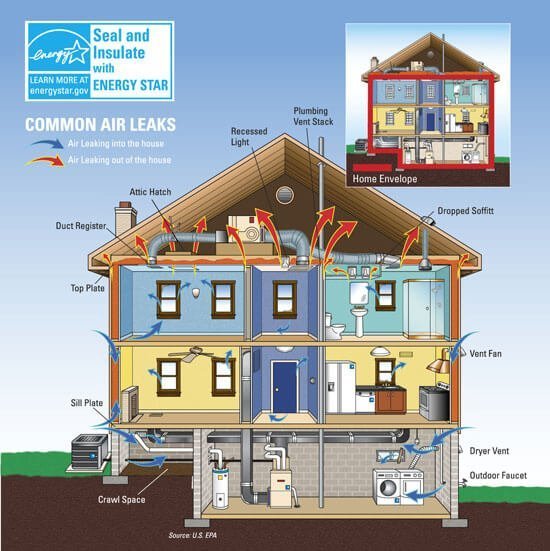
The biggest payoff for both saving money and reducing emissions is weatherizing the home to stop leaks. Losing cool air in summer and warm air in winter means heating and cooling systems run more, and they’re among the most energy-intensive systems in a home.
Gaps along the baseboard where the wall meets the floor and at windows, doors, pipes, fireplace dampers and electrical outlets are all prime spots for drafts. Fixing those leaks can cut a home’s entire energy use by about 6%, on average, by our estimates. And it’s cheap, since those fixes mostly involve caulk and weather stripping.
The Inflation Reduction Act offers homeowners a hand. It includes a $150 rebate to help pay for a home energy audit that can locate leaks.
While a professional audit can help, it isn’t essential – the Department of Energy website offers guidance for doing your own inspection.
Once you find the leaks, the act includes 30% tax credits with a maximum of $1,200 a year for basic weatherization work, plus rebates up to $1,600 for low- and moderate-income homeowners earning less than 150% of the local median.
Insulation can also reduce energy loss. But with the exception of older homes with poor insulation and homes facing extreme temperatures, it generally doesn’t have as high of a payoff in whole-house energy savings as weatherization or window replacement.
The Inflation Reduction Act includes up to $600 to help pay for window replacement and $250 to replace an exterior door.
Upgrade appliances, especially HVAC and dryers
Buildings cumulatively are responsible for about 40% of U.S. energy consumption and associated greenhouse gas emissions, and a significant share of that is in homes. Heating is typically the main energy use.
Among appliances, upgrading air conditioners and clothes dryers results in the largest environmental and cost benefits; however, HVAC systems – heating, ventilation and air conditioning – come with some of the highest upfront costs.
That includes energy-efficient electric heat pumps, which both heat and cool a home. The Inflation Reduction Act offers a 30% tax credit up to $2,000 available to anyone who purchases and installs a heat pump, in addition to rebates of up to $8,000 for low- and moderate-income households earning less than 150% of the local median income. Some high-efficiency wood-burning stoves also qualify.
The act also provides rebates for low- and moderate-income households for electric stoves of up to $840, heat-pump water heaters of up to $1,750 and heat-pump clothes dryers of up to $840.
Change your behavior in a few easy steps
You can also make a pretty big difference without federal incentives by changing your habits. My dad was energy-efficient before it was hip. His “hobby” was to turn off the lights. This action itself has been among the most cost-saving behavioral changes.
Just turning out the lights for an hour a day can save a home up to $65 per year. Replacing old lightbulbs with LED lighting also cuts energy use. They’re more expensive, but they save money on energy costs.
We found that a homeowner could save $265 per year and reduce emissions even more by adopting a few behavioral changes including unplugging appliances not being used, line-drying clothes, lowering the water heater temperature, setting the thermostat 1 degree warmer at night in summer or 1 degree cooler in winter, turning off lights for an hour a day, and going tech-free for an hour a day.
Some appliances are energy vampires – they draw electricity when plugged in even if you’re not using them. One study in Northern California found that plugged-in devices, such as TVs, cable boxes, computers and smart appliances, that weren’t being used were responsible for as much as 23% of electricity consumption in homes.
Start with a passive solar home
If you’re looking for a home to rent or buy, or even to build, you can make an even bigger difference by looking at how it’s built and powered.
Passive solar homes take advantage of local climate and site conditions, such as having lots of south-facing windows to capture solar energy during cool months to reduce home energy use as much as possible. Then they meet the remaining energy demand with on-site solar energy.
Studies show that for homeowners in cold climates, building a passive design home could cut their energy cost by 14% compared with an average home. That’s before taking solar panels into account.
The Inflation Reduction Act offers a 30% tax credit for rooftop solar and geothermal heating, plus accompanying battery storage, as well as incentives for community solar – larger solar systems owned by several homeowners. It also includes a $5,000 tax credit for developers to build homes to the Energy Department’s Zero Energy Ready Homes standard.The entire energy and climate package – including incentives for utility-scale renewable energy, carbon capture and electric vehicles – could have a big impact for homeowners’ energy costs and the climate. According to several estimates, it has the potential to reduce U.S. carbon emissions by about 40% by the end of this decade. (The CONVERSATION)
By Sean Lang | Senior Lecturer in History, Anglia Ruskin University
When the late historian Sir Ben Pimlott embarked on his 1996 biography, his colleagues expressed surprise that he should consider Queen Elizabeth II worthy of serious study at all. Yet Pimlott’s judgement proved sound and, if few academics have followed his lead, the political role of the monarchy has received thoughtful treatment in the creative arts.
Stephen Frears’s 2006 film, The Queen, showed her dilemma after the death of Princess Diana; Peter Morgan’s stage play The Audience showed the monarch’s weekly meetings with her prime ministers. And she has been shown in a generally positive and sympathetic light by both Netflix’s acclaimed drama series The Crown and even in Mike Bartlett’s speculative play King Charles III, about the difficulty her heir would have in filling her shoes.
Elizabeth’s reign was a delayed result of the abdication crisis of 1936, the defining royal event of the 20th century. Edward VIII’s unexpected abdication thrust his shy, stammering younger brother Albert onto the throne as King George VI. Shortly thereafter he was thrust into the role of figurehead for the nation through the second world war.
The second world war was an important formative experience for the future queen, seen here with family celebrating VE Day in 1945. Kathy deWitt/Alamy Stock Photo
The war was the most important formative experience for his elder daughter, Princess Elizabeth. Her experience as a car mechanic with the ATS (Auxiliary Territorial Service – the women’s army service) meant that she could legitimately claim to have participated in what has been called “the people’s war”.
The experience gave her a more naturally common touch than any of her predecessors had displayed. When, in 1947, she married Philip Mountbatten – who became Duke of Edinburgh (and died in April 2021 at the age of 99) – her wedding was seized on as an opportunity to brighten a national life still in the grip of post-war austerity and rationing.
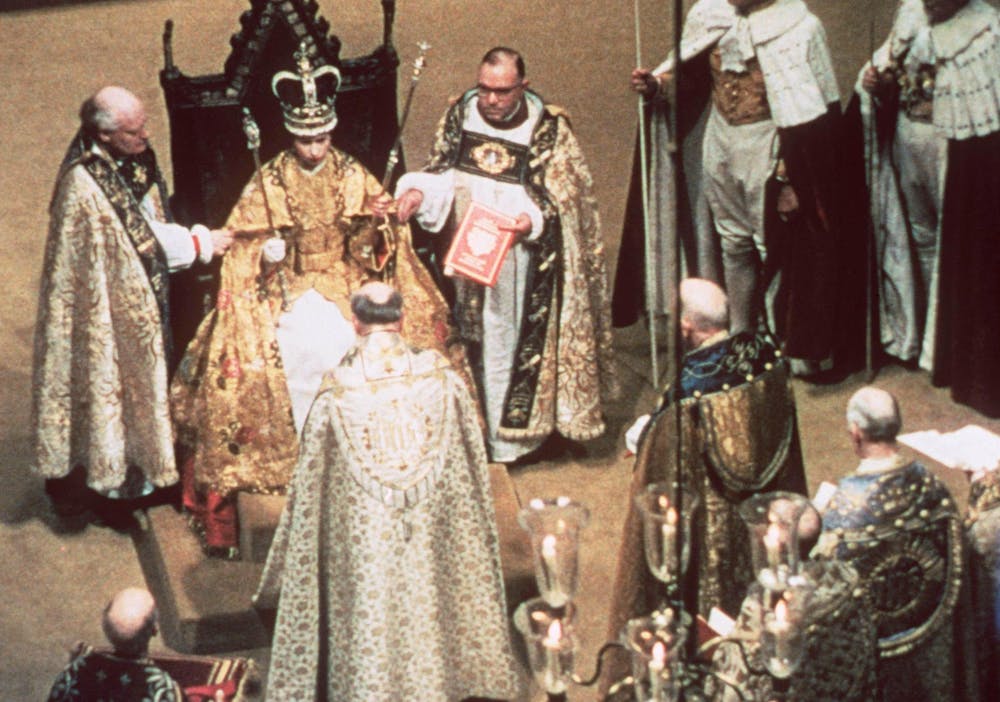
God Save the Queen: Elizabeth II is crowned in Westminster Abbey, June 2 1952.
Elizabeth II inherited a monarchy whose political power had been steadily ebbing away since the 18th century but whose role in the public life of the nation seemed, if anything, to have grown ever more important. Monarchs in the 20th century were expected both to perform ceremonial duties with appropriate gravity and to lighten up enough to share and enjoy the tastes and interests of ordinary people.
The Queen’s elaborate coronation in 1953 achieved a balance of both these roles. The ancient ceremony could be traced to the monarchy’s Saxon origins, while her decision to allow it to be televised brought it into the living rooms of ordinary people with the latest modern technology. Royal ceremonial was henceforth to be democratically visible, ironically becoming much better choreographed and more formal than it had ever been before.
The Queen went on to revolutionise public perceptions of the monarchy when, at the urging of Lord Mountbatten and his son-in-law, the television producer Lord Brabourne, she consented to the 1969 BBC film Royal Family. It was a remarkably intimate portrayal of her home life, showing her at breakfast, having a barbecue at Balmoral and popping down to the local shops.
The Queen’s silver jubilee in 1977 was a high point in the middle of her reign. Trinity Mirror/Mirrorpix/Alamy Stock Photo
Prince Charles’s investiture as Prince of Wales the same year, another royal television event, was followed in 1970 by the Queen’s decision during a visit to Australia and New Zealand to break with protocol and mix directly with the crowds who had come out to see her. These “walkabouts” soon became a central part of any royal visit.
The highpoint of the Queen’s mid-reign popularity came with the 1977 Silver Jubilee celebrations, which saw the country festooned in red, white and blue at VE Day-style street parties. It was followed in 1981 by the enormous popularity of the wedding at St Paul’s Cathedral of Prince Charles to Lady Diana Spencer.
Testing times
The following decades proved much more testing. Controversy in the early 1990s about the Queen’s exemption from income tax forced the Crown to change its financial arrangements so it paid like everyone else. Gossip and scandal surrounding the younger royals turned into divorces for Prince Andrew, Princess Anne and – most damagingly of all – Prince Charles. The Queen referred to 1992 – the height of the scandals – as her “annus horribilis”.
Happy family? The marriage of Prince Charles to Lady Diana Spencer put pressures on the House of Windsor. Ron Bell/PA Images/Alamy Stock Photo
The revelations about the misery Princess Diana had endured in her marriage presented the public with a much harder, less sympathetic image of the royal family, which seemed vindicated when the Queen uncharacteristically miscalculated the public mood after Diana’s death in 1997. Her instinct was to follow protocol and precedent, staying at Balmoral and keeping her grandchildren with her.
This seemed hard and uncaring to a public hungry for open displays of emotion that would have been unthinkable in the Queen’s younger days. “Where is our Queen?” demanded The Sun, while the Daily Express called on her to “Show us you care!” insisting that she break with protocol and fly the Union Jack at half-mast over Buckingham Palace. Never since the abdication had the popularity of the monarchy sunk so low.
Caught briefly on the back foot by this remarkable change in British public behaviour, the Queen soon regained the initiative, addressing the nation on television and bowing her head to Diana’s funeral cortege during a cleverly conceived and choreographed televised service.
The extent to which she quickly regained public support was shown by the enormous, if unexpected, success of her 2002 Golden Jubilee, which was ushered in by the extraordinary sight of Brian May performing a guitar solo on the roof of Buckingham Palace. By the time London hosted the Olympics in 2012 she was sufficiently confident of her position to agree to appear in a memorable tongue-in-cheek cameo in the opening ceremony, when she appeared to parachute down into the arena from a helicopter in the company of James Bond.
Political sphere
Queen Elizabeth kept the crown above party politics, but she was always fully engaged with the political world. A firm believer in the Commonwealth, even when her own prime ministers had long lost faith in it, as its head she mediated in disputes between member states and provided support and guidance even to Commonwealth leaders who were strongly opposed to her own UK government.
Her prime ministers often paid tribute to her political wisdom and knowledge. These were the result both of her years of experience and of her diligence in reading state papers. Harold Wilson remarked that to attend the weekly audience unprepared was like being caught at school not having done your homework. It was widely believed that she found relations with Margaret Thatcher difficult.
The Queen and the Duke of Edinburgh sometimes objected to the political use to which governments put them. In 1978 they were unhappy to be forced by the then foreign secretary, David Owen, to receive the Romanian dictator Nicolae Ceausescu and his wife as guests at Buckingham Palace.
The Queen could act to very positive effect in international relations, often providing the ceremonial and public affirmation of the work of her ministers. She established a good rapport with a string of American presidents, particularly Ronald Reagan and Barack Obama, and her successful 2011 state visit to the Republic of Ireland, in which she astonished her hosts by addressing them in Gaelic, remains a model of the positive impact a state visit can have.
She was even able to put aside her personal feelings about the 1979 murder of Lord Mountbatten to offer a cordial welcome to the former IRA commander Martin McGuinness, when he took office in 2007 as deputy first minister of Northern Ireland.
Only very occasionally and briefly did the Queen allow her own political views to surface. On a visit to the London Stock Exchange after the 2008 financial crash she asked sharply why nobody had seen it coming.
In 2014, her carefully worded appeal to Scots to think carefully about their vote in the Independence Referendum was widely – and clearly rightly – interpreted as an intervention on behalf of the Union. And in the run-up to the 2021 UN COP26 conference in Glasgow, from which she had to pull out on medical advice, she was overheard expressing irritation at the lack of political action on the climate change emergency.
Final years
As she approached her tenth decade, she finally began to slow down, delegating more of her official duties to other members of the royal family – even the annual laying of her wreath at the cenotaph on Remembrance Sunday, while in May 2022 she delegated her most important ceremonial duty, the reading of the Speech from the Throne at the State Opening of Parliament, to Prince Charles.
She retained her ability to rise to a crisis, however. In 2020, as the COVID pandemic descended, the Queen, in sharp contrast to her prime minister, addressed the nation from lockdown at Windsor in a calm, well-judged message. Her short address combined solidarity with her people with the reassurance that, in a conscious reference to Vera Lynn’s wartime hit, “We will meet again.”
The decade also brought sadness. Her grandson, Prince Harry, and his wife Meghan Markle withdrew completely from royal duties, causing deep hurt to the royal family. This hurt was compounded when the Sussexes accused the royal family, in an interview with Oprah Winfrey which was watched around the world, of treating them with cruelty, disdain and even racism.
The shock of the interview was followed quickly by the death of Prince Philip, her husband of 73 years, a few months short of his 100th birthday. At his funeral, which was reduced in scale to meet the requirements of COVID regulations, the Queen cut an unusually lonely figure, small, masked and sitting alone. As her health declined in the months following his death, the deep impact of his loss became all too apparent.
The pain of the Sussexes’ estrangement from the royal family was heavily compounded by the disgrace soon afterwards of Prince Andrew, her second and, it was often suggested, her favourite son. His close involvement with the convicted American paedophile, Jeffrey Epstein, led to the unedifying spectacle of a senior member of the royal family being accused in an American court of underage sex; he made his own position immeasurably worse by agreeing to a disastrous interview on the BBC current affairs programme Newsnight.
The Queen responded to the scandal with remarkable decisiveness: she stripped her son of all his royal and military titles, including the cherished “HRH”, and reduced him, in effect, to the status of a private citizen. Even her closest family were not to be allowed to undermine all she had done to protect and preserve the monarchy.
The remarkable success of her 2022 Platinum Jubilee was a sign of just how much she had retained the affections of her people; a particularly well-received highlight was a charming cameo performance showing her having tea with the children’s television character, Paddington Bear.
Apart from in dreams, in which she was often popularly supposed to appear, the Queen’s most regular contact with her subjects was in her annual Christmas message on television and radio. This not only reflected her work and engagements over the previous year, but it reaffirmed, with greater frankness and clarity than many of her ministers seemed able to summon, her deeply held Christian faith.
As head of the Church of England she was herself a Christian leader and she never forgot it. The Christmas message adapted over the years to new technology, but it was unchanging in style and content, reflecting the monarchy as she shaped it.
Despite the scandals that occasionally hit the House of Windsor, Elizabeth II was presented as a steadfast family woman. John Henshall/Alamy Stock Photo
Under Elizabeth II, the British monarchy survived by changing its outward appearance without changing its public role. Republican critics of monarchy had long given up demanding its immediate abolition and accepted that the Queen’s personal popularity rendered their aim impracticable while she was still alive.
Elizabeth II, whose 70-year reign makes her the longest reigning monarch in British history, leaves her successor with a sort of British monarchical republic, in which the proportions of its ingredients of mystique, ceremony, populism and openness have been constantly changed in order to keep it essentially the same. It has long been acknowledged by political leaders and commentators all over the world that the Queen handled her often difficult and delicate constitutional role with grace and remarkable, even formidable, political skill.
Her wisdom and unceasing sense of duty meant she was widely viewed with a combination of respect, esteem, awe and affection, which transcended nations, classes and generations. She was immensely proud of Britain and its people, yet in the end she belonged to the world, and the world will mourn her passing. (The CONVERSATION)
Americans are not just fighting the burdensome impact of inflation that has grown to our current recession, with doubled prices for food, gas, housing and most everything. Today, Americans, you are also carrying the load of the massive spending of governments.
The US Bureau of Labor Statistics published a report on Sept. 8, 2022 that each American adult should consider relative to your work, your earnings and the government that spends much of that which is yours.
Assessing the spending of Americans for 2021, for food, clothing and healthcare, combined, individuals and families in the US spent an average of $15,495.28. By comparison, $16,729.73 in taxes to governments at the federal, state and local levels was paid by those same individuals and families.
You spent more paying the government than taking care of your own family’s needs. This year, the average American worked until April 18 to pay their tax obligation to the federal, state and local governments, as tracked annually and published by Financial Gravity. Of the 365 days in 2022, your earnings went to pay taxes the first 108 days.
Because taxes are automatically withheld for most, the reality of the heavy tax burden to workers goes unnoticed.
While there is no question our governments provide essential services to citizens, government spending has grown well beyond these important services. Americans need a safety net of income for food, healthcare and welfare for those temporarily seeking assistance between jobs–to roads, infrastructure, educational opportunities and safety and those who cannot authentically care for themselves. But the line of excess spending of your money now appears.
Bear in mind, no government has money of its own. Governments have revenue from mandatory contributions from your income, from levies on goods, services and transactions in the form of fees and charges. Your money is placed into the possession of governments to redistribute in the form of services and allocated funding.
As you read of working 3.5 months to carry the load of taxes which come from your earnings and understand that the price of everything has at least doubled in the last 18 months, appreciate the value of your voice in your government.
Knowing that our constitutional republic is framed to legally protect individuals from oppressive governance and that our country was founded on the understanding that citizens’ consent was necessary in its operations and success, the ongoing growth of government on the backs of working Americans endangers your personal freedom to own property and pursue happiness as you define it, not government officials.
Big government typically creates a weakened, small citizenry as measured by opportunity and freedom. Good government remains within its enumerated, specified bounds and does only that which an individual is unable to do for themselves. Currently, you are carrying the burden of caring for your family along with the excessive taxes and spending of governments.
Be aware and make sure you consent. It’s your money.
“Don’t mess with Bill. No, no no! Don’t mess with Bill. Cause he’s all mine. Leave my Billy alone. I say it one more time, don’t mess with Bill.”
– The Marvelettes
If I didn’t know any better – wishful thinking, maybe – it seems that the New York Times has a sneaky way of anticipating what yours truly is about to write about. I mean, how else do I explain it’s September 12 front page story about my work on my latest column, the subject of whom is an Atlanta District Attorney.
Now speaking of newspapers, on a recent morning a headline read, “Gang used TV, social media, DA says.” And later that evening her name and a short video clip of her popped up in a “Gangs? Drugs? Theft Crimes?” townhall meeting sponsored by the local police department.
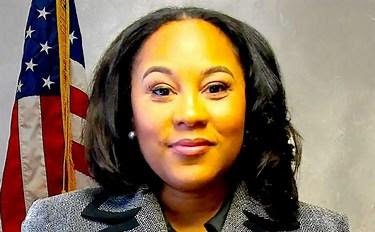
The her? The DA? Fulton County, Georgia District Attorney one Fani Willis.
Truth is I was close to titling today’s narrative “Rubbernecking Fani,” in that whenever her name comes up in the news, there’s a tendency to crane my neck to listen to what she has to say. And she seldom disappoints.
So here’s the question: What do ex-president Trump, former NYC mayor Rudy Giuliani, Senator Lindsey Graham, Georgia governor Brian Kemp, rapper Young Thug and members of the Bloods and Crips gang all have in common?
And here’s the answer: Nary one of them will be sending a Christmas card to Fani Willis. Why? Because like “white on rice,” Willis is relentless in issuing subpoenas and indictments against these men for alleged efforts to overturn the recent presidential election or, in the case of the gang members, for plotting home invasions and burglaries.
The bet here is that in some circles Willis is probably dubbed “polarizing” at a minimum or an ‘angry Black Woman,’ tags I suspect she wears as badges of honor.
Now this is not really a column about Fani Willis per se. Or, for that matter, is it about her laser like focus on rooting out corruption and the crap spewed in rap music. It is, rather, a case study in audacity, fearlessness and courage, qualities we could use a lot more of nowadays especially, dare I say, in too many men!
Chutzpah, gall, spine, not sure what to call it, but there’s something special about Fani Willis; something I can’t quite put my finger on. Her swagger and no-nonsense style, valued in men, much less so in women, does not escape notice and is downright refreshing.
But who is this woman who a local police chief called out in unbridled glee during a recent town hall meeting on crime and gangs as the kind of tough leader badly needed in his city?
To begin, Willis graduated from Howard University, the same university that produced the likes of Vice President Kamala Harris; writer Toni Morrison; late actor Chadwick Boseman; former Virginia governor Doug Wilder; and Supreme Court Justice Thurgood Marshall. Emory University School of Law is where she earned her law degree.
She cut her legal teeth by spending 16 years as a prosecutor in the Fulton County, Georgia district attorney‘s office. “I wore a pager and got up in the middle of the night and walked over bodies,” she said about the murder cases she took on for eight straight years. Her most prominent case was her 2013 indictments in the Atlanta public schools cheating scandal.
Last year Willis launched a criminal investigation into an infamous telephone call to Georgia Secretary of State Brad Raffensperger by Trump to “find” enough votes to ensure his victory in Georgia. That opened a floodgate to other investigations, including subpoenas to Guiliani, Senator Graham, and Governor Kemp. Next in her crosshairs are local gangs and violent lyrics by rappers.
In May 2022, Willis’s office indicted the “Young Thug” for 56 counts of gang-related crimes under Georgia’s Racketeer Influence and Corrupt Organizations statute and felony charges for possession of illicit firearms and drugs. She indicted 26 “Drug Rich” gang members for plotting home invasions and burglaries in Fulton County.
“If you thought Fulton was a good county to bring your crime to, to bring your violence to, you are wrong and you are going to suffer consequences,” she said at a recent news conference when she cautioned rappers to stop discussing their criminal activities in rap lyrics because she has no plans to stop using them in her cases against them.
“I think if you decide to admit your crimes over a beat, I’m gonna use it,” Willis said. “I’m going to continue to do that; people can continue to be angry about it. I have some legal advice for you: don’t confess to crimes in rap lyrics if you do not want them used—or at least get out of my county.”
These days critics of Willis come from both conservatives and liberals, and even from some African Americans who have called her a sellout for her use of rap lyrics to build her anti-gang cases. Clearly unmoved by it all, an unapologetic Willis is quick to rattle off a list of innovations she has implemented included in alternative sentencing and diversion programs, and a criminal justice class for public school children.
I close with a warning: don’t think for a moment that your race, age, wealth, gang affiliation, rap lyrics or political position will immune you from indictments for corruption and violence with Fani Willis on your tail….because she’s coming after ya?
Okay readers, sing after me: “Don’t mess with Fani….No, no no!…..Leave my Fani alone”