

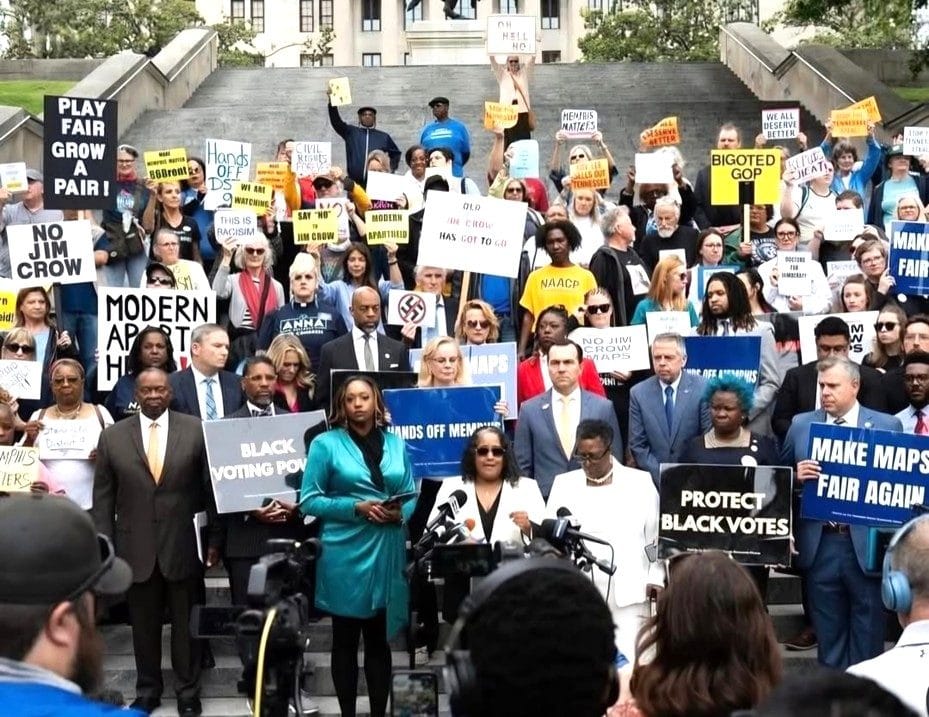
When Tennessee state Rep. Yusuf Hakeem stood before his colleagues last week, he invoked the people who came before him–those who marched, bled, and died so that every Tennessean might have an equal voice in government.
What he saw happening around him, he said, dishonored every one of them.
“It’s desperate. It’s dangerous. It’s flat-out un-American,” the Chattanooga Democrat said as lawmakers reconvened in a special session to redraw the state’s congressional districts mid-decade.
His words came as Gov. Bill Lee signed a sweeping new congressional map into law May 7–and the NAACP filed an emergency lawsuit within hours to block it.
The lawsuit argues Tennessee Republicans not only drew a racially discriminatory map but violated their own state laws in doing so, setting the stage for a legal battle voting rights advocates say strikes at the heart of American democracy.
Rep. Hakeem, whose district sits in the heart of Chattanooga, was unsparing in his assessment of the Republican majority’s motivations. Tennesseans deserve leadership focused on lowering costs, strengthening schools, and improving life for working families, he said–and Republicans know their record on those issues is weak.
“Gas prices aren’t lower. Groceries aren’t cheaper. Our schools are still underperforming,” Rep. Hakeem said. “They know they don’t have to face accountability on their record–instead, they can just change the rules in the middle of the game.”
While Chattanooga’s congressional representation is not dramatically altered under the new map–Hamilton County remains whole within the district currently held by U.S. Rep. Chuck Fleischmann of Ooltewah–Rep. Hakeem warned his constituents not to mistake local stability for safety. The real story, he said, is what is happening to Memphis.
“Chattanooga may not see a dramatic change in its congressional representation under this proposal, but what is happening to Memphis today should concern communities across this state,” he said. “We have seen these kinds of efforts before, and we know what is at stake when communities lose their ability to fully make their voices heard.”
The map’s most consequential provision splits Memphis–one of the nation’s largest predominantly Black cities–into three separate congressional districts, scattering Black voters across swaths of rural white constituencies.
The redraw is expected to eliminate the lone Democratic, majority-Black congressional seat currently held by Rep. Steve Cohen. Rep. Hakeem pledged to use every available tool in Nashville to fight the maps.
“We’ve come too far in this fight to turn back now,” he said.
The NAACP’s emergency lawsuit, filed just after Gov. Lee signed the bill, takes an approach that sidesteps the weakened federal Voting Rights Act and targets Tennessee Republicans on their own legal turf.
At the heart of the complaint is a procedural argument: that Gov. Lee’s proclamation calling lawmakers into special session never specifically authorized the repeal of a five-decade-old statute prohibiting mid-decade congressional redistricting.
Under the Tennessee Constitution, legislators in a special session may only act on matters the governor explicitly identifies.
NAACP General Counsel Kristen Clarke did not mince words. “It is a direct attack on our democracy and our Constitution to dismantle majority-Black districts,” she said. “We will fight this map, tooth and nail.”
Gloria Sweet-Love, president of the Tennessee State Conference of the NAACP, called the redraw part of a long, painful pattern.
“There is a long history and contemporary pattern of unfair redistricting practices in rural West Tennessee that have harmed Black political representation,” she said.
The day before Gov. Lee signed the bill, the Hamilton County branch of the NAACP hosted a press conference at which community leaders drew direct lines between last week’s events and the long arc of Black Americans’ struggle for political participation.
The Rev. Ernest Reid offered a sobering reminder.
“Our ancestors bled for this right. They marched for this right. They were jailed, beaten, humiliated, and in some cases killed for this right,” Reid told those gathered. “For Black communities, this conversation is deeply personal because the right to vote has always come at a cost.”
Eric Atkins, co-chair of the Unity Group of Chattanooga–founded in 1969 to support Black candidates for public office–called the moment a direct action phase and urged those present to respond accordingly.
“If we let this country revert back to Jim Crow,” he said, “this country will cease to exist as we know it. It will be the death of democracy.”
Under the proposed map, Meigs and Rhea counties would join Hamilton County in Fleischmann’s district. Morgan County would shift to the Middle Tennessee district represented by Rep. Scott DeJarlais. Portions of Campbell and Scott counties would move to Rep. John Rose’s district.
House Speaker Cameron Sexton stated during a Congressional Redistricting Committee meeting that race data was not factored into the proposed map–that only population and politics guided the redraw.
Critics, however, argue the distinction is hollow given that Black voters have historically supported Democrats in overwhelming numbers, making the racial and partisan impacts of the map functionally inseparable.
Lt. Gov. Randy McNally framed the effort in purely political terms.
“Tennessee now has the opportunity to send another Republican voice to Washington,” he said. “We intend to seize it.”
Tennessee joins Florida, Louisiana, Mississippi, Alabama, and Illinois among states already moving to redraw congressional maps following the Supreme Court’s gutting of Section 2 of the Voting Rights Act.
Primary elections are scheduled for Aug. 6, and candidate qualifying deadlines have already passed–leaving campaigns scrambling in districts that no longer exist. The compressed timeline, voting rights advocates warn, threatens confusion for voters and candidates alike with the 2026 midterms just months away.
For Rep. Hakeem, the moment is not abstract–it is personal, historical, and urgent.
“My whole life, I have stood on the shoulders of those who came before me,” he said. “People who fought to ensure every Tennessean, especially our Black neighbors, had an equal voice in our government and in our elections.”
That fight, he made clear, is not over.