Monday, October 12, 2026
Advertisement
Home Blog Page 36

The Hunter Museum Invites Active-Duty Military and Families for Free Summer Visits

0

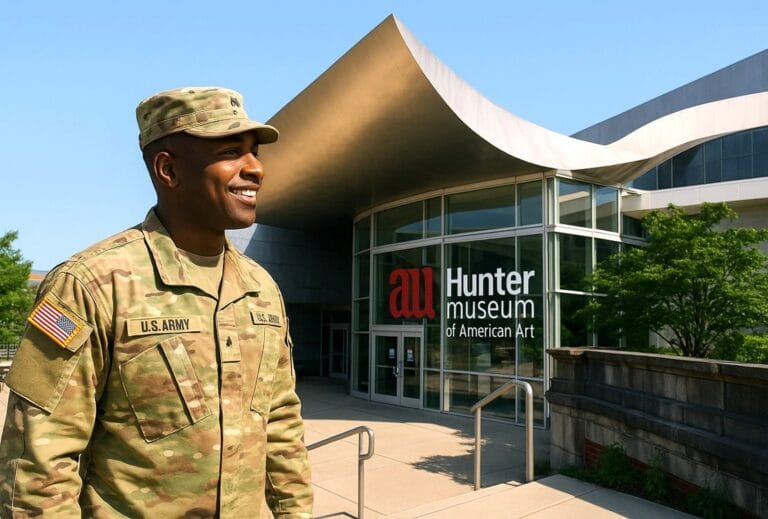
The Hunter Museum of American Art is honoring the service and sacrifice of the nation’s military families by offering free admission this summer through the Blue Star Museums program.

Located at 10 Bluff View, overlooking the scenic Tennessee River, the Hunter Museum joins more than 2,000 museums across the country in the annual initiative, which offers free entry to active-duty U.S. military personnel and their families from Armed Forces Day through Labor Day. This year’s program began Sat., May 17, and will continue through Mon., Sept. 1.

Blue Star Museums is a collaboration between the National Endowment for the Arts (NEA), Blue Star Families, the U.S. Department of Defense, and participating museums nationwide. It includes not only art museums like the Hunter but also science centers, children’s museums, zoos, and nature centers.

Eligible participants include those currently serving in the U.S. Army, Navy, Air Force, Marine Corps, Space Force, Coast Guard, and members of the National Guard and Reserve, as well as the U.S. Public Health Commissioned Corps and National Oceanic and Atmospheric Administration (NOAA) Commissioned Officer Corps. Military ID holders may bring up to five family members per visit. A military ID, such as a CAC card or DD Form 1173, is required for admission.

Founded in 1952 and situated in the historic Bluff View Art District, the Hunter Museum showcases one of the most comprehensive collections of American art in the Southeast. Its three-part building–featuring classical revival, brutalist, and contemporary architectural elements–reflects the evolution of both American art and design.

Admission through Blue Star Museums covers general entry to the Hunter’s permanent collection and select exhibits. Special exhibitions or ticketed events may require an additional fee. Families of deployed service members are also eligible, even if the active-duty member is not present.

The Blue Star Museums initiative began in 2010 to enhance the quality of life for military families–especially those with young children–and to offer an affordable and enriching experience during summer break. To date, millions have participated.

For a full list of participating institutions and more details, visit bluestarfam.org/family-life/blue-star-museums or arts.gov/bluestarmuseums.

For information specific to the Hunter Museum, visit huntermuseum.org, or call (423) 267-0968.

Meet Hercules Posey, George Washington’s Unsung Black Chef

Carla Hall, Marcus Samuelsson, Robert W. Lee – These are the names of only three of America’s top African-American chefs. There is truly no shortage of these skilled persons in history. However, one name has gone without acknowledgment for decades. His name was Hercules Posey.

In April of 1789, General George Washington became the first President of the United States. During his time in office, Chef Hercules Posey joined the ranks of the White House kitchen. BBC comments in depth regarding Posey, claiming: “Posey was unique among his peers in that he was famous in his own time and was acknowledged by white society.”

Posey’s story, like the grand majority of black men and women of his time, was not documented or preserved well through the years. But through the praise and high regard of people such as Washington’s descendent, George Washington Parke Custis, today we know that Posey was considered “’a culinary artiste’ and ‘dandy’, with ‘great muscular power’ and a ‘master spirit’, whose ‘underlings flew to his command.’” His culinary skill may have been considered great in his time, but unfortunately, we have no survived record of his recipes. That said, BBC claims knowledge of accounts that detail “meals with each course featuring a dizzying variety among dishes like roasted beef, veal… puddings, jellies… oyster stews… ice cream and seasonal fish. All were accompanied by various wines and were elegantly presented.” It’s truly no wonder that American cuisine has always been driven and founded on the remarkable abilities of Black chefs.

Happy Mother’s Day … but I wonder what kind of a day it was for you!

“Sometimes I feel like a motherless child, a long way from home.” –  Spiritual

Please indulge me, readers, as I take you back to May 11, Mother’s Day. It wasn’t that long ago. Remember what that day was like for you? Dinner? Worship? Travel? Slouched on a couch? Perhaps some or none of those.

Well for yours truly, we two guys sat in a plush restaurant in Atlanta having taken our brides out for a Mother’s Day brunch when some indescribably uncomfortable thoughts took shape in my head; thoughts that ultimately led to the piece you’re now reading.

You see, as I scanned the room, I thought less about who was there, and more about who wasn’t and should have been there. While our waitress served up dishes of incredibly good food my head kept serving up pangs of guilt about my being there.

Chief among other thoughts was the trip we took the week before to the Legacy Museum in Montgomery, Alabama and the shocking images of the horror and brutalities of slavery in America. The nagging images of what Mother’s Day could have been like for the scores of mothers was hard to shake. I thought about the mothers of Dr. King, Medgar Evers, Emmitt Till, Viola Liuzzo, Andrew Goodman ….and I could go on.

But I digress.

As we know, every Mother’s Day celebration just comes and goes. Once Sunday brunch at her favorite restaurant is paid for, days later the bouquet of red roses wilt on the dining table, Mother’s Day cards snapped up at Walmart are placed in drawers with others from years past, and we move back to the humdrum of life and depressing news cycles.

Now if you know me, you know that I can’t let an opportunity to throw in one of my signature “man, why did he go there?” head scratchers, especially if it’s controversial or is repeated so ad nauseum that it’s become almost obligatory and devoid of real meaning. So, we do the perfunctory box checking then it’s see ya this time next year.

So, fasten your emotional seatbelts and join me for some “wondering” about Mother’s Day.   

I wonder how happy a day it was for the untold number of mothers who were not showered with flowers, a seat at the table at an exquisite restaurant like we were or received warm hugs and kisses from family members.

I wonder how happy a day it was for the daughters and sons, sisters and brothers of mothers who are no longer with us.

I wonder what kind of a day it was for those mothers who are still with us, those who spent the day alone at home, or in a nursing home, who would have loved nothing better than a call from someone who they either birthed or in some way had an influence on their life.

I wonder about what kind of a day it was for those mothers who packed lunches and sent their young ones off to school only to find out later that their lives were snuffed out while being at the wrong place at the wrong time with the wrong people. It seems that we’ve grown callously accustomed to their prolonged, high-pitched cries of pain, grief and anger on the evening news. So, what do we do? We switch the channel.

I wonder about those mothers who witness the slaughter of their babies during conflicts on foreign soils – think Haiti, Gaza, Mexico City, the Sudan and other places – when their homes, schools and hospitals are bombarded with missiles or ravaged by roving gangs of thugs and gun toting drug cartels. Burying a loved one is excruciating, but burying a child is a special kind of awful.

I wonder how happy a day it was for mothers on the southern border, many with children in tow or strapped on their backs, who have been caricatured, demonized and politicized by slick politicians to play to a base and to detract from more pressing issues.

I wonder how happy a day it was for scores of “foreign looking” women who live in fear of being snatched up from home, on a street corner, at school or at work, handcuffed and flown off to some prison.

I wonder how happy a day it is for mothers of the incarcerated who sit separated by thick cellophane glass from their sons or daughters on the other side, donned in prison garb while beefy prison guards eye them from a distance.

I wonder how happy a day it was for mothers who had to stomach the news that their daughters were sexually abused by pedophiles, well-heeled political figures and multimillionaire entertainment moguls. (Sorry readers, but I have no desire to tarnish this space with their names. You know who they are).

“This is a man’s world” James Brown

I wonder how happy a day it was for those men who remain silent, lack courage, and are complicit and indifferent to the sufferings of women who are abused by other men.

I wonder how happy a day it was for those largely forgotten women who were motherless because of factors beyond their control who would, nonetheless, have appreciated a “just thinking about you today” call, card or bouquet of roses.

I wonder how happy a day it was for those so-called “men” who, for some inexcusable or flimsy reason, did not call their moms on Mother’s Day.

A short “I wonder” pause here before we move on with this lyrical interlude from a years ago piece by Grandmaster Flash, “It makes me wonder sometimes what keeps me from goin’ under.”

“Maybe it is such a day for you,” wrote John Pavlovitz about Mother’s Day in his Our Beautiful Mess newsletter. “It might bring the scalding sting of grief for the empty chair around a table. It might come with choking regret for a relationship that has been severed. It might be a day of looking around at other mothers and other children and feeling the unwelcome intrusion of jealousy that comes with comparison. It might be an annual injury you sustain.”

Now some may remember the 1966 song, “This is a man’s world” sung by the late soul singer James Brown. Well Mr. Brown, aka “soul brother number one,” if I contextualize your song in our world today, I’ll say that hey, you’re right, it is a man’s world…. and maybe that explains why we’re in the awful mess we’re in today. Terry Howard is an award-winning writer, a contributing writer with the Chattanooga News Chronicle, The American Diversity Report, The Douglas County Sentinel, Blackmarket.com, recipient of the Dr. Martin Luther King, Jr. Leadership Award, and third place winner of the Georgia Press Award.

TDMHSAS AWARDS $5,200,000 TO CREATE AFFORDABLE HOUSING FOR PEOPLE LIVING WITH BEHAVIORAL HEALTH CHALLENGES

NASHVILLE, Tenn. – The Tennessee Department of Mental Health and Substance Abuse Services (TDMHSAS) is releasing $5.2 million in grant funding to create safe, quality, affordable housing for people living with mental illness, recovering from substance use disorder, and re-entering communities from incarceration.

TDMHSAS awarded grants from the Creating Homes Initiative (CHI) to 12 non-profit agencies across the state. In total, the agencies committed to create 101 new beds with the funding.

Since 2000, the Creating Homes Initiative has leveraged more than $1.3 billion in federal, state, local, foundational, and other funding sources to create more than 36,000 housing opportunities. The Creating Homes Initiative takes seed money from a recurring state investment and creates a system for writing grants and leveraging additional sources of funding to create housing for people living with behavioral health challenges. The initial model serving people with Serious Mental Illness proved so successful that Governor Bill Lee expanded it twice to support the housing needs of people in recovery from substance use disorder and re- entering the community after incarceration.

“We are so excited to offer this latest round of grants through the Creating Homes Initiative. For 25 years now, CHI has created safe, quality, affordable housing for some of Tennessee’s most vulnerable residents. It’s no surprise that shelter is an essential part of a person’s journey of mental wellness and recovery, and CHI has met that need and supported tens of thousands of people to live the lives they always dreamed of,” said TDMHSAS Commissioner, Marie Williams, LCSW.

Grantees will be creating new housing in Davidson, Knox, Madison, Obion, Overton, Shelby, Sullivan, Sumner, and Washington Counties. The timelines for completion range from six months to a year.

A key feature of the Creating Homes Initiative is the team of Regional Housing Facilitators across the state. These men and women partner with agencies to write grants, seek out additional funding sources, and gather community support. To find the Regional Housing Facilitator for your area or to learn more about the Creating Homes Initiative, visit this link on TN.gov: TN.gov/behavioral-health/chi

You Decide–Is Erlanger’s $1 million sponsorship of The Lookouts Clever or Not So Smart

Whew, there’s lots of talk regarding Erlanger Medical Center’s banner sponsorship of the Lookouts new stadium under construction. For $1 million annually, the new stadium will be named Erlanger Park.

Weighing in with varying opinions have been Hamilton County Mayor Weston Wamp, Chattanooga Mayor Tim Kelly, the Chattanooga Lookouts, and the public relations company handling the press and likely some of the negotiations between decision-makers in this pricey marketing move. Public opinion forming with greatest efforts now are seeming to sell the community on the significant financial investment by Erlanger Medical Center.

Let’s look at some facts you need to evaluate that will permit you to decide: Is the Erlanger $1 million sponsorship of the Lookouts stadium clever or not so smart?

The status of Erlanger Hospital changed in 2023, after local efforts were successful ending Erlanger Medical Center’s organization and operations as a public nonprofit that was first beholden to the public. Like a school, Erlanger received funding from public or government sources with the requirement of open, transparent meetings. Now, Erlanger Medical Center is an independent nonprofit organization operating with covenants governing its function with private meetings, negotiations, and transactions like other competing health systems and other health entities.

As part of these covenants of the newly structured Erlanger approved by the County Commission, the intent was clear from the local and state governments that “the historic mission of Erlanger as a teaching hospital, regional referral center, and safety-net provider for Hamilton County” would continue. This included the understood role in delivering “charity care remaining consistent with Erlanger’s historical policies.”

Put simply, whether public or private, as a nonprofit hospital, Erlanger was to continue to serve as the area’s safety net providing care that didn’t discriminate on one’s ability to pay or the robustness of one’s insurance coverage. These intentions were part of the 2023 deal in addition to the medical center’s ability to compete and grow in an important healthcare market.

The hospital, founded in 1889, has served as the area’s public hospital, once supported by both county and city government funding, but as recently as 2023, the recipient of $1.5 million in county government tax dollars.

The Lookouts Stadium is projected to be ready by Spring 2026 and serve as the anchor facility for the 400+ acre development of retail that is estimated to generate over $1 billion in revenue through development, jobs, and consumer spending.

The focus of public sparring is whether Erlanger Medical Center should spend $1 million to see its name everywhere at the Lookouts Stadium, just as AT&T has had at Hawk Hill. Marketing and branding show community presence and support, but also establishes a front-of-mind name to steer consumers to the sponsor’s facility. There are benefits.

Whether the million-dollar investment results in good patient care by the best faculty and staff is not the immediate question here. It’s clear the Lookouts’ development wins. Still, the public opinion on patient care and excellence will determine whether this was clever or not so smart.

Editor’s Note:  The CNC welcomes your opinions at newschronicleinc@gmail.com

Ronald Harris Retires After 40 Years with BlueCross BlueShield of Tennessee, Called to Pastorate

After four decades of dedicated service, Mr. Ronald Harris retired from BlueCross BlueShield of Tennessee on May 1. Widely respected for his leadership, vision and heart for people, Harris leaves behind a legacy that helped shape the company’s culture and set a national example for diversity, equity and inclusion.

Mr. Harris served as vice president of Corporate Workforce Diversity, where he played a pivotal role in aligning diversity and inclusion with the company’s overall corporate strategy. Under his leadership, BlueCross earned numerous accolades, including recognition from Forbes as one of America’s Best Employers for Diversity and Best Large Employers. The company was also named among the Best Places to Work by the Human Rights Campaign and Disability:In, the leading nonprofit resource for business disability inclusion worldwide.

“God is the foundation of my life,” Mr. Harris said in an exclusive interview with the Chattanooga News Chronicle following his retirement. “I’ve always trusted the Lord to lead me. And when it was time to retire, I felt like God was leading me to other things.”

Those “other things” now include the pastorate. Mr. Harris has been called to serve as senior pastor of Mt. Paran Baptist Church in Chattanooga–a calling he embraces with both humility and anticipation.

“In every chapter of my life, God has led me,” Mr. Harris shared. “This wasn’t something I saw coming, but I’m really excited and thankful to give back and serve His people.”

Throughout his 40-year tenure at BlueCross BlueShield of Tennessee, Mr. Harris became known not only for his professional achievements, but also for his deep commitment to mentoring and empowering others.

“Certainly, I’ve been blessed beyond belief,” he said. “One of the things I’ve always tried to do is send the elevator back down so others could benefit from the positions I’ve been blessed with. It’s all about community.”

Mr. Harris joined BlueCross BlueShield of Tennessee in 1986, and held numerous leadership roles with increasing responsibility. Before his time at BlueCross, he worked as personnel director for Central Soya. He co-founded the Blue Cross Blue Shield Association Diversity Alliance and became a frequent speaker on workplace inclusion, delivering expert insight at conferences and forums across the country.

His work earned national recognition, including the 2017 Legacy Award from the National Organization for Workforce Diversity and the 2018 Julie Baumgardner Leadership Award from the Chattanooga Area Chamber of Commerce, to name a few. He was also recognized by the Chattanooga Women’s Leadership Institute as one of the top five men advocating for women in senior positions.

Mr. Harris has been featured in USA Today, African American Career World magazine, Equal Opportunity Publications, and various other media outlets. His vision, humility and faith have left a lasting impact not only on his company but also on the wider public.

He continues to contribute to the community through his board memberships and also has a more than 60-year association with Chattanooga’s Second Missionary Baptist Church, where he served as an associate pastor.  He is married to Rosalind Crutcher Harris and is the father of two children: the late Jerron M. Harris and daughter Shronda S. Harris.

As Mr. Harris enters this new chapter, his legacy remains an enduring example of faith, service, and leadership.

“God’s blessings have always preceded whatever I’ve done,” he said. “And I trust they always will.”

A formal retirement reception for Mr. Harris was held on May 24.

BlueSky Tennessee Institute Celebrates Fourth Signing Day–with Help From its First Graduates

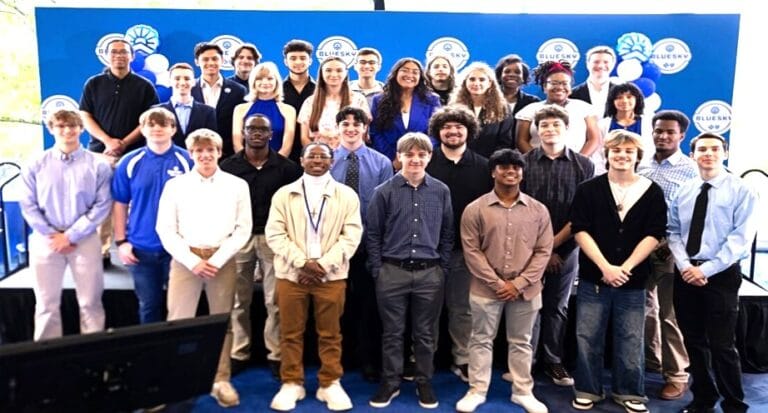
BlueCross BlueShield of Tennessee (BlueCross) and East Tennessee State University (ETSU) recently celebrated the fourth class of students committing to the BlueSky Tennessee Institute at the program’s annual Signing Day event on Cameron Hill, bringing the total number of students to 90. This year, the crowd of supporters and volunteers included members of BlueSky’s inaugural class, who graduated in December 2024 and are now full-time employees of BlueCross enterprise information technology division.

BlueSky Institute is a workforce development initiative providing BlueCross a pipeline of the advanced technology talent needed to serve its members and business customers in communities throughout Tennessee. Students experience a tailored, accelerated version of ETSU’s accredited Computing curriculum and gain real-world experience through a series of internships in BlueCross tech divisions.

They have professional mentoring and comprehensive support from BlueCross along the way, all on site at the company’s Chattanooga headquarters. Program graduates can earn a job offer with the company following graduation. BlueSky Institute adds roughly 30 students each fall, and the total headcount of students and alumni is up to 117.

“It’s been really exciting to see our first graduates come aboard as successful full-time BlueCross employees–it’s a tight-knit group, and many have stepped into a mentoring role as the program continues to grow,” said Bradley Leon, BlueSky Institute’s executive director. “We know our newest BlueSky students will benefit from what we’ve all learned since launching this program in 2022, and we’ll continue to enhance various elements as we move forward.”

Members of the newest cohort appreciated the warm welcome.

“I do know a few BlueSky people already, so it’s been really nice to connect and learn about the program ahead of committing,” said Emily Sanchez, one of the incoming students. “I’m so excited to learn more about a field that I’m really interested in, alongside so many new people who have similar interests and are equally driven.”

The newest class was chosen from the most competitive set of applicants to date, representing more than a dozen schools from across the greater Chattanooga area. They will begin their studies on the BlueCross Cameron Hill campus in late summer.

“We are so pleased to see the continued growth of this program, and we look forward to supporting the newest BlueSky Institute as they start their journey with us in August,” said Dr. Tony Pittarese, professor and dean of the College of Business and Technology at ETSU.

Learn more about the BlueSky Institute program at blueskytn.com.

Local Leaders and Community Members Experience Life as Firefighters at Fire Ops 101

A diverse group of Chattanooga’s city leaders, nurses, and engaged community members traded their usual routines for a day of intense, hands-on training on May 10, as they participated in the annual Fire Ops 101 event.

Hosted by the Chattanooga Fire Fighters Association, IAFF Local 820, and the Chattanooga Fire Department, the immersive class provided an in-depth look at the multifaceted operations of the fire service.

This year’s Fire Ops 101 held a special significance, being the first event of its kind hosted at the Chattanooga Fire Department and Hamilton County Emergency Services’ newly opened training tower.

Diamond Love, Vanderbilt Burn Center, participated in a rappelling exercise, experiencing firsthand the challenges faced by Chattanooga firefighters.

Participants were given a realistic glimpse into the daily challenges and critical skills required of firefighters through a series of dynamic training evolutions. The day’s curriculum included practical sessions on utilizing fire extinguishers, navigating fire suppression and search scenarios, mastering urban search and rescue rope techniques, performing vehicle extrication, and understanding hazardous materials (Hazmat) protocols.

This firsthand experience allowed attendees to not only witness, but actively participate in some of the core responsibilities of Chattanooga’s firefighters.

According to the union, the annual Fire Ops 101 class serves a crucial purpose: to educate the public on the demanding nature of the firefighting profession. By stepping into the boots of a firefighter for the day, participants gained a deeper appreciation for the physical and mental fortitude required to respond to emergencies.

Diamond Love, from the Vanderbilt Burn Center, was among the participants who experienced the intensity of the training.

“We have used the jaws of life and all the other large tools to break into cars,” Love shared. “We’ve learned the way fires work, how they escalate, and which fire extinguishers extinguish which fires. We got to see a little bit of height and rappelling on how they do certain rescues.”

A participant practices urban search and rescue rope techniques during the Fire Ops 101 training on May 10, experiencing a realistic simulation of a high-angle rescue scenario.

The comprehensive program, which ran from 7 a.m.-1p.m., also included a CPR demonstration and an overview of the CFD firefighter ability test. Throughout the day, attendees had the opportunity to interact directly with the dedicated men and women who serve the city of Chattanooga, gaining valuable insights into their training, equipment, and the risks they face daily.

Organizers emphasized that Fire Ops 101 aims to expose participants to the realities of the job, including the smoke, the adrenaline rush, and the significant physical and emotional stress firefighters and emergency medical personnel routinely encounter.

Furthermore, they say, the event serves to highlight the critical need for adequate and safe staffing, up-to-date protective equipment, modern apparatus, and presumptive laws that protect these vital public servants.

Trump treats laws as obstacles, not limits − and the only real check on his rule-breaking can come from political pressure

Andrew Reeves, Professor of Political Science

and Director of the Weidenbaum Center,

Washington University in St. Louis

Lately, the headlines have been clear: President Donald Trump is headed for a showdown with the courts. If he ignores their rulings, the courts have few tools and limited power to make him comply.

But the real contest is not legal. It is political.

As a political scientist who studies presidential behavior and public responses to unilateral action, I have spent my career examining the boundaries of executive power.

Those limits, aimed at constraining the president, are set in law.

The Constitution outlines the powers of Congress and the president in articles 1 and 2. It formally gives Congress the power of the purse and requires the president to “take Care that the Laws be faithfully executed.”

Statutes dictate how agencies operate, how appointments are made and how funds must be spent. Courts interpret and enforce these rules.

These legal constraints reflect the founders’ concern with unchecked executive power. That concern is embedded in the country’s political origins – the Declaration of Independence was a direct rebuke to royal overreach.

But law alone has never been enough to prevent presidents from abusing their power. The law’s force depends on political will. Presidents often follow the law not simply because they must, but to avoid backlash from Congress, the media or the public.

What the United States is witnessing in 2025 is not just a president testing the system. It is a transformation of the presidency into a fully political institution. The president acts until political resistance becomes strong enough to stop him.

President Donald Trump criticizes judges whose decisions he doesn’t like.

Testing the limits

These political constraints are informal and fluid.

They arise from public opinion, media scrutiny, pressure from party leaders and other elected officials, and the threat of electoral consequences. While legal rules rely on institutions, political limits depend on reputation, norms and the willingness of others to resist.

Trump’s presidency operates within this second framework. Legal boundaries are still present, but they are often treated by his administration as optional and without deference.

Trump, for example, has sidelined the Office of Legal Counsel, the executive branch’s source of legal guidance. His focus appears to be not on legality, process or constraint, but on headlines, polling and control of the narrative.

Courts still issue rulings, but their power depends on a broader political culture of compliance, and that culture is weakening.

Trump is not the first president to test the limits of authority. But the pace and scale of his defiance are without precedent. He appears to be betting that pushing boundaries will continue to pay off.

Lag between law and action

The legal challenges facing Trump are real.

In his first 100 days back in office, he took aggressive steps on federal spending, appointments to key executive branch positions, tariffs and deportations. Trump has announced he will not enforce legislation that the Supreme Court confirmed was constitutional. Many of these actions have already triggered legal challenges.

These are not isolated incidents. Taken together, they reveal a broader pattern.

Trump appears to treat legal rules not as limits but as obstacles to be negotiated or ignored. One recent scholarly paper has described Trump’s approach as “legalistic noncompliance,” where the administration uses the language of law to give the appearance of compliance while defying the substance of court orders.

The executive branch can move quickly. Courts cannot. This structural mismatch gives Trump a significant advantage. By the time a ruling is issued, the political context may have changed or public attention may have moved on.

Judges have begun to notice. In recent weeks, courts have flagged not only legal violations but also clear signs of intentional defiance.

Still, enforcement is slow, and Trump continues to behave as though court rulings are little more than political talking points.

Politics the only real check

Trump is not guided by precedent or legal tradition. If there is a limit on presidential power, it is political. And even that constraint is fragile.

In a February 2025 national survey by the Weidenbaum Center, a research institute that I head at Washington University in St. Louis, just 21% of Americans said the president should be able to enact major policy without Congress. The public does not support unchecked presidential power: A further 25% of respondents, including more than one-third of Republicans, neither agreed nor disagreed that a president should have this type of unchecked power. Of those with an opinion, a solid 72% of Americans oppose unilateral presidential action, including 90% of Democrats, 76% of independents and 42% of Republicans.

These findings align with nine earlier national surveys conducted during the Obama and Trump administrations. Jon Rogowski and I report these results in our book, “No Blank Check.”

But one important shift stands out in the recent survey. Support for unilateral executive action among the two-thirds of Republicans who expressed an opinion has reached an all-time high, with 58% of them endorsing presidential action without Congress. That is more than 16 points higher than in any previous wave.

Despite that rise in partisan support, Trump’s broader political position remains weak.

His approval ratings remain underwater. His policies on tariffs and federal spending cuts are unpopular. Consumer confidence is falling.

Congressional Republicans continue to offer public support, but many are watching their own polling numbers closely as the midterms approach.

If the economy falters and public opinion turns more sharply against the president, political resistance could grow. I believe that’s when legal rules may begin to matter again – not because they carry new force, but because violating them would carry higher political costs.

Real test still ahead

So far, no judge has held the Trump administration in contempt of court. But the signs of erosion are unmistakable. Trump recently accused the Supreme Court of “not allowing me to do what I was elected to do” after it temporarily blocked his administration’s effort to deport migrants with alleged ties to Venezuelan gangs. Treating the judiciary as just another political  adversary and ignoring its rulings risks an even deeper constitutional crisis.

The most meaningful check on presidential power will be political.

Courts rely on the broader political system for enforcement. That support can take many forms: elected officials speaking out in defense of the rule of law; Congress using its oversight and funding powers to uphold court rulings; bureaucrats refusing to implement unlawful directives; and a press and public that demand compliance. Without that support, even the clearest legal decisions may be ignored. The legal fights unfolding today are serious and must be watched closely. But Trump is not focused on the courts. He is focused on politics – on how far he can go, and whether anyone will make him stop. (The CONVERSATION)

Morgan Freeman, Now 87 Years Old, Started Acting at Age 9

Morgan Freeman, an actor, director, and narrator is well-known for his distinctively deep voice and for playing a variety of roles in a wide range of film genres. 

Morgan was born on June 1, 1937 in Memphis, Tennessee, to Mayme Edna (Revere), a teacher, and Morgan Porterfield Freeman, a barber. Freeman was raised in Mississippi, where he began acting in school plays in his hometown of Greenwood, Mississippi when he was just 9 years old. When Freeman made his acting debut as the main character in a school play at the age of twelve, he won a statewide drama competition and while settling into school, he also discovered music and theater.

Morgan Freeman served several years in the US Air Force as a mechanic between 1955 and 1959.

The young Freeman attended Los Angeles City College to study Theatre Arts where a teacher pushed him to pursue a dancing career. He appeared in stage productions in his early career. His first dramatic arts exposure was on the stage including appearing in an all-African American production of the exuberant musical Hello, Dolly!.

He rose to fame in the 1970s for his role in the children’s television series The Electric Company which gave him financial stability and recognition among American audiences. Freeman then appeared in the Shakespearean plays Coriolanus and Julius Caesar, the former of which earned him an Obie Award. In 1978, he was nominated for the Tony Award for Best Featured Actor in a Play for his role as Zeke in the Richard Wesley play The Mighty Gents.

His breakout role was in Street Smart (1987), playing a hustler, which earned him an Academy Award nomination for Best Supporting Actor and he achieved further stardom in Glory (1989), the biographical drama Lean on Me in which Freeman portrays a school principal at an under-performing and drug- and crime-ridden New Jersey high school.

He also starred in the comedy drama Driving Miss Daisy (1989), the latter of which garnered him his first Academy Award nomination for Best Actor. He has won several other awards throughout his career spanning over five decades, including an Academy Award, a Screen Actors Guild Award, and a Golden Globe Award.

In addition to acting, Freeman directed the drama Bopha in 1993 and he also founded a film production company Revelations Entertainment with business partner Lori McCreary.

He is the recipient of the Kennedy Center Honor, the AFI Life Achievement Award, the Cecil B. DeMille Award, and the Screen Actors Guild Life Achievement Award.

For his performances in theatrical productions, he has won three Obie Awards, one of the most prestigious honors for recognizing excellence in theatre. 

Freeman is still an incredibly busy actor, with multiple films in theaters even today in 2025 and most recently starred in A Good Person alongside Florence Pugh. 

He has also embarked on several ventures outside of acting, including environmental and political activism and was a  huge advocate of the COVID-19 vaccine.  He earned a Private Pilot license at the age of 65.

He also owns and operates Ground Zero, a Blues club in Clarksdale, Mississippi, and is the former co-owner of Madidi, a fine dining restaurant in the same city. He received a trademark on his name from the U.S. Patent and Trademark Office on September 19, 2006.

In 2021, Freeman donated $1 million to the University of Mississippi to launch its Center for Evidence-Based Policing and Reform.

Freeman has been awarded several honorary degrees for his incredible contributions to the arts, culture and major charitable endeavors.  He received an honorary Doctor of Arts and Letters degree from Delta State University in 2006, an honorary degree from Howard University in 2015 and an honorary Doctor of Humane Letters from Boston University in 2016.

In addition to his on-camera work, he’s also created a name for himself as a voice actor due to his distinctive tone. His iconic voice has narrated Steven Spielberg’s War of the Worlds, March of the Penguins and more.

So what was left for Freeman to do ……..besides be the voice of God? He did just that in Bruce Almighty and its sequel Evan Almighty.