Monday, October 12, 2026
Advertisement
Home Blog Page 32

Baby Grok is Born–the Next Generation of AI for Kids

0

Tennessee is now home to “xAI,” or the Artificial Intelligence platform and supercomputing of Elon Musk. Located in the old Electrolux building in southwest Memphis, the supercomputer runs Grok, the free digital AI assistant that offers searches, some image generation, and analysis that is available in  premium versions, Grok 3 and 4, that perform more complex tasks and analysis using real-time data retrieval and machine thinking to offer data, solutions, and research.

Well, it seems Grok isn’t just for the adults or competitive corporations seeking analysis and research. Grok had a baby, literally Baby Grok.

Currently in development, the kid-friendly platform via app will have educational content and age-appropriate content. Parents are assured the content will be “safe” or free of online predatory functions and content.

A father who encourages fatherhood, Elon Musk announced the new platform himself in a social media post on X, formerly Twitter, in response to a parent’s expressed concerns about allowing her child to use a chatbot for searches.

Baby Grok is set to “foster creativity and entertainment, potentially allowing kids to explore interactive content or create stories, similar to features in other child-focused AI apps” but with strong parental controls and “robust content filters to ensure responses are free from mature, controversial, or harmful content.”

While most see AI as a high-powered search engine acting as a handheld wizard of sorts at the user’s disposal to answer questions, Baby Grok will offer “educational modules tailored to different age groups, ensuring content is engaging and relevant to the child’s developmental stage.” The target age vaguely referenced will be children 6-12 years of age, or elementary school aged.

Artificial Intelligence is viewed as a “slippery slope” with just cause. For those who would choose to use the tool in attempts to do the complete work digitally using the platform, the guarantee is a lack of mastery, a dumbing down with little to no critical thinking or resourcefulness. In contrast, when AI is carefully integrated into broader learning objectives that emphasize discussion, presentation, and demonstrable mastery through testing and measurement, learning can be significantly enhanced by the easy access to information it provides.

Chattanooga Honors Clyde Stubblefield, Legendary ‘Funky Drummer,’ with Tennessee Music Pathways Marker

Born Clyde Austin Stubblefield on April 18, 1943, in Chattanooga, his musical journey began not in a classroom, but by mimicking the industrial rhythms he heard around him–the clatter of trains, the hum of grain elevators. These everyday sounds fueled his innate sense of rhythm, which he honed into a percussive art form. He often said he could play any drum pattern he could hum.

Chattanooga’s own Clyde Stubblefield, the legendary “Funky Drummer” whose beats are the invisible backbone of countless recordings worldwide, was permanently honored on July 17 with a Tennessee Music Pathways marker unveiled in Miller Park.

The plaque serves as a lasting memorial to a self-taught musical pioneer who transformed the sounds of his hometown into a global rhythmic phenomenon.

Stubblefield, who passed away in 2017, is widely recognized as one of the most sampled musicians in history, with his iconic drum patterns appearing on over 1,500 tracks. From the foundational grooves of funk to the intricate soundscapes of hip-hop and pop, his influence stretches across generations and genres, shaping the work of artists such as LL Cool J, N.W.A., Public Enemy, Run-DMC, Ed Sheeran, Madonna, and Sinéad O’Connor, among many others.

His most famous contribution, the break from James Brown’s 1970 single Funky Drummer, remains a cornerstone of sampling.

Marcus Carlisle, Stubblefield’s great-nephew, spoke emotionally at the ceremony, expressing profound gratitude on behalf of the family.

“I just want to say, on behalf of my family, thanks to all those involved that put all this together to make this become a reality,” Carlisle stated. “Because in his own words, he never expected none of this to happen, if you talked to him and he tell his story, from leaving here to going to Macon in order to play the drums.”

Born Clyde Austin Stubblefield on April 18, 1943, in Chattanooga, his musical journey began not in a classroom, but by mimicking the industrial rhythms he heard around him–the clatter of trains, the hum of grain elevators. These everyday sounds fueled his innate sense of rhythm, which he honed into a percussive art form. He often said he could play any drum pattern he could hum.

Stubblefield started his professional career with local R&B groups in Chattanooga, including The Blue Shufflers, Inclines, and Cascades. His talent soon led him to Macon, Georgia, where he toured with Otis Redding and played with guitarist Eddie Kirkland, before joining James Brown’s band in 1965. For six pivotal years (1965-1970), Stubblefield’s syncopated drum patterns, particularly on hits like Cold Sweat and I Got the Feelin’, helped define the sound of funk.

After his time with Brown, Stubblefield settled in Madison, Wisconsin, where he remained a beloved figure in the local music scene, performing extensively in jazz and blues circles and serving as the house drummer for National Public Radio’s Whad’Ya Know.

His enduring legacy has earned him recognition as one of the greatest drummers of all time, and in 2017, he received an honorary degree from the University of Wisconsin-Madison.

The Tennessee Music Pathways initiative, which connects visitors to the state’s rich musical heritage through an online travel guide and physical markers, proudly added Stubblefield to its distinguished list. This statewide driving tour spans seven genres of music–blues, bluegrass, country, gospel, soul, rockabilly and rock ‘n’ roll–and identifies and preserves unique musical history across all 95 counties.

Chattanooga Mayor Tim Kelly, himself a drummer, emphasized the significance of the tribute.

“As a drummer myself, it is a true honor to celebrate the legacy of Clyde Stubblefield,” Mayor Kelly remarked. “Known around the world as the ‘Funky Drummer,’ Clyde’s rhythm powered hits with James Brown and became the heartbeat of countless songs across genres. He is the most sampled drummer in history, and for good reason. Now we honor Clyde’s extraordinary contribution to music right in the heart of Chattanooga. Long live the funk!” Efforts are also underway to create a documentary about Stubblefield’s immense and often uncredited influence on modern drummers, further solidifying his place in music history.

CFD Lieutenant David Ruffin Promoted to Captain

0
Newly promoted Chattanooga Fire Captain David Ruffin (center, holding certificate) is pictured with his family and fellow firefighters from Station 5.

CHATTANOOGA, Tenn. (July  2025) – Mayor Tim Kelly has promoted Karen Rennich to the role of interim administrator of the Department of Planning and interim executive director of the Chattanooga-Hamilton County Regional Planning Agency (RPA).

Rennich has served as deputy administrator of the Department of Planning for more than 14 years. She replaces Dan Reuter, who has resigned. A permanent executive director of the RPA will be selected by the RPA Executive Committee at a later date.

“When it comes to affordable housing, land use and public transit, the Department of Planning is on the front lines,” Kelly said. “Their work helped to re-imagine the city’s zoning for the first time since the 1960s, along with updating the sign ordinance and mapping out an urban tree canopy. I’m excited for Karen and her team to continue producing tangible results for Chattanoogans.” “The Department of Planning works hard to move the One Chattanooga plan forward and help to ensure we have responsive and effective government,” Rennich said. “I want to thank Mayor Kelly for the appointment and look forward to continuing the great work of the department.”

Tennessee Black Caucus to Host Legislative Town Hall in Chattanooga

The Tennessee Black Caucus of State Legislators (TBCSL) is bringing its 2025 Legislative Town Hall Series to Chattanooga on Tuesday, July 29. The free, public event will take place from 5-7 p.m. at the historic Bessie Smith Cultural Center, located at 200 E. M.L. King Blvd.

This town hall discussion offers Chattanooga community members a vital opportunity to engage directly with members of the Tennessee Black Caucus on key issues impacting both the state and local communities. Discussions are slated to cover crucial topics including Civil Rights, Education, and Diversity, Equity, and Inclusion (DEI).

“The Legislative Town Hall Series is designed to foster open dialogue between state lawmakers and the citizens they serve, providing a platform for thoughtful discussion, shared concerns and collaborative solutions on matters impacting African American communities and the broader Tennessee population,” officials stated regarding the series’ purpose.

Representative Sam McKenzie who serves Knoxville’s District 15 and chairs the event for the TBCSL, extended an open invitation to residents.

“We invite everyone in the Chattanooga area to join us for this important conversation,” said Rep. McKenzie. “We are committed to listening, learning and working together to advance policies that ensure fairness, opportunity and justice for all Tennesseans.”

Representative Yusuf Hakeem, who serves District 28, emphasized the importance of community involvement. District 28 includes neighborhoods around downtown Chattanooga as well as several outlying areas, such as East Chattanooga, Brainerd and Alton Park.

“The Tennessee Caucus of Black Legislators is conducting a statewide listening tour and holding town hall meetings in each of the state’s Grand Divisions,” he explained. “The purpose of the tour is to maintain and improve our interaction with citizens of Tennessee. The meetings provide an opportunity for citizens to express themselves and seek answers to their meaningful concerns that state government impacts, as well as inform them of current and future Black Caucus initiatives. Meetings like these help to ground the Caucus in the needs and concerns of the people. Additionally, Caucus members will tour and volunteer to help out at the Chattanooga Community Kitchen. Community service is critical to our Caucus mission.”

The Tennessee Black Caucus of State Legislators is dedicated to “advocating for policies and legislation that promote equality, justice, and opportunity for African Americans and other marginalized communities across Tennessee.” For more information, interested individuals can contact Rep. McKenzie at rep.sam.mckenzie@capitol.tn.gov.

The Mary Walker Foundation Carries a Legacy of Literacy and Civil Rights

David Bulls

By David Bulls, age 15

Camp REACH and the Mary Walker Foundation stand on the shoulders of giants, said Adrian Edwards, executive director of the Mary Walker Foundation.

“The purpose is still relevant today because 54 percent of Americans read at or below a sixth-grade level.”

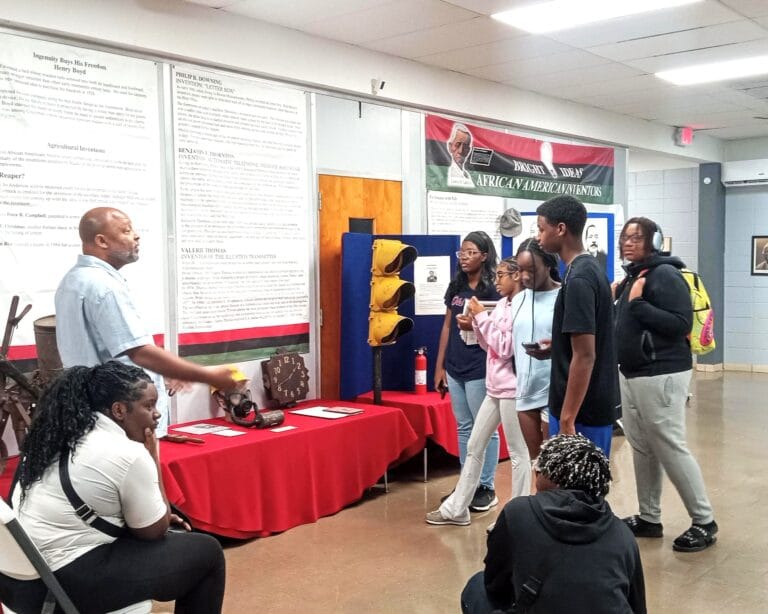
Speaking to a group of teens at Camp REACH this summer, Edwards shared how the program is rooted in Chattanooga’s fight for equality and literacy.

“This history is important,” said Camp REACH student Rebekah Wright. “It tells us why the camp is here.”

Camp REACH was founded in 2021 by the late Rev. Lurone “Coach” Jennings Sr., former Howard High School principal and retired city administrator. His mission: promote literacy, expose teens to careers, and help them become financially sustainable. Jennings was inspired by Adrian’s grandfather, the late Rev. John Lloyd Edwards.

Rev. Edwards helped integrate Erlanger Hospital, worked alongside Dr. Martin Luther King Jr., and once had his home bombed for his civil rights efforts. In 1974, he founded the Mary Walker Foundation, named after a former slave who learned to read at age 116, proof, Edwards said, that it’s never too late to learn.

“To give you the backstory, my grandfather was involved in the Civil Rights Movement,” Adrian told students seated on wooden pews inside Hope City Church, home to Camp REACH.

As a youth pastor in Nashville, Rev. Edwards transported students from Fisk and Tennessee State to organize sit-ins, including future legends like Congressman John Lewis and strategist Diane Nash. In 1963, he moved to Chattanooga to lead Cosmopolitan Community Church after Rev. C.T. Vivian left to join the movement more directly.

That same year, Mary Walker began learning to read.

Walker had survived slavery and segregation. At 116, she joined a literacy class. By 117, she was reading, writing, and doing arithmetic. She passed away at 121.

“My grandfather didn’t know her,” Adrian said, “but after his house was bombed, her obituary ran right below the newspaper article. Years later, while working at a halfway house he owned, he found a recording of her voice.”

The tape was buried in an old dresser from a building that once belonged to a record company. It contained Mary Walker telling her life story—from slavery to education.  Rev. Edwards started The Mary Walker Foundation in 1974 in her honor to promote academic and economic literacy.

“Her story became the inspiration for the Mary Walker Foundation,” Adrian said. “It just seemed like divine inspiration.”

Camp REACH is a work-based summer youth program of the Mary Walker Founda tion, designed to cultivate literacy, journalism, career exploration, and leadership development. Visit marywalkerfoundation.org to find out how to support.

Morehouse School of Medicine Expands to Chattanooga Through Historic Partnership

State Representative Yusuf Hakeem (2nd from left) and Chattanooga Mayor Tim Kelly (far right) join representatives from Morehouse School of Medicine and CHI Memorial Hospital during the announcement of their groundbreaking partnership at the Bessie Smith Cultural Center.

A groundbreaking partnership between Morehouse School of Medicine and CHI Memorial Hospital is set to transform healthcare education and equity in Chattanooga, with plans to establish a regional medical campus that could significantly increase the number of Black and minority healthcare professionals serving the community.

The collaboration, operating under the “More in Common Alliance,” represents a 10-year, $100 million initiative between the Atlanta-based historically Black medical school and CommonSpirit Health, CHI Memorial’s parent company. The partnership addresses a critical gap in healthcare representation: while Black and African American individuals comprise nearly 14% of the U.S. population, only 5.7% of active physicians identify as Black or African American, according to the Association of American Medical Colleges.

Dr. Veronica Mallett, Senior Vice President and Chief Administrative Officer of the More in Common Alliance, emphasized the broader vision.

“We are exploring the possibility of doing not just undergraduate medical education, or medical school and PA (Physician Assistants) school, but residency training,” she explained. “And that residency training really does help to cement this impact, because we know that a very high percentage–over 80%–of residents stay where they train.”

The economic impact extends beyond healthcare. Each resident trained through the program contributes an estimated $250,000 to the city’s economy, and many graduating physicians are expected to remain in Chattanooga to serve the local community.

Chattanooga Mayor Tim Kelly praised the collaboration as a significant step forward for the city.

“This initiative will bring medical students to our city for clinical rotations, strengthening our healthcare system and directly tackling the racial and economic disparities in public health outcomes we see,” he said. “This bridges the ‘two Chattanoogas’ I often speak of.”

CHI Memorial Market President Janelle Reilly highlighted the hospital’s historical commitment to equitable care, noting that the Sisters of Charity of Nazareth, who founded Memorial Hospital in 1952, took early steps to end segregation at the facility.

“The partnership between CHI Memorial and Morehouse School of Medicine is a major step to help solve provider shortages through the recruitment and training of healthcare professionals that mirrors their community,” Reilly said.

The alliance also recognizes the importance of cultural competency in healthcare delivery. Dr. Mallett pointed out that fewer than 7% of the nation’s physicians are African American and fewer than 6% are Latino, despite these groups representing nearly one-third of the nation’s population.

“This population has the opportunity to be cared for by someone who shares their lived experience,” she explained. “Someone who can relate to the challenges that they might face and who simply listens in a different way.”

The joint venture includes plans to collaborate with other hospital systems in the Chattanooga area to ensure students can complete all required rotations locally. Additionally, Morehouse School of Medicine has established connections with institutions like Chattanooga Girls Leadership Academy to create pathways for more underrepresented students to pursue medical careers.

State Representative Yusuf Hakeem praised the initiative’s focus on cultivating physicians committed to comprehensive care.

“Today we celebrate a renewed commitment to community health engagement and fostering future generations of compassionate physicians,” he said.

Morehouse School of Medicine was founded in 1975 as the Medical Education Program at Morehouse College. In 1981, it became an independently chartered institution and is accredited by the Southern Association of Colleges and Schools Commission on Colleges (SACSCOC) to award masters and doctorate degrees.

Chattanooga Honors Anthony O. Sammons with Proclamation for Dedicated Public Service

0

The City of Chattanooga officially recognized the dedication and significant contributions of Anthony O. Sammons, with Mayor Tim Kelly presenting a proclamation on June 17,  declaring it “Anthony O. Sammons Day” in Chattanooga. The honor celebrates Sammons’ distinguished career in public service, which spans nearly two decades with the City of Chattanooga, culminating in his role as the Chief Equity Officer.

Mayor Kelly lauded Sammons’ impact, stating, “Tony Sammons is a truly great public servant who has served the City of Chattanooga with unwavering dedication since June 2006. He began his distinguished career as the Deputy Administrator of Neighborhood Services and Community Development in 2006, and completed his service under my administration as the Chief Equity Officer. His steadfast commitment to our city and its residents has left a lasting mark.”

The Mayor further expressed gratitude for Sammons’ investment in the growth and development of multiple City departments and countless City partnerships, which have significantly contributed to Chattanooga’s success.

“We are incredibly grateful for his years of service and the profound positive impact he has had on our community,”  he said. “Thank you, Tony, for everything.”

Born and raised on Chattanooga’s Westside, Sammons returned to his hometown after a period away to begin his dedicated service to the city. He officially joined the City of Chattanooga in June 2006 as the deputy administrator of Neighborhood Services and Community Development, a position he held until March 2013. He continued to serve as administrator of the Department of Community Development before stepping into his most recent and impactful role.

In a unanimous decision on Tuesday, May 16, 2023, the Chattanooga City Council approved Sammons’ appointment as Chief Equity Officer, Supplier Diversity for the City of Chattanooga. He succeeded Tamara Steward, the inaugural holder of the Chief Equity Officer title, a position established under Mayor Kelly’s administration to address socioeconomic disparities across the city.

Bringing over two decades of experience in government administration and community development to the Chief Equity Officer role, Sammons demonstrated a strong background in policy analysis, organizational development and public relations. His expertise in economic development, grant writing, volunteer management, strategic planning and event management proved crucial in his efforts to enhance community welfare, Mayor Kelly said.

Sammons is an alumnus of Tennessee State University, where he earned a Bachelor’s degree in Business Administration in 1980. During his time at TSU, he was a member of the Kappa Alpha Psi Fraternity, Inc., the  Kappa Kappa Psi Honorary Band Fraternity, and famously served as the Head Drum Major for “The Aristocrat of Bands.”

He fondly recalls becoming a member of the band and fraternity, and graduating, but most of all “establishing new friendships that have grown over the years. Friends that have become family.”

Outside of his professional life, Sammons is a longtime member of Greater Tucker Missionary Baptist Church, and remains passionate about fostering community engagement and collaboration, reflecting his deep-seated dedication to improving the lives of citizens in Chattanooga.

The Weight Of The Past: Legacy Museum

By Jada Harris, Senior Journalism Major, Tennessee State University

This summer I had the opportunity to participate as an intern with seasoned professional journalists at CAMP REACH.  As a college student majoring in journalism at Tennessee State University, I am passionate about captivating a story. Using this space I will share reflections on my personal experiences as well as observations from the teens, ages 14 to 17 who attend Camp REACH and learn valuable skills and explore varied activities.

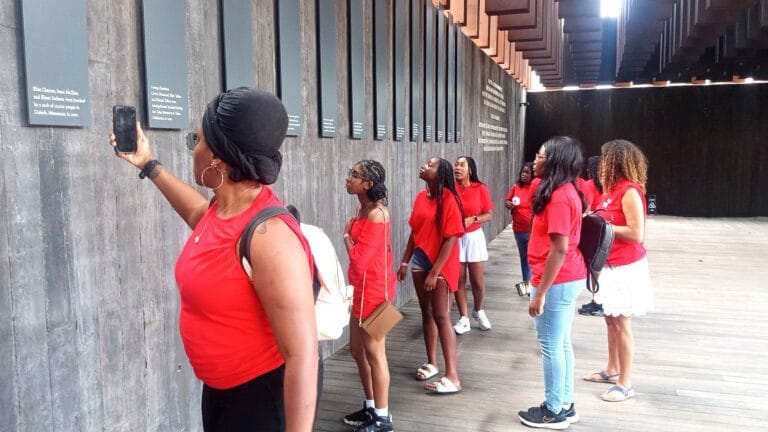
Camp REACH students and volunteer professionals/instructors recently visited the Legacy Museum in Montgomery, Alabama, less than 250 miles from Chattanooga.  I was thrilled with the opportunity to attend. The Legacy Museum was one of several stops in June in Montgomery on a day-long field trip to learn more our history. Also visited were the National Memorial for Peace and Justice and the Freedom Monument Sculpture Park.

Our Camp REACH group watched as ocean water rose across the screen at the Legacy Museum.  Our group of teens and adults were captivated as we read the story of the beginning of enslaved Africans in America and as this history was displayed on the screen in blood red letters.

“I thank Jesus I don’t have to go through this,” said 13-year-old Rose Wright after learning about the cruelty that slaves experienced.

Some students remarked they didn’t know what lynching was until they saw the displays during the museum trip.

The museum exhibits showed how enslaved Africans were depicted as “cargos of human flesh.”

It was a terrifying and deadly journey that separated 12 million black people from their homes, ancestors, and land. More than 2 million of them died; but for those who survived, the horror of slavery began!! according to museum exhibits.

“It’s important to understand, even though this was a short period in our history, how devastating it was,” said Adrian Edwards, executive director of the Mary Walker Foundation which sponsors Camp REACH annually.

The museum exhibits emphasized the connection between slavery in America and the disproportionately high number of blacks in prison.

Edwards said the trip is among several he wants to offer to Camp REACH students as a focus to inform students about their past and to inspire their future. He stated that he wants younger people to “be aware of the shoulders they stand upon”.

Camp REACH students said now that they know this portion of history, they have a responsibility to tell others what they learned.

Halfway through the museum tour Camp REACH director Dr. LaTonya Pinkard sighed deeply and bowed her head to the floor.

“I know my history. I’ve taught our history but to see this all in one space, I’ve just got to sit with it and let the emotions settle,” she said.

Hanging along the walls were various poems scattered. Each poem telling a different story. One poem that stood out, in particular, was a poem by Abel Meeropol. The poem is titled, ‘strange fruit’.

“Southern trees bear a strange fruit. Blood on the leaves and at the root. Black body swinging in the southern breeze. Strange fruit hanging from the poplar trees.” – Strange Fruit, Abel Meeropol. Seen midway through the tour, the poem evoked a whirlpool of emotions.  And, placed beside the poem was a wall with quotes and pictures from African Americans who have departed; each story different than the next. Though the stories differed they all still had one common factor; they all (each person) lost their life to racism in America.

Redefining Public Education: 2025 Charter Schools Hall of Fame Inductees Announced –Dr. Elaine Swafford, Inducted!

WASHINGTON, D.C.  – The National Alliance for Public Charter Schools announced last night four visionary leaders as the 2025 inductees of the Charter Schools Hall of Fame. Since 2007, the Hall of Fame has honored educators and philanthropists whose groundbreaking contributions have shaped and advanced the charter school movement nationwide. 

“These four school leaders serve as inspiration for all of us who believe in the infinite power of public education and public charter schools,” said Starlee Coleman, president and CEO of the National Alliance of Public Charter Schools. “Every day, these transformative leaders show us what’s possible in public education through flexible, innovative approaches that meet student needs, open doors to opportunity, and change lives.”

This year’s honorees include:

Chris Barbic, founder of YES Prep Public Schools in Houston, the first public school network in the nation to make four-year college acceptance a graduation requirement. His leadership helped thousands of students access higher education who may not have had the opportunity.

“I’m truly honored to be recognized among so many inspiring leaders in the charter community,” said Barbic. “I’ve always tried to focus my work in our sector on ensuring students have the opportunities they deserve, and families have the support they need to succeed.” 

Constance Ranae Jones, former CEO of Noble Schools, the largest public charter school network in Chicago. From 2018 to 2025, she led efforts to break down financial barriers for families while helping students fulfill their potential and pursue their dreams. In 2023, Noble graduates earned more than $624 million in scholarships for higher education.

“This honor reaffirms my lifelong belief that when we trust communities, empower educators, and put students at the center, transformational change is not only possible—it’s inevitable,” said Jones. 

Dr. Elaine Swafford, CEO of Chattanooga Girls Leadership Academy, the first all-girls public charter STEM school in Tennessee. When she took the helm in 2012, the school was on the brink of closure. Under her leadership, it earned Reward School status, the highest designation under Tennessee’s federal accountability system.

“I am blessed to have spent most of my 42-year educational career serving underserved youth, watching dreams become reality, to witness families realize that success is absolutely within their reach, proving that high quality education is the great equalizer,” said Dr. Swafford. 

J.C. Huizenga, founder and Chairman of National Heritage Academies (NHA). Since 1995, his organization has grown to serve more than 60,000 students across 100-plus schools in nine states. Seven NHA partner-schools have earned National Blue Ribbon Schools recognition, and in 2025, 18 were ranked among the Top 10 Best Charter Elementary and Middle School lists in three states by U.S. News & World Report.

“Throughout the years, many charter school advocates have walked with me to bring high-quality school choice to families,” said Huizenga. “Our mission at National Heritage Academies is to transform lives, and we are celebrating 30 years of impacting students and communities.” 

The 2025 Charter Schools Hall of Fame inductees were honored and presented with a plaque at the National Charter Schools Conference in Orlando.  From expanding public school access for students to breaking down financial barriers, these trailblazers embody a legacy of advocacy, leadership, and innovation.

Downtown Weekend Prepaid Parking Pass –A Solution or Convenience?

0

Have you had trouble finding parking downtown to enjoy one of the many events in recent weekends?

CARTA has announced a paid in advance weekend parking pass with the claims in its press release that “this pass has you covered for the ENTIRE weekend.” The $25 pass gives access to any Chattanooga Parking Authority (CPA) lots, all paid street parking, and the Shuttle Park at the Northshore and North Garages.

“No more parking stress during your downtown adventures,” promises the Weekend Pass promotion that’s touted to be discounted for the parking from Fridays at 6 p.m. through Monday mornings at 6 a.m.

So, what does a weekend pass purchaser get?

Your $25 paid in advance online at the introductory rate prepays your parking in CPA lots at the Riverfront (261), Coolidge Park (262), Renaissance Park (263), the Theatre Centre (264), the Northshore Garage (265), and the CARTA Incline (266), street parking paid for by the Park Mobile app and meters, and the Shuttle Park locations.

But does the prepaid purchase guarantee a spot at any of these locations? Do the Weekend Pass purchasers enjoy any ability to reserve a parking spot or have an assurance that the lot won’t be filled by walk-up-pay parkers?

Chattanooga is home to incredible recreation, entertainment, and activities in the downtown area. Is the Weekend Prepaid Pass the answer to the parking issues? We’ll see.

Go to ChattanoogaParking.org. It may be a user convenience to prepay and to avoid parking tickets that come with pricey fines.

Will it remove the stress of finding parking in downtown? You decide.