

Leamon Pierce Passes

Leamon Pierce left his mortal body on Saturday, October 11, 2025. His legacy, however, lives on among others who were in the arena when others looked on. Leamon Pierce made his mark in the Chattanooga community and for good.
Today’s swipe and click news too often doesn’t make time to appreciate the depths of history local men and women have made. Let’s take a few minutes to remember the husband, father, grandfather, businessman, and history-making activist.
In 1960, Mr. Pierce joined Doris Jean Johnson, a fellow student at Howard High School, and Booker Scruggs at a downtown Chattanooga “white only” lunch counter. It was called the United States’ first boycott against segregation led by only high school students.
On February 19, 1960, the Howard High School senior class participated in the peaceful acts of speaking with their occupation of seats at “all-white” dining counters throughout the city of Chattanooga. Their cause was to do more than talk about ending segregation; they wanted to take their seats in the dignity and rights endowed by our Creator that are irrespective of color, ethnicity, socioeconomic status, or any other factor.
This senior class sent letters of support of the civil rights for access to fairly priced housing, to quality education, and to receive equal pay for equal work.
Leamon Pierce was in that Class of 1960 getting his early start to a life serving the public.
JoAnne Favors, former TN State Representative and Hamilton County Commissioner, Retired, former classmate and colleague, pays tribute to Leamon: “I met the Honorable Leamon Pierce when we entered seventh grade in 1954 at the newly opened Howard School. He always exhibited a high level of maturity and was certainly a change agent who left his footprints in the areas of civic, political, business ownership and construction. I will always be appreciative of the political support that he provided to me. My condolences are extended to his wife Sue, his children and grandchildren. He will certainly be missed by the Howard Class of 1960”.
In March of 1965, the renowned and consequential 50-mile March from Selma, Alabama to the state’s capitol in Montgomery occurred. Dr. Martin Luther King, Jr. led the throng of thousands after extraordinarily tumultuous days of violence against Black Americans. Leamon Pierce marched from Selma to Montgomery.
Again, his actions matched his beliefs.
Leamon Pierce made history again in becoming Tennessee’s first Black businessowner of a bail bonding company, Liberty Bonding Company. Located on Martin Luther King, Jr. Boulevard, the company remains in business after its founding in 1974.
Among the longest serving members of the Chattanooga City Council, Leamon Pierce served from 1990-2009 representing the citizens of District 8. Among key issues championed, Councilman Pierce fought for the Golden Gateway Project’s completion, to protect the Bessie Smith Strut from attempts to charge for the formerly free night during Chattanooga’s Riverbend Festival, and led the charge to make MLK Boulevard a two-way commuter avenue to boost travel and retail opportunities.
After 84 years of life, many of those spent with his dear wife Sue, being a “girl dad” to his three daughters, and watching his 10 grandchildren and 3 great-grandchildren carry on the Pierce family legacy, Leamon Pierce entered his rest.
Prayers are extended for the family. And as another Civil Rights activist has gone home, we watch for the next great minds who lead in peace and wisdom.
Arrangements: Mr. Pierce will lie-in-state on Sunday, October 19, 2025, from 9-11:30 a.m. at Taylor Funeral Home and from 1-6 p.m. at Olivet Baptist Church. Funeral service will be Monday, October 20, 2025, at 9 a.m. at Olivet Baptist Church with Bishop Kevin L. Adams, Sr., Pastor and Brother John R. Taylor, Sr. as the Eulogist. Burial in Forest Hills Cemetery.
OBITUARY Follows:
Still Marching On: The Life of Leamon Pierce
Leamon Pierce entered this world on April 11, 1941, with the parents of Robert and Eddie Lou Pierce. He was the youngest of three born into this union. Leamon was a lifetime resident of the Park City Community. Leamon was a graduate of Howard High School class of 1960. He was a Howard High Alumni Association member and a lifetime member of the NAACP.
Leamon was proceeded in death by his son Leamon, Jr., his parents Robert & Eddie Lou Pierce; his brothers Hosea Pierce, Sr.; Willie Pierce; niece Cathy and nephew Hosea Pierce Jr.
Leamon’s hobbies were bowling and playing cards. He mostly used his talent for building homes and remodeling.
Leamon leaves sweet memories and a cherished legacy for his loving wife of 59 years, Sue A. Gray Pierce. To their blessed union is a devoted daughter Mia Francetta Pierce; two granddaughters, JeMiia Pierce & HM2 JeLiia Pierce, United States Navy; and one great- grandson Shaddai Ali Pierce.
Leamon also leaves two daughters, LaShandra (Eric) Rivers Sr., and LaToya (Ricky) Harper Sr., eight grandchildren: JaVaughn Craig, Ashiya Ervin, Eric Rivers Jr., Destiny Ervin, Kayla Rivers, Ricky Harper Jr., Zariyah & Tykiem Harper; and two great-grandchildren Eli Rivers and Dekari Saddler.
Additional family include two sisters-in-law Mary Gray and Gloria Dozier; one brother-in-law Gordon Gray; nieces & nephews Cynthia (Autry) Jones, Michael & Regina Pierce, Yolanda (Horace) Besley, Shenia (Elton) Fowkles, Amber & Eric Flowers, Alicia (David) Moore, and Sabrina (Ricardo) Williams; three cousins Ronald (Yvette) Stevenson, Julius Summerow and Minister Perry Beck. A host of nieces & nephews Lakitta (Michael) Taylor, Rekitta & Rickey Dews Jr., Pierre (Maletha) Rogers, Niijia Williams, Hosea Pierce III, Victoria & Adam Fowkles. Best friends: Stanley Thurmond, William Clark, Jeffrey Besley and Harvey Hereford. Special daughters & grandchildren-in-love: Louise Evans, Lena Fugett, Kathryn Gladden, Tomyra Pruitt, DeSharla Rowland, Denita Strickland, Korshantae Tulloss, and Morgan Holloway, Niyona Gibbs UNS, Erica Dismuke, and Christopher Rivers.
Funeral Arrangements entrusted to Taylor Funeral Home.
Tribute to Leamon……In his own words:
The Movement of Leamon Pierce
I was born in a two-bedroom house at 2717 Cannon Ave. I wasn’t just an average young little guy. I was a young man; I was just curious about things about life. I followed my daddy around learning how to build using a hammer, using a screwdriver, using different tools, using my hands to build for my future.
I used to hang out with the guys in our community in Park City but I knew I wanted to do more so I didn’t play much because I had to work. I went to the school that was called the Park City School which is now a playground up the street from where I still lived.
I went to Howard High School. My class started doing things, we decided to make a change so we had a meeting, we marched from our school to downtown to Woolworth because at that time, in our day, there was a lot going on and a lot that we couldn’t do. At Woolworth we were Not allowed to sit at the counter. So that was our plan, we wanted to sit at the counter… so the Class of 1960 and others made our way to go sit at the Woolworth counter, but the police was ready for us. However, they were not ready for what we were ready to do! And, today you know the history….. y’all know what happened!
After leaving high school I didn’t go to college because I still had a bigger dream, and I knew that I could get it done. I got a job working at America Lava. In 1963, I went to Washington DC for the March on Washington. THAT WAS A SIGHT To SEE!…. in my early age seeing that many black men from everywhere, coming together to try to make a change for the world! And I knew that my voice, one day, would be heard.
In 1965, I was working in Alabama and I heard that there was going to be a meeting in Selma, AL. with Martin Luther King Jr. ……so one night when I got off work, I got in my car and I drove to Selma. I was in the meeting with Martin Luther King; there was a plan to March from Selma AL., to Montgomery, AL., to make another change.
Coming back to my hometown Chattanooga, the things that I had been doing, my parents didn’t know that I was doing all what I could to to effect CHANGE!! But they knew their baby boy was up to something? From 1960-1970, I was the civil rights movement.
In 1966 I got married to my wife Sue. Two years later we had our daughter who was born early, I believe she came early for a reason. In 1968, I was preparing to go to Memphis, TN., to be there with Martin Luther King, Jr., I missed being in Memphis, Tn. I was working for Electric Power Board (EPB) and during my time there I became the company’s first black lineman.
I went on to have other little jobs that I wanted to explore. I even started my photography studio named Sunbeam. Still seeking to be my own BOSS, I then opened AAA Bonding because I figured I would be first on the list. That just wasn’t the name I really wanted, I came up with Liberty Bonding Company in 1974, which is still open. I then became the first black bail bondsman. I was investing my money in the Park City Community by buying property. Later I opened another Bonding office in the name of Best Bonding Company, opening doors for my nephew Hosea, and friends, Stanley Thurmand, Linda Morris and Rev. Wright.
In 1989, Brown v Board can I say we did that? We changed the form of government here in Chattanooga. For 19 years I sat on the Chattanooga City Council. I even held the position of chairman. I help to lead the change to keep Bessie Smith Night free. I pressed to change M L King Blvd from a one-way street to the current two way. Durning my time on City Councilman my votes help change a lot in the downtown area. I fought for my community to be able to get a bus stop for the children, sidewalks and tried to fight other issues. I know people sometimes didn’t like my vote on the council, but I was told that I was a straight shooter. In 2003, I was named to the State POST Commission. In 2020, there was a protest during COVID and I wanted to go see and be a part of it. I stood there with the people protesting hand in hand.
I still had a voice.
THE MOVEMENT: Leamon Pierce
Museum of Christian and Gospel Music opens in the Music City

The Museum of Christian & Gospel Music opened its doors October 3rd, 2025 in downtown Nashville with a ribbon-cutting ceremony that brought together city leaders, artists, and visionaries from across the faith and music communities, including Gov. Bill Lee, GMA President Jackie Patillo, and former Congressman Zach Wamp. The celebration marked the launch of the museum’s permanent home at 402 Commerce Street, just steps from the Ryman Auditorium, and the unveiling of the GMA Gospel Music Hall of Fame within its walls.
The event featured remarks from Tennessee Governor Bill Lee, museum visionary Steve Gilreath, Metro Clerk Howard Gentry, GMA President Jackie Patillo, former Congressman Zach Wamp, and Dr. Rhonda Lowry, with additional appearances by Councilman Jacob Kupin, Commissioner Mark Ezell, and Councilwoman Joy Styles. Together, they highlighted the significance of preserving and showcasing the rich legacy of Christian and Gospel music.
The museum features over 500 historical moments told through video, artifacts, and photos, honoring more than 200 Hall of Fame artists and providing an interactive space for future generations to experience the enduring impact of faith-driven music.
Organizers say it’s a sign Christian music is experiencing a revival.
Another exhibit pays tribute to the famed Jubilee Singers from Fisk University, whose prowess in the 1800s helped give Nashville the nickname of Music City. “When I walked in yesterday and there were archives in the cases, I cried,” Patillo said. “This is the birthing of a vision, and to see it tangibly is amazing.”
City Council Confirms Cedric Henson as Administrator of Department of Community Development

Cedric Henson has been named the administrator of Chattanooga’s Department of
Community Development, following a City Council vote on Oct. 7.
City Council on Oct. 7 confirmed Cedric Henson as administrator of the Department of Community Development after his appointment by Mayor Tim Kelly as interim administrator of the Department of Community Development in July.
Henson previously served as the deputy administrator for the Department of Public Works (DPW) and has worked for the city for the past two years.
“I’m excited that Cedric Henson will continue to serve as Administrator of Community Development,” said Mayor Kelly. “Cedric has done an outstanding job as interim administrator since last July. I know he is the right leader to continue the department’s important work for the people of Chattanooga as we transition to the Community Hub model of service delivery.” “It’s an honor to be named Administrator of Community Development after serving in the interim role,” said Henson. “I’m grateful for the trust placed in me by Mayor Kelly and City Council, and I look forward to continuing working alongside our outstanding team and center managers to serve Chattanoogans.”
City to Host Public Works Roundtable on October 20
The City of Chattanooga’s Department of Public Works, in collaboration with Neighborhood Services, has announced the next event in its 2025 Neighborhood Roundtable Series. The public is invited to attend a comprehensive presentation on the city’s vital infrastructure and environmental services.
The roundtable will be held on Monday, October 20, from 5:30-6:30 p.m. at the Chattanooga City Council Building, located at 1000 Lindsay Street.
This event offers residents an opportunity to gain insight into how the city plans, builds, maintains and protects its infrastructure and environment. Public Works staff will present detailed information on a wide range of topics, including streets and sidewalks, garbage and recycling services, stormwater management, tree care and urban forestry, and development permitting and code compliance.
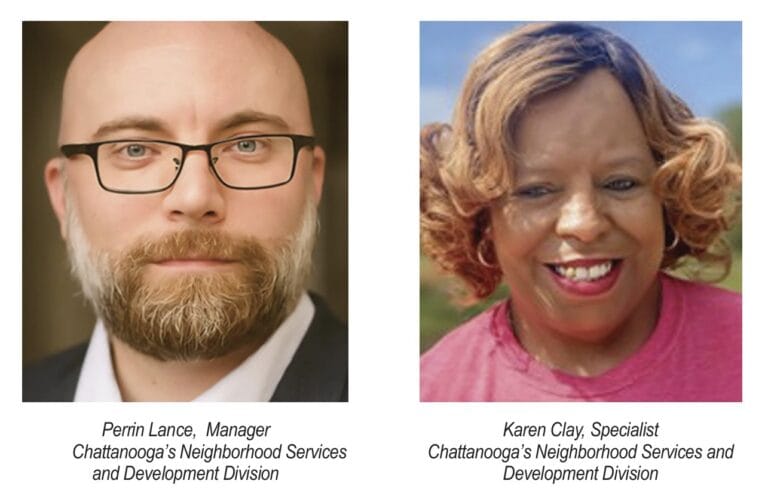
“This is an excellent chance for residents, especially members of our Neighborhood Associations, to get an inside look at the services that keep our city running smoothly,” said Perrin Lance, manager of Neighborhood Service and Development. “We’ll share what we’re doing now, what’s planned for the future, and how the community can partner with us to help make a difference.”
The Department of Public Works is responsible for the essential services that impact the daily lives of Chattanooga citizens, ensuring the safety, health, and welfare of the community. Key areas of responsibility include street maintenance, solid waste collection, engineering, stormwater quality, and transportation.
The City of Chattanooga’s Neighborhood Services and Development Division (NSD) acts as the critical bridge connecting city government and local residents, with a mission to empower communities and advance local democracy. Functioning within the Equity and Community Engagement Department, the NSD’s core work revolves around supporting, initiating, and connecting Neighborhood Associations to enhance the overall quality of life.
The division actively facilitates civic participation by providing guidance to community leaders, administering programs like the Neighborhood Action Grant to fund local improvements, and working directly with residents through programs such as Neighborhood Walking Audits, where staff log concerns–from potholes to code violations–directly into the 311 system for prompt departmental action. This proactive approach ensures citizen concerns are heard and resources are directed toward building healthy, thriving and engaged neighborhoods.
For questions or additional information about the roundtable event, contact Karen Clay, Neighborhood Relations specialist, at (423) 355-7003 or kclay@chattanooga.gov.
Chattanooga Pride Festival Celebrates 25 Years with Record Turnout


The 25th annual Chattanooga Pride Festival drew an enthusiastic crowd to Ross’s Landing on Sunday, October 5, as the city celebrated love, identity, and community during LGBTQ+ History Month.
The festival, which ran from 2 to 8 p.m., featured live music, drag performances, food trucks, local vendors, and family-friendly activities. The day began with the Pride Parade at 1 p.m., starting from the Unum Parking Lot at Ross’s Landing.
“Fantastic turnout at this year’s Chattanooga Pride Parade,” said Chattanooga Mayor Tim Kelly. “We love our neighbors in Chattanooga, and you could really feel the love today.”
This year’s celebration held special significance as attendees from Knoxville joined the festivities after Knox Pride Fest 2025 was abruptly cancelled just days before it was scheduled to take place on October 3-4.
John Camp, Knox Pride’s president, announced the cancellation in a Facebook video on October 1, explaining that organizers were unable to secure liability insurance at the last minute.
“I know this is disheartening, disappointing and upsetting for a lot of folks,” Camp said, expressing hope that the Knoxville community would travel to support Chattanooga’s celebration.
The Knox Pride cancellation announcement sparked intense online debate, with a Facebook post from local news reporter Kyle Grainger drawing nearly 4,000 comments ranging from supportive messages to expressions of hate and judgment directed at the LGBTQ+ community.
Mayor Kelly emphasized Chattanooga’s welcoming spirit ahead of the festival: “Chattanooga is a kind, welcoming city where we want all our neighbors to know that they belong and are loved.”
The week-long series of events leading up to Sunday’s festival included drag shows, wrestling, drag bingo, outdoor games, and yoga, catering to diverse age groups and interests.
October serves as LGBTQ+ History Month in the United States, Canada, and Australia. Founded in 1994 by Missouri high school teacher Rodney Wilson, the month was strategically chosen to coincide with National Coming Out Day on October 11 and the anniversaries of historic marches on Washington for LGBTQ+ rights in 1979 and 1987.
The observance is distinct from Pride Month, celebrated in June to commemorate the 1969 Stonewall Riots–the catalyst for the modern LGBTQ+ rights movement.
The Supreme Court’s New Vision

By Graham G. Dodds, Professor of Political Science, Concordia University
(The CONVERSATION) President Donald Trump set the tone for his second term by issuing 26 executive orders, four proclamations and 12 memorandums on his first day back in office. The barrage of unilateral presidential actions has not yet let up.
These have included Trump’s efforts to remove thousands of government workers and fire several prominent officials, such as members of the Corporation for Public Broadcasting and the chair of the Commission on Civil Rights. He has also attempted to shut down entire agencies, such as the Department of Education and the U.S. Agency for International Development.
For some scholars, these actions appear rooted in the psychology of an unrestrained politician with an overdeveloped ego.
But it’s more than that.
As a political science scholar who studies presidential power, I believe Trump’s recent actions mark the culmination of the unitary executive theory, which is perhaps the most contentious and consequential constitutional theory of the past several decades.
A prescription for a potent presidency
In 2017, Trump complained that the scope of his power as president was limited “You know, the saddest thing is that because I’m the president of the United States, I am not supposed to be involved with the Justice Department. I am not supposed to be involved with the FBI, I’m not supposed to be doing the kind of things that I would love to be doing. And I’m very frustrated by it.”
The unitary executive theory suggests that such limits wrongly curtail the powers of the chief executive.
Formed by conservative legal theorists in the 1980s to help President Ronald Reagan roll back liberal policies, the unitary executive theory promises to radically expand presidential power.
There is no widely agreed upon definition of the theory. And even its proponents disagree about what it says and what it might justify. But in its most basic version, the unitary executive theory claims that whatever the federal government does that is executive in nature – from implementing and enforcing laws to managing most of what the federal government does – the president alone should personally control it.
This means the president should have total control over the entire executive branch, with its dozens of major governmental institutions and millions of employees. Put simply, the theory says the president should be able to issue orders to subordinates and to fire them at will.
The president could boss around the FBI or order the U.S. attorney general to investigate his political opponents, as Trump has done. The president could issue signing statements – a written pronouncement – that reinterpret or ignore parts of the laws, like George W. Bush did in 2006 to circumvent a ban on torture. The president could control independent agencies such as the Securities and Exchange Commission and the Consumer Product Safety Commission. The president might be able to force the Federal Reserve to change interest rates, as Trump has suggested. And the president might possess inherent power to wage war as he sees fit without a formal authorization from Congress, as officials argued during Bush’s presidency.
A constitutionally questionable doctrine
A theory is one thing. But if it gains the official endorsement of the Supreme Court, it can become governing orthodoxy. It appears to many observers and scholars that Trump’s actions have intentionally invited court cases by which he hopes the judiciary will embrace the theory and thus permit him to do even more. And the current Supreme Court appears ready to grant that wish.
Until recently, the judiciary tended to indirectly address the claims that now appear more formally as the unitary executive theory.
During the country’s first two centuries, courts touched on aspects of the theory in cases such as Kendall v. U.S. in 1838, which limited presidential control of the postmaster general, and Myers v. U.S. in 1926, which held that the president could remove a postmaster in Oregon. In 1935, in Humphrey’s Executor v. U.S., the high court unanimously held that Congress could limit the president’s ability to fire a commissioner of the Federal Trade Commission. And in Morrison v. Olson the court in 1988 upheld the ability of Congress to limit the president’s ability to fire an independent counsel.
Some of those decisions aligned with some unitary executive claims, but others directly repudiated them.
Warming up to a unitary executive
In a series of cases over the past 15 years, the Supreme Court has moved in an unambiguously unitarian, pro-presidential direction. In these cases, the court has struck down statutory limits on the president’s ability to remove federal officials, enabling much greater presidential control.
These decisions clearly suggest that long-standing, anti-unitarian landmark decisions such as Humphrey’s are on increasingly thin ice. In fact, in Justice Clarence Thomas’ 2019 concurring opinion in Seila Law LLC v. CFPB, where the court ruled the Consumer Financial Protection Bureau’s leadership structure was unconstitutional, he articulated his desire to “repudiate” the “erroneous precedent” of Humphrey’s.
Several cases from the court’s emergency docket, or shadow docket, in recent months indicate that other justices share that desire. Such cases do not require full arguments but can indicate where the court is headed.
In Trump v. Wilcox, Trump v. Boyle and Trump v. Slaughter, all from 2025, the court upheld Trump’s firing of officials from the National Labor Relations Board, the Merit Systems Protection Board, the Consumer Product Safety Commission and the Federal Trade Commission.
Previously, these officials had appeared to be protected from political interference.
Total control
Remarks by conservative justices in those cases indicated that the court will soon reassess anti-unitary precedents.
In Trump v. Boyle, Justice Brett Kavanaugh wrote, “whether this Court will narrow or overrule a precedent … there is at least a fair prospect (not certainty, but at least a reasonable prospect) that we will do so.” And in her dissent in Trump v. Slaughter, Justice Elena Kagan said the conservative majority was “raring” to overturn Humphrey’s and finally officially embrace the unitary executive.
In short, the writing is on the wall, and Humphrey’s may soon go the way of Roe v. Wade and other landmark decisions that had guided American life for decades.
As for what judicial endorsement of the unitary executive theory could mean in practice, Trump seems to hope it will mean total control and hence the ability to eradicate the so-called “deep state.” Other conservatives hope it will diminish the government’s regulatory role.
Kagan recently warned it could mean the end of administrative governance – the ways that the federal government provides services, oversees businesses and enforces the law – as we know it:
“Humphrey’s undergirds a significant feature of American governance: bipartisan administrative bodies carrying out expertise-based functions with a measure of independence from presidential control. Congress created them … out of one basic vision. It thought that in certain spheres of government, a group of knowledgeable people from both parties – none of whom a President could remove without cause – would make decisions likely to advance the long-term public good.” If the Supreme Court officially makes the chief executive a unitary executive, the advancement of the public good may depend on little more than the whims of the president, a state of affairs normally more characteristic of dictatorship than democracy. (The CONVERSATION)
Tennessee Celebrates Minority Enterprise Development Week, October 12–19

Governor Bill Lee Issues Proclamation; Contracting Summit in Nashville Highlights Opportunities
NASHVILLE, TN – Tennessee House Minority Leader State Representative Karen Camper announced today that Governor Bill Lee has officially proclaimed October 12–19, 2025 as Minority Enterprise Development (MED) Week in Tennessee. The proclamation highlights the vital role minority-owned businesses play in strengthening communities, creating jobs, and driving innovation across the state.
As part of Tennessee’s observance, Leader Camper will host a Contracting Summit on October 14, 2025, from 9:00 a.m. to 3:00 p.m. at the William Snodgrass Tennessee Tower Conference Center in Nashville. The event is organized in partnership with the Nashville Black Hospitality Group, Darrell S. Freeman Sr. Incubation and Innovation Center, Nashville Black Chamber of Commerce, Urban League of Middle Tennessee, Tennessee Pride Chamber, Nashville Area Hispanic Chamber of Commerce, U.S. Small Business Administration, and other community partners. The summit will feature workshops, agency and corporate roundtables, and one-on-one matchmaking opportunities designed to connect minority-owned firms with procurement officers, capital providers, and technical resources.
To register for the summit please click the following link: www.LeaderKarenCamper.com/TNMEDWeek
Leader Camper emphasized the importance of this year’s commemoration:
“Minority businesses are the lifeblood of our neighborhoods and a cornerstone of our state’s economic growth. When we support and invest in minority entrepreneurs, we are investing in stronger communities, greater innovation, and a brighter future for all Tennesseans. MED Week is not just about recognition—it is about action, partnership, and continued commitment.”
About Minority Enterprise Development (MED) Week
Origins and National History
MED Week was first established in 1983 by President Ronald Reagan through a Presidential Proclamation to recognize the outstanding achievements of minority entrepreneurs and highlight the significant contributions of minority-owned businesses to the U.S. economy. Since then, MED Week has been celebrated annually, coordinated nationally by the U.S. Department of Commerce’s Minority Business Development Agency (MBDA), with local observances hosted in cities and states across the country.
The original intent of MED Week was twofold:
- Celebrate entrepreneurial excellence by honoring successful minority-owned firms.
- Expand opportunity by providing workshops, networking events, and matchmaking opportunities between minority businesses and public/private sector partners.
Impact on the Economy
Today, minority-owned businesses represent one of the fastest-growing segments of the U.S. economy. According to the U.S. Census Bureau, there are more than 9.4 million minority-owned firms nationwide, generating over $1.6 trillion in annual revenue and employing more than 8.7 million workers. These businesses are critical to community wealth-building, job creation, and innovation across industries—from technology and manufacturing to health care and professional services.
MED Week plays a crucial role in ensuring that these enterprises are not only celebrated but also connected to the resources, capital, and contracting opportunities they need to thrive.
Tennessee’s Commitment
In Tennessee, the observance of MED Week has gained new visibility and momentum. Governor Bill Lee’s proclamation underscores the bipartisan recognition that supporting minority business enterprises strengthens the entire state economy.
The Nashville Contracting Summit on October 14 is a cornerstone of this year’s celebration, providing real access points for minority-owned businesses to expand their reach and capacity. By bringing together public officials, private industry leaders, and community organizations, the summit turns MED Week into meaningful action for Tennessee entrepreneurs.
Why MED Week Matters
- Equity in Opportunity: Minority businesses often face barriers in accessing capital, markets, and contracting pipelines. MED Week is about breaking down those barriers.
- Strengthening Communities: When minority businesses succeed, they create jobs, build wealth, and reinvest in their neighborhoods.
- Innovation & Competitiveness: A diverse business community fuels creativity and economic resilience, benefiting Tennessee and the nation as a whole.
This year’s proclamation by Governor Lee and the Nashville Contracting Summit affirms that supporting minority businesses is not a partisan issue but a shared responsibility. By uniting around the vision of economic empowerment, Tennessee can ensure that all entrepreneurs—regardless of background—have the opportunity to thrive and contribute to the state’s prosperity.
The Nobel Prize, U.S. currency and coins…well, here we go again!

Unwilling to let a delicious controversy to go by without weighing in – this time about a Nobel Peace Prize nomination, debates about images on U.S. currency or legislation to get their hero’s face on a coin – well, here I go again. The names we’re talking about here are, respectively, Nobel Prize aspirant Donald J. Trump, Harriet Tubman versus Andrew Jackson on currency and the late Charlie Kirk on a coin.
Yes, here we go again folks!
To begin, initially I didn’t know if an idea from my friend “Sis Faith” was a serious one or not. Then again, I figured that she knew that yours truly has a weakness for the Nobel Prize, particularly award winners in the literature category. As many know, I’ll judiciously drop a prize winner’s name in my narratives from time to time. But to be abundantly clear, I’ve no illusions, real or imagined, of ever winning the Nobel Prize for Literature myself. I mean my chances would be like one in 10 billion. No way. No mas. Case closed.
Now with all that aside, here’s the text message I received the other day from “Sis Faith,” one that I initially laughed off as amusing before allowing it to sink in for a minute:
“Terry, I have a commentary idea for your consideration: Threats to the integrity and legacy of the Nobel Peace Prize! Does this idea give lift to your brows or gnaw in your gut?”
Of course, it doesn’t take a rocket scientist – or a Nobel Laureat for that matter – to figure that behind her message is the move underway in some quarters to get the United States President to receive the Nobel Peace Prize and, if my memory serves me well, he’s even hinted at nominating himself for the prize. Well word on the street is that his chances of receiving the award are slim to none, but as we all know these are not normal times.
Now let’s begin by setting the prize’s historical record straight, shall we?
The Nobel Prize was set up when businessman and entrepreneur Alfred Nobel died and left the majority of his fortune to the establishment of prizes in physics, chemistry, physiology or medicine, literature and peace. His will stated that the prizes should be awarded to “those who, during the preceding year, shall have conferred the greatest benefit to humankind.”
In order to become a Nobel Prize laureate, one must first be nominated by an eligible nominator. Sorry to disappoint Mr. Trump, but self-nominations are not allowed. Except for the Nobel Peace Prize, nominations are by invitation only and nominators must fulfill the criteria set out by the awarding institutions. Eligible nominations are then considered by the awarders who make the final decision as to who will receive a Nobel Prize.
A total of 21 prizes have been awarded to U.S. citizens, the most recent of whom was President Obama. Beginning with Theodore Roosevelt in 1906, there have been 18 American men and three American women who have been awarded the Nobel Peace Prize.
Several U.S. Presidents have been awarded the Nobel Peace Prize, all recognized for their significant contributions to peace and diplomacy during their lifetimes. Here’s a list of them and the years they received the award:
Theodore Roosevelt – Awarded in 1906 for mediating the end of the Russo-Japanese War.
Woodrow Wilson – Awarded in 1919 for his efforts in establishing the League of Nations after World War I.
Jimmy Carter – Awarded in 2002 for his decades of work in promoting peace, democracy and human rights.
Barack Obama – Awarded in 2009 for his extraordinary efforts to strengthen international diplomacy and cooperation between peoples.
One more thing before I go – actually two, maybe more – this time having to do with facial images on currency and coins. First, American abolitionist and social activist Harriet Tubman whose face on our $20 bill replacing slave holder Andrew Jackson has been challenged by the current administration as “pure political correctness.”
Second and not to be outdone, Republican lawmakers are preparing to introduce a bill that could place the late conservative activist Charlie Kirk’s face on U.S. currency. The legislation would direct the U.S. Treasury to mint 400,000 silver dollar coins bearing Kirk’s and would feature his full name and the year 2026. On the reverse, the design would include the words: “Well done, good and faithful servant.”
What’s next on the ever-contentious images battlefront? Well, it seems to me that which faces should be on our postage stamps, which national anthem should be sung during the Super Bowl, should we resurrect the names and images of the old Confederacy and Lord know what else may be next in our cultural cross hairs.
So fasten your seatbelts readers and replenish your supply of popcorn for what promises to be a bumpy ride.
Okay “Sis Faith,” I’ll give you a call later this week and let you know if my brows are lifted or if there’s a gnaw in my gut.
Terry Howard is an award-winning writer, a contributing writer with the Chattanooga News Chronicle, The American Diversity Report, The Douglas County Sentinel, Blackmarket.com, recipient of the Dr. Martin Luther King, Jr. Leadership Award, and third place winner of the Georgia Press Award.
John P. Franklin Funeral Home welcomes community to Annual Fall Festival, Oct. 19th

CHATTANOOGA, Tenn. (October 1, 2025) – John P. Franklin Funeral Home is thrilled to invite the community to its annual Fall Festival on Sunday, October 19 from 2 pm to 4 pm. The festival will be held in the funeral home’s parking lot at 1101 Dodds Avenue in Chattanooga. This free, family-friendly event promises something for everyone, with delicious food, lively music, dancing, and games that are fun for kids and adults alike. It’s a perfect way for neighbors, friends, and families to come together and celebrate the beauty of the season.


