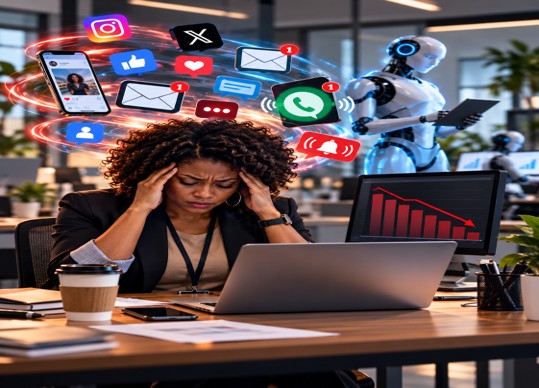
The greatest threat to human productivity may not be artificial intelligence. Instead, it may be our inability to stay on task, maintain focus, and keep our value up in the workplace to compete.
Today, our immediate availability is often mistaken for productivity. Phones vibrate, emails arrive, social media beckons, and instant messages demand attention. Some of those incoming messages and exchanges may be related to work; some may not, and often aren’t.
Rapid and continuous responsiveness or multiple conversations while completing assignments does not demonstrate competence. Scientific evidence suggests our attempts at being constantly available comes with a cost.
Constant interruptions can undermine the very intellectual abilities that make human workers valuable. Even multitasking at work-related requirements may harm productivity.
The American Psychological Association reports that there are measurable cognitive costs when we’re engaged in what appears to be simultaneous productivity–switching between tasks. Each transition requires the brain to disengage from one objective, adjust its mental processes, and resume another. Researchers have estimated that repeated switching can consume as much as 40 percent of productive time.
The consequences extend beyond lost minutes. Interrupted workers must repeatedly reconstruct their thinking, increasing mental fatigue, mistakes, and the time required to complete complex assignments.
A 2023 study published in the Journal of Occupational Health examined 247 participants, including workers and students. Researchers found that disabling communication notifications for one day generally improved reported performance and reduced psychological strain.
The “telepressure” to answer messages quickly because others expect constant availability may come when your productivity is interrupted on another project or require you to reconstruct access and pieces of relevant information to provide a response. All of this consumes time and interrupts workflow.
Repeated interruptions may teach the brain through conditioning that shorter bursts of focus and cognitive workload are needed.
A 2026 study published in Computers in Human Behavior found that social media notifications temporarily slowed cognitive processing for approximately seven seconds. The disruption was associated with learned responses to digital signals and was greater among participants who frequently checked their phones–whether related to work or social notifications.
In other words, distraction can be conditioned behavior. We begin checking devices not because information is needed, but because repeated exposure has established an expectation of stimulation.
Protecting concentration therefore becomes a professional priority.
Consider establishing uninterrupted periods for demanding assignments, silence nonessential notifications, schedule email reviews, and separate genuine emergencies from ordinary requests. Leaders and employees play a role to evaluate work by its quality and results rather than response speed.
Organizations expecting immediate replies throughout the day are creating active barriers against their own productivity goals. Employees must reduce external distractions except during breaks.
Technology should expand human capability, not continuously fragment it. The emerging workplace will distinguish between individuals who simply process information and those who can interpret it, challenge it, and convert it into sound decisions. The ability to concentrate is no longer merely a good work habit. It’s a competitive advantage worth protecting.